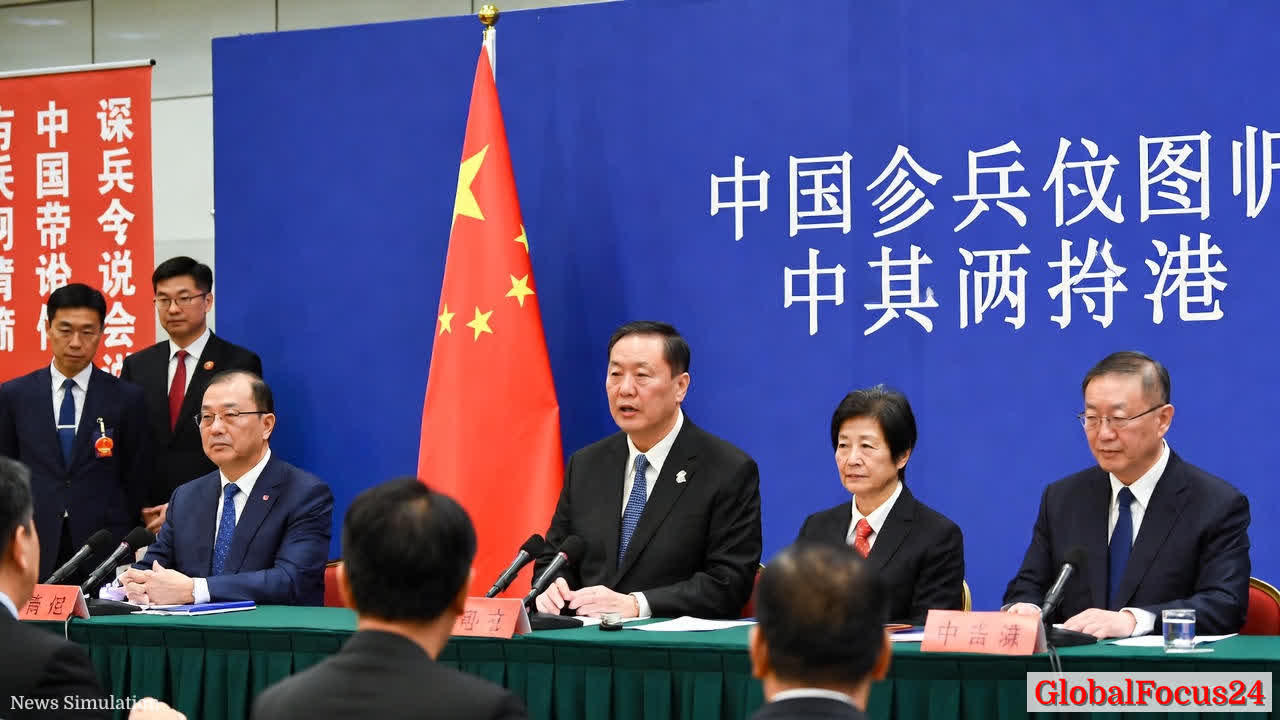
China Imposes Sanctions on US Defense Firms Over Taiwan Arms Deal
Beijing — In a move that intensifies the broader strategic rivalry between the world’s two largest economies, China announced sanctions on several U.S. defense contractors tied to a recent arms package to Taiwan. The measures mark a notable escalation in the ongoing confrontation over Taiwan’s status and reflect Beijing’s willingness to deploy economic and regulatory tools to deter foreign weapons transfers that it views as a direct challenge to its sovereignty claims.
Historical context and the arc of tension The current sanctions sit within a long arc of cross-strait and U.S.-China frictions that have repeatedly circled around Taiwan’s security and the international community’s response to it. Since the early years of the post–World War II order, Taiwan’s political status has remained a flashpoint in Sino-American relations. Washington’s policy framework—while emphasizing strategic ambiguity and Taiwan’s self-defense capabilities—has evolved through cycles of arms sales, diplomacy, and strategic signaling. Beijing’s response to foreign defense assistance to Taiwan has consistently included public condemnation, diplomatic protests, and, increasingly in recent decades, economic and financial measures aimed at constraining or penalizing entities involved in stabilizing or expanding Taiwan’s defense posture.
The latest sanctions come after a broad array of U.S. arms sales that included advanced missile systems, radar, and other technologies designed to bolster Taiwan’s deterrence. In this context, Beijing’s stated objective is to deter what it characterizes as provocations that threaten regional stability and Beijing’s sovereignty claims. The timing underscores how the Taiwan question remains a fulcrum of strategic competition, even as both sides seek to balance competing interests in global trade, technology access, and regional security architectures.
Economic impact and supply-chain implications Sanctions on defense contractors can reverberate beyond immediate regulatory actions. For the companies involved, the measures can restrict access to Chinese markets and partners, complicate ongoing projects, and disrupt supply chains that weave through Asia’s manufacturing ecosystems. Analysts often flag potential knock-on effects, such as shifts in procurement strategies, changes in manufacturing localization plans, or the redirection of components toward other regions. The broader consequence for regional supply chains is a greater degree of uncertainty, which can influence pricing, project timelines, and investment decisions across defense-related sectors.
China’s stance on arms sales to Taiwan also intersects with its broader economic policy environment. If sanctioned firms rely on China for specific components, the sanctions may create bottlenecks that impact not only the firms’ bottom lines but also the capacity of allied manufacturers to fulfill orders from partners or customers who value proximity to Chinese supply chains. In parallel, the United States and its allies have sought to cultivate diversified supply chains in defense industries, aiming to reduce dependency on any single market for critical technologies. The current action could accelerate efforts to diversify and reconfigure supply networks in defense ecosystems across North America, Europe, and parts of Asia.
Regional comparisons and broader strategic implications The dynamics of Taiwan-related sanctions echo patterns seen in other strategic competition episodes where a major power leverages economic tools to influence security outcomes. For example, past episodes have shown how targeted sanctions against defense contractors can:
- Create ripple effects through supplier networks, encouraging firms to adjust contracts or seek alternative markets.
- Signal political resolve, reinforcing domestic and allied expectations about how a nation will respond to perceived threats to its interests.
- Prompt countermeasures, as affected firms and partners seek to mitigate risk by pursuing shifts in investment, production sites, or employment strategies.
In the Asia-Pacific region, several economies maintain intricate defense supply chains that depend on a mix of domestic capabilities and international partnerships. China’s sanctions, if extended or broadened, could encourage regional partners to reassess risk exposure and potential dependency on suppliers subject to political risk. Conversely, the decree could also catalyze closer integration among like-minded economies seeking to maintain security and stability in the Taiwan Strait, prompting investments in indigenous defense manufacturing or regional collaboration on dual-use technologies.
Policy frameworks, diplomacy, and regional stability The sanctions illustrate how economic tools intersect with diplomacy in a high-stakes security environment. They come at a moment when Washington has emphasized commitments to Taiwan’s defense capabilities while urging allies to take a more active role in regional deterrence. Beijing, meanwhile, has repeatedly warned against actions it views as endorsing Taiwan’s independence efforts, framing foreign arms sales as a direct challenge to its territorial claims. The exchange underscores the delicate balance policymakers face in maintaining deterrence without triggering an unnecessary escalation of confrontation.
From a governance perspective, sanctions against specific defense contractors depend on formal mechanisms that regulate foreign investment, export controls, and cross-border transactions. The absence of immediate public detail about which entities are targeted or the precise scope of the restrictions highlights the often-shrouded nature of sanctions policy. In many cases, governments provide broad definitions of prohibited activities while leaving the practical effects to be interpreted by the firms and financial institutions involved. Observers often look for signs of the measures’ breadth, such as asset freezes, licensing prohibitions, or bans on certain types of collaboration, as well as any stated timelines for review or renewal.
Public reaction and market sentiment Markets and defense-industry stakeholders typically respond to sanctions developments with cautious analysis. Investors assess potential volatility in stock valuations, currency movements, and hedging strategies related to geopolitical risk. Public sentiment in regions directly affected—along with allied nations—tends to reflect a mix of concern for regional stability, support for alliance commitments, and anxiety about the knock-on effects on civilian markets and job security within the defense sector.
In the digital age, public discourse can amplify both fear and resilience. Social media, industry forums, and expert commentary often weigh the strategic calculus behind sanctions, the reliability of supply chains, and the long-term implications for regional power dynamics. While the immediate political statement is clear, the broader public response tends to hinge on how governments communicate risks, manage uncertainty, and demonstrate commitment to stability and predictable frameworks for defense trade.
Historical parallels and lessons for the future Reflecting on past episodes of sanctions tied to Taiwan-related matters, analysts note that such measures can serve as a barometer for broader strategic intent. They can signal a country’s willingness to use its economic influence to support or discourage certain foreign policies, while also illustrating how international norms, alliance commitments, and economic interdependencies shape outcomes. The trajectory of these measures—whether they remain targeted or expand to encompass broader sectors—will influence how states calibrate risk, invest in domestic capabilities, and coordinate with international partners to uphold regional security standards.
Looking ahead, several scenarios could unfold. First, the sanctions could remain narrow and targeted, prompting affected firms to seek alternative markets or adjust supply chains without triggering a larger economic decoupling. Second, the measures could broaden to additional contractors or expand into related export controls, intensifying pressure on the defense-industrial base and potentially accelerating regional realignments in technology development. Third, diplomatic channels may intensify behind the scenes, with negotiations aimed at stabilizing cross-strait tensions and clarifying the boundaries of defense cooperation in a manner compatible with international law and regional security norms.
Operationalizing resilience for firms and economies For companies facing sanctions, resilience hinges on proactive risk management. Key steps include: conducting thorough due diligence to understand exposure to sanctions regimes, diversifying supplier networks to reduce single-point dependencies, and maintaining supplier transparency to stabilize procurement processes. Firms often reassess contract structures, pricing models, and compliance architectures to ensure they can navigate evolving regulatory landscapes. Governments, for their part, can support resilience by providing clear guidelines, expediting license determinations when appropriate, and fostering international cooperation to deter illicit channels while preserving legitimate defense trade that supports alliance interoperability.
Regional economies that rely on defense manufacturing or adjacent components may consider strategic investments to bolster domestic production. Investments in advanced materials, sensor technologies, and propulsion systems, coupled with workforce development programs, could help reduce vulnerability to external disruption. Cross-border collaboration within trusted supply chains can also facilitate continuity of operations during periods of heightened geopolitical tension.
Conclusion As China imposes sanctions on U.S. defense contractors tied to Taiwan-related arms sales, the incident underscores the enduring fragility and complexity of cross-strait and U.S.-China security dynamics. The actions reflect a strategic choice to leverage economic leverage to deter perceived provocations while signaling a readiness to respond decisively to new developments in defense trade. For markets, policymakers, and industry participants, the episode serves as a reminder of the tight linkage between geopolitical signaling and real-world economic consequences. The road ahead will likely involve a mix of calibrated diplomacy, continued investment in defense interoperability, and careful attention to the evolving balance of power in the Asia-Pacific region, where Taiwan remains a focal point of international attention and strategic calculation.