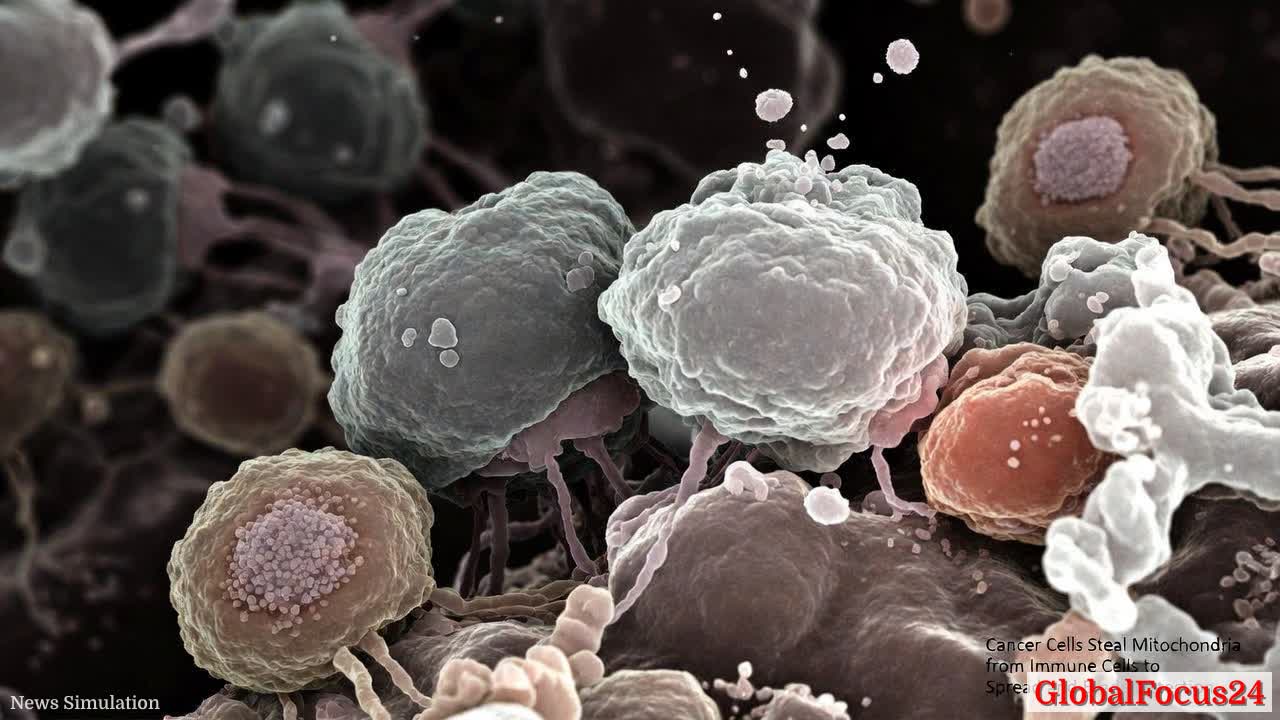
Cancer Cells Steal Mitochondria from Immune Cells to Spread and Evade Detection
A New Tactic in Cancer’s Battle Against the Immune System
Cancer cells may be using a previously underappreciated strategy to spread and escape immune destruction: stealing mitochondria from the very immune cells meant to kill them. New research in mice suggests that tumor cells can acquire mitochondria from nearby immune cells, weakening those defenders while activating genetic programs that help cancer invade lymph nodes and avoid detection.
The findings illuminate a novel, energy-independent role for mitochondria in cancer progression and offer fresh insight into why tumors so effectively colonize lymph nodes, one of the most important staging grounds for immune surveillance. The study raises the possibility that blocking mitochondrial transfer or its downstream signaling might slow metastasis and improve treatment outcomes.
How Mitochondrial Theft Works
Mitochondria are best known as the “powerhouses” of the cell, producing ATP, the molecule that fuels most cellular processes. But they also serve as central hubs for signaling pathways that regulate immunity, cell death, and inflammation. The new research highlights how cancer cells exploit these signaling functions.
In controlled mouse experiments, scientists implanted cancer cells in multiple locations and tracked interactions with surrounding immune cells. Across different tissues and tumor microenvironments, cancer cells consistently absorbed mitochondria from several types of immune cells at similar rates. This transfer did not appear to be a rare or accidental event; instead, it occurred robustly and repeatedly, suggesting a regulated biological process rather than random cellular debris uptake.
When cancer cells captured mitochondria, two critical outcomes followed:
- Donor immune cells, now deprived of part of their mitochondrial network, showed impaired function.
- Recipient cancer cells activated a set of genes linked to type I interferon signaling, a pathway deeply involved in immune regulation and antiviral responses.
Strikingly, the benefit to the tumor cells persisted even when the energy-producing capacity of the acquired mitochondria was blocked, indicating that ATP generation was not the key advantage. Instead, the mitochondria acted as signaling organelles, triggering molecular cascades that helped tumor cells survive in hostile environments such as lymph nodes.
Lymph Nodes: From Immune Strongholds to Cancer Gateways
Lymph nodes serve as command centers for the immune system. They filter lymphatic fluid, collect antigens, and coordinate immune cell activation against infections and malignant cells. Because they teem with T cells, B cells, and other immune sentinels, lymph nodes should, in principle, represent a dangerous place for cancer cells to reside.
Yet lymph node metastasis is one of the most common and clinically important steps in cancer spread. Many solid tumors, including breast, melanoma, head and neck, and gastrointestinal cancers, are staged and treated based on whether they have invaded nearby lymph nodes. The paradox has long puzzled oncologists: how do malignant cells manage to seed and thrive in such heavily guarded tissue?
The new findings point to mitochondrial transfer as part of the answer. By stripping mitochondria from immune cells within or near lymph nodes, cancer cells may blunt local immune activity while simultaneously activating pathways that help them adapt to the lymph node microenvironment. This dual effect could tip the balance in favor of tumor survival and expansion at a critical metastatic hub.
The Role of Type I Interferon Signaling
One of the most intriguing aspects of the research is the link between acquired mitochondria and activation of genes tied to the type I interferon pathway. Type I interferons are signaling proteins normally associated with antiviral defense and immune modulation. They help coordinate innate and adaptive immune responses and can, under many circumstances, promote anti-tumor activity.
In the context of mitochondrial theft, however, this pathway appears to be repurposed. After taking up mitochondria, cancer cells turned on a network of interferon-related genes. Rather than triggering their destruction, this gene activation seemed to aid tumor cells in evading immune recognition and migrating into lymph nodes.
When researchers disrupted key genes in this pathway, cancer cells lost much of their ability to invade lymph nodes. This suggests that the mitochondrial signal is not merely a byproduct of cellular stress but a functional driver of metastasis. It reframes type I interferon machinery as a double-edged sword: a system that can protect the body from threats, but also one that cancer can hijack to survive and spread.
A Shift in Understanding Mitochondria in Cancer
For decades, research on cancer metabolism has focused on how tumor cells alter energy use, from the classic Warburg effect—favoring glycolysis even in the presence of oxygen—to more nuanced models of metabolic flexibility. In that framework, mitochondria are often viewed primarily as energy factories and biosynthetic hubs.
This new work adds another layer: mitochondria as transferable, modular signaling units that can be moved from cell to cell to reshape the tumor microenvironment. It underscores that mitochondrial function in cancer extends far beyond ATP production.
The fact that blocking ATP generation in the transferred mitochondria did not eliminate the metastatic advantage suggests that the structural presence of mitochondria and their internal components—such as mitochondrial DNA and membrane-bound proteins—may be sufficient to alter nuclear gene expression in cancer cells. These signals can then rewire immune interactions and behavior, including migration and survival in lymphoid tissues.
Historical Context: Cell–Cell Organelle Transfer
The concept of material transfer between cells is not new. Over the past two decades, scientists have described structures like tunneling nanotubes and extracellular vesicles that allow cells to exchange proteins, RNA, and even entire organelles. In some neurological and inflammatory diseases, mitochondrial transfer from healthy cells has been explored as a potential rescue mechanism to restore function in damaged tissues.
In oncology, there have been reports of stromal cells donating mitochondria to tumor cells, helping them resist chemotherapy or adapt to low-oxygen conditions. However, the idea that cancer cells might steal mitochondria directly from immune cells and use them to subvert immune surveillance and promote lymph node metastasis represents a significant evolution of this line of research.
Historically, explanations for lymph node metastasis have focused on physical lymphatic drainage routes, selective pressures within the node, and immune editing—where only the fittest, most evasive cancer cell variants survive. This new mechanism introduces active organelle acquisition as an additional dimension, suggesting that metastasis is shaped not just by selection, but by continuous, dynamic exchange of cellular components.
Economic and Clinical Impact of Lymph Node Metastasis
Lymph node involvement remains a critical determinant of cancer prognosis, treatment intensity, and healthcare costs worldwide. When tumors spread to lymph nodes, patients often require more extensive surgery, radiation, and systemic therapies, including chemotherapy, targeted drugs, and immunotherapies. These treatments significantly raise direct medical expenditures and indirect societal costs, such as lost productivity and long-term disability.
For health systems already under pressure, metastatic disease drives a disproportionate share of cancer spending. Interventions that can delay or prevent lymph node involvement could therefore have substantial economic benefits:
- Reduced need for radical lymph node dissection and associated complications, such as lymphedema.
- Lower reliance on multi-drug chemotherapy regimens.
- Fewer hospitalizations and shorter treatment durations.
- Improved survival and quality of life, potentially translating into sustained workforce participation.
If mitochondrial transfer proves to be a targetable process, therapies aimed at blocking organelle exchange or interrupting the downstream interferon-related signaling could complement existing treatments. Even modest reductions in the rate or extent of lymph node metastasis could yield measurable cost savings and better outcomes at a population level.
Regional and Global Perspectives
Patterns of lymph node metastasis and access to advanced cancer therapies vary widely by region. In high-income countries, routine imaging, sentinel lymph node biopsies, and molecular diagnostics allow earlier detection of nodal involvement and more personalized treatment strategies. However, the costs of cutting-edge immunotherapies and targeted drugs remain high.
In many low- and middle-income countries, patients often present with more advanced disease, including extensive lymph node metastases, due to limited screening programs and barriers to early diagnosis. Surgical options may be constrained, and systemic therapies are sometimes less comprehensive or inconsistently available. As a result, the burden of metastatic cancer on these health systems is particularly severe.
Understanding fundamental mechanisms like mitochondrial transfer offers a globally relevant foundation for future therapies that might be adapted to different resource settings. For example:
- Small-molecule inhibitors of mitochondrial trafficking or signaling could, in theory, be developed as oral medications that are easier to distribute widely than complex biologics.
- Biomarkers based on interferon-related gene activation in tumor cells might help stratify patients by metastatic risk, guiding more efficient allocation of intensive treatments.
- Insights into how cancer manipulates immune cells within lymph nodes could inform vaccine strategies or combination therapies that are more feasible to implement across diverse healthcare systems.
Regional differences in tumor types also matter. Cancers with a strong tendency for lymphatic spread—such as breast cancer, cervical cancer, gastric cancer, and certain head and neck tumors—are prevalent in many parts of Asia, Africa, and Latin America. Research into mitochondrial theft and lymph node colonization may therefore have particular relevance for regions where these cancers represent a major share of the disease burden.
Implications for Immunotherapy
Immunotherapies, including immune checkpoint inhibitors and CAR-T cell treatments, have transformed care for several malignancies. However, not all patients respond, and resistance often develops. The discovery that cancer cells can directly disarm immune cells by stripping them of mitochondria introduces a potential new mechanism of immune escape that current therapies may not fully address.
If mitochondrial loss diminishes the vigor of T cells, natural killer cells, or other immune effectors in the tumor microenvironment, it could help explain why some cancers remain refractory to immune-based treatments even when relevant targets are present. Therapies that preserve immune cell mitochondria or prevent their capture could, in principle, enhance the potency of existing immunotherapies.
Moreover, the type I interferon pathway activated in tumor cells after mitochondrial acquisition may shape how these cancers respond to immune checkpoint blockade. Depending on the context, interferon signaling can either support or hinder treatment efficacy. Understanding exactly how mitochondrial transfer alters this balance will be important for designing combination regimens that maximize clinical benefit.
Future Research Directions
While the new findings arise from mouse models, they open several lines of inquiry for human cancer:
- Determining how frequently and in which tumor types mitochondrial theft from immune cells occurs in patients.
- Identifying the molecular machinery—such as surface receptors, nanotubes, or vesicle systems—that mediates mitochondrial transfer.
- Clarifying whether specific immune cell subsets are more vulnerable as mitochondrial donors and how this affects the overall immune landscape.
- Mapping the precise gene networks activated in cancer cells following mitochondrial uptake, especially those related to interferon signaling, migration, and survival.
- Evaluating potential drugs or biologics that can interrupt mitochondrial transfer or selectively modulate the downstream signaling without broadly suppressing beneficial immune responses.
As these questions are addressed, the concept of organelle exchange between cancer and immune cells may become a central theme in how scientists think about tumor–host interactions.
A New Frontier in Understanding Cancer Spread
The discovery that cancer cells can steal mitochondria from immune cells to spread and evade detection reframes a fundamental aspect of cancer biology. It suggests that metastasis is not only a matter of rogue cells traveling through the body but also of active cellular piracy, where malignant cells extract critical components from their would-be attackers.
By turning immune powerhouses into sources of signaling advantages, tumors gain access to lymph nodes—key hubs of immune activity—and convert them into launching pads for further dissemination. As researchers continue to unravel the details of mitochondrial transfer and its consequences, this emerging field may provide new targets to slow or prevent metastasis, with widespread clinical and economic implications across regions and health systems.