Brazil’s Supreme Court Faces Turmoil Over Banco Master Scandal
A Deepening Crisis at the Heart of Brazil’s Judiciary
Brazil’s Federal Supreme Court (STF) is facing one of its gravest crises in decades following revelations linking several justices to the collapsed Banco Master, a once rapidly expanding financial institution now at the center of a far-reaching fraud investigation. Allegations of improper relationships between prominent judges and business elites have rocked the country’s highest court, shaking public confidence in the integrity of Brazil’s judiciary and reigniting calls for structural reform.
The controversy, unprecedented in its scope, exposes how Brazil’s complex intersection of politics, finance, and law has created fertile ground for ethical lapses. What began as an investigation into falsified credit operations has evolved into a national debate over whether the guardians of the constitution have themselves become entangled in the very corruption they are meant to prevent.
The Rise and Fall of Banco Master
Banco Master’s downfall has become emblematic of Brazil’s recurring struggles with financial malfeasance. Founded by businessman Daniel Vorcaro, the bank grew aggressively through high-yield credit instruments and partnerships with corporate and political clients. For years, its spectacular profits and expanding asset base made it a darling of investors.
That illusion collapsed when federal regulators and prosecutors uncovered what they describe as a multi-billion-real fraud scheme involving fictitious credit notes and forged operations designed to inflate the bank’s balance sheet. The losses triggered a liquidity crisis, forcing Brazil’s Central Bank to intervene and ultimately liquidate the institution. Thousands of investors and depositors were left reeling, and the revelation sent shockwaves through Brazil’s already volatile financial system.
Investigators quickly turned their attention to the bank’s inner circle, discovering communications that allegedly connected its owner to sitting members of the Supreme Court. Calls, messages, and meeting records indicated unusually close contact between Vorcaro and several justices, raising questions about potential conflicts of interest and influence peddling.
Allegations Involving Supreme Court Justices
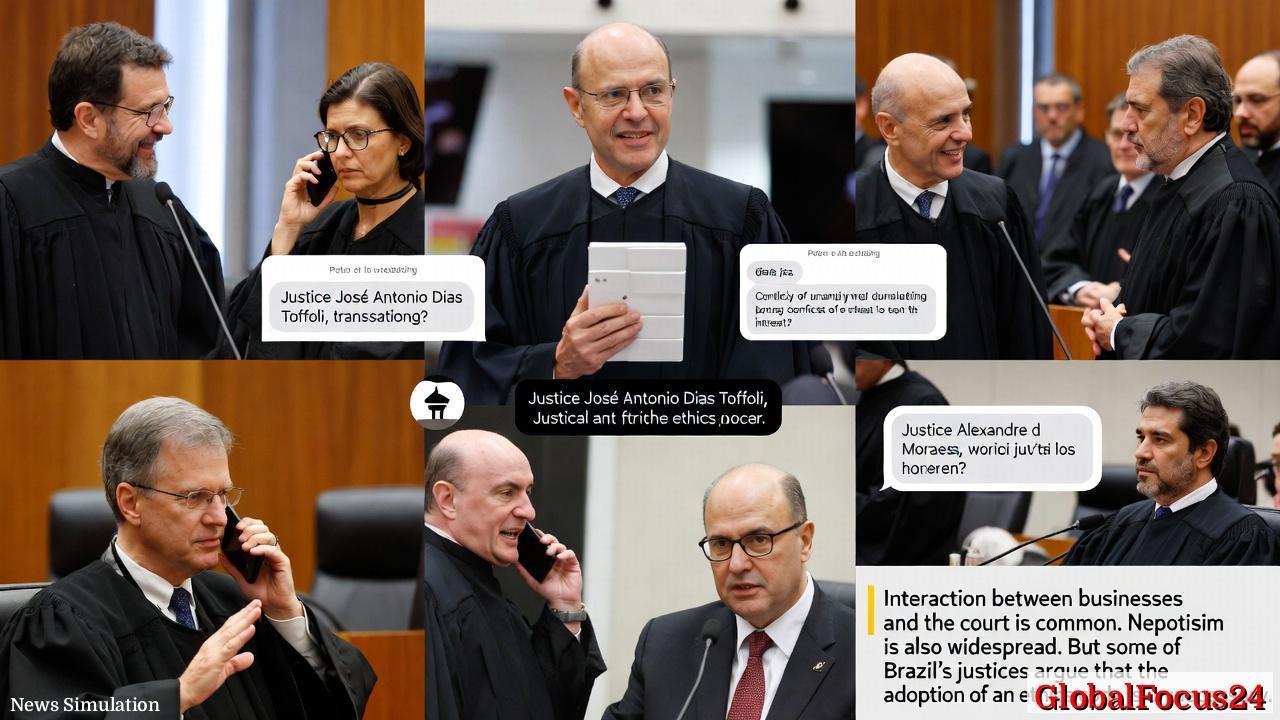
Among those most deeply implicated is Justice José Antonio Dias Toffoli, who initially oversaw parts of the investigation into Banco Master’s financial irregularities. Toffoli stepped aside after media outlets reported on his personal ties to Vorcaro, including a series of private meetings and alleged discussions involving sensitive financial transactions. While Toffoli has denied any wrongdoing, his recusal added fuel to speculation that the STF’s internal integrity mechanisms are ill-equipped to manage conflicts among its own members.
Justice Alexandre de Moraes, another influential figure on the court, has also faced scrutiny. Reports revealed that his wife’s law firm maintained a substantial contract with Banco Master—valued at approximately R$129 million—for legal and consulting services. The firm insists that all work was legitimate and predated the scandal. Nonetheless, revelations that Moraes met multiple times with Central Bank officials to discuss the bank’s regulatory situation raised new doubts about whether his actions blurred the line between judicial independence and private interest.
Both justices have defended their conduct, characterizing the accusations as politically motivated attempts to undermine the judiciary’s authority. Yet their explanations have done little to quell public unease. For many Brazilians, the scandal confirms long-standing perceptions of a judiciary enmeshed in elite networks, shielded from transparency and accountability.
Public Reaction and Institutional Fallout
The revelations have dominateds across Brazil, triggering outrage among citizens and sharp criticism from legal scholars. Calls for greater judicial transparency have grown louder, with advocacy groups demanding that the Supreme Court adopt binding ethics codes, asset disclosures, and clearer conflict-of-interest standards—measures common in other democratic systems but historically resisted by the STF.
Opinion polls indicate a marked decline in public trust toward the judiciary. Once viewed as a stabilizing institution amid Brazil’s turbulent political environment, the court now faces accusations of hypocrisy after years of overseeing high-profile corruption prosecutions, including those related to the massive Lava Jato (Car Wash) investigation. Legal analysts note the irony: judges who once prosecuted executives and politicians for influence peddling are now confronting similar accusations themselves.
Economic Reverberations of the Scandal
The scandal’s economic impact extends beyond the courtroom. Banco Master’s collapse has intensified volatility in Brazil’s financial markets, particularly in the mid-tier banking sector, where investor confidence remains fragile. Analysts warn that the incident has exposed significant gaps in regulatory oversight, echoing previous crises such as the 2014 Banco Panamericano collapse and the 1990s Banco Santos failure.
Foreign investors, already cautious amid persistent fiscal uncertainty, view the Banco Master affair as a reminder of Brazil’s institutional vulnerabilities. Risk premiums on some domestic bonds have widened, and the Brazilian real has shown brief bouts of weakness following disclosures about judicial involvement. Economists emphasize that restoring confidence will require not only tighter financial supervision but also a credible commitment to judicial impartiality.
From a broader perspective, the crisis also threatens Brazil’s standing as Latin America’s largest economy striving for renewed credibility after years of political and financial turbulence. Stable judicial systems are often a precondition for investment, and any perception of compromised courts can deter international capital. For a country seeking to attract foreign funds to its infrastructure, green energy, and technology sectors, reputational damage of this kind is particularly costly.
The Legal System Under Scrutiny
The Federal Supreme Court occupies a uniquely powerful position in Brazil’s democratic architecture. Beyond interpreting the constitution, it also exerts influence over elections, criminal investigations, and administrative decisions—a reach unmatched by most other constitutional courts worldwide. Critics argue that this concentration of authority makes ethical lapses especially perilous, as they risk contaminating multiple branches of governance.
Historically, Brazil’s judiciary has prided itself on independence, often positioning itself as the last bastion against political interference. Yet that independence, coupled with lifetime appointments and limited external oversight, has also fostered a perception of untouchability. While Brazil’s Congress and executive branch are subject to regular accountability mechanisms, justices face few formal constraints once appointed.
Previous attempts to introduce a binding judicial ethics code have repeatedly stalled, often facing opposition from within the judiciary itself. Proponents of reform now see the Banco Master episode as a potential turning point—an opportunity to enact long-delayed measures such as transparent reporting of personal assets, restrictions on family members’ business dealings, and standardized recusal protocols.
Regional Parallels and Lessons
The situation in Brazil is not without precedent. Across Latin America, judicial corruption scandals have periodically undermined public institutions. In Argentina, allegations of improper ties between judges and business interests have dogged the judiciary for decades. In Peru, a sweeping judicial bribery scandal in 2018 led to mass resignations across the court system. These episodes reveal a structural challenge that transcends national borders: the tension between judicial independence and accountability.
Brazil’s challenge is particularly acute given its global profile. As a member of the G20 and a key energy exporter, its governance standards set an important precedent for emerging economies. The credibility of its Supreme Court, therefore, carries implications not only for domestic rule of law but also for international perceptions of Brazil’s investment climate and democratic stability.
Toward Reform and Renewal
In the aftermath of the Banco Master revelations, leading legal associations have proposed a series of reforms aimed at rebuilding institutional trust. These include mandatory disclosure of justices’ communications with private-sector representatives, expanded powers for the National Justice Council to investigate misconduct, and stricter guidelines on family and business relationships involving judicial officials.
Civil society groups and legal experts argue that implementing such reforms would align Brazil’s judiciary with international best practices observed in countries such as Chile and Spain. Without these changes, they warn, public cynicism may deepen, undermining the very legitimacy of judicial decisions.
Even so, significant obstacles remain. Many justices view proposals for increased oversight as a threat to the court’s constitutional autonomy. The internal culture of the judiciary—traditionally hierarchical and self-protective—adds another layer of resistance. Some analysts predict that meaningful reform is unlikely unless public pressure intensifies or external investigations force concessions.
An Institutional Crossroads
As Brazil confronts the fallout of the Banco Master scandal, the Supreme Court stands at an institutional crossroads. The crisis has illuminated the fragile balance between authority and accountability that defines modern governance. For a nation long grappling with the legacy of corruption, the conduct of its highest judges now carries extraordinary symbolic weight.
If the court embraces reform and transparency, it could emerge stronger, reaffirming its role as a guardian of justice and democratic norms. If it resists scrutiny, however, it risks deepening public distrust at a time when Brazil can least afford further erosion of confidence in its core institutions.
The coming months will reveal more about how far-reaching the scandal truly is—and whether Brazil’s judiciary can restore the public faith upon which its legitimacy depends.