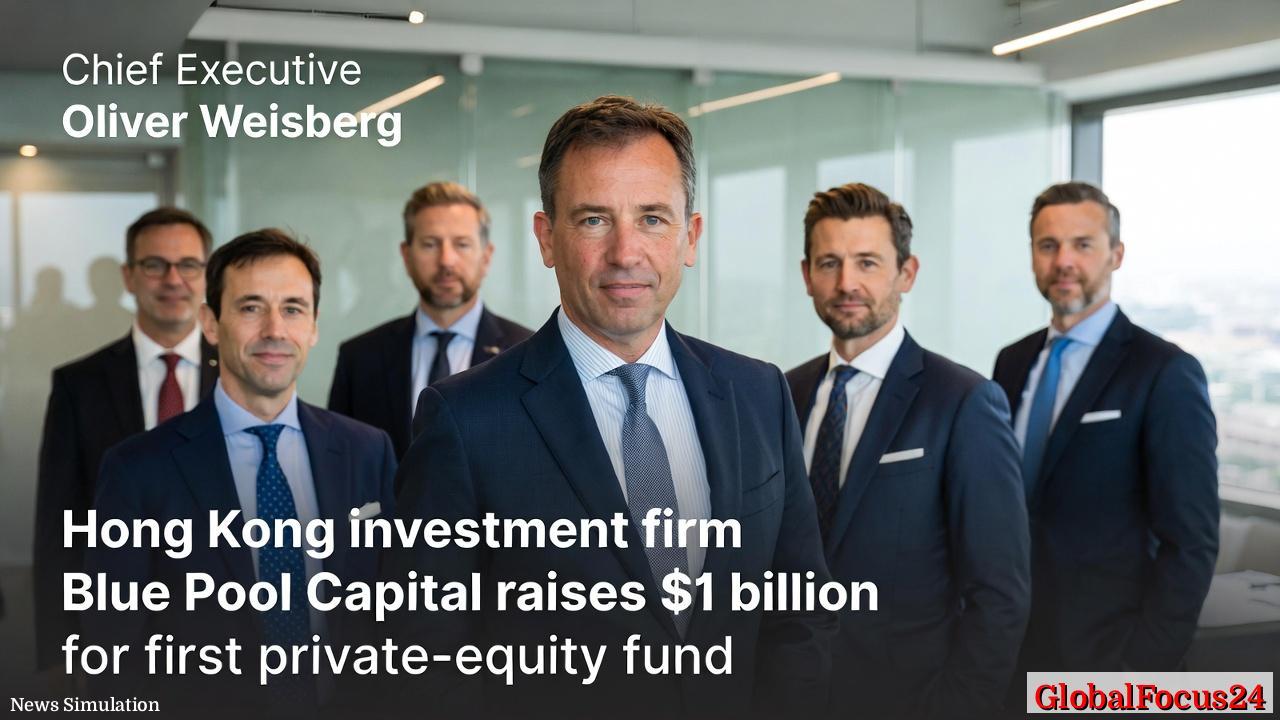
Blue Pool Capital Raises $1 Billion for Global Consumer Growth Fund “Riverside”
A Major Step in Hong Kong’s Private-Equity Landscape
Hong Kong-based investment firm Blue Pool Capital has closed $1 billion in commitments for its first dedicated private-equity fund, named Riverside. The new vehicle marks a pivotal milestone for the firm, expanding its role from managing family investments and multi-strategy portfolios into leading large-scale private equity initiatives targeting high-growth consumer businesses worldwide.
Led by Chief Executive Oliver Weisberg, Blue Pool Capital’s leadership team are also the largest investors in the fund, signaling deep alignment with limited partners and confidence in their strategy. The fund’s close, completed this week, arrives at a time of tightening conditions for global private-equity fundraising, underscoring investor confidence in Blue Pool’s track record and global reach.
Building on a Decade of Private-Equity Success
While Riverside is Blue Pool’s first dedicated buyout and growth-equity fund, the firm is hardly new to the space. For more than a decade, it has invested in private companies through its multistrategy vehicles, generating an estimated gross internal rate of return of 55% over the ten years ending December 31, 2025. That performance firmly positions Blue Pool among Asia’s most consistently successful private investment managers.
The firm’s previous holdings read like a who’s who of disruptive global brands: luxury footwear label Golden Goose, rocket manufacturer SpaceX, gaming powerhouse Epic Games, and ByteDance, the parent company of TikTok. One notable exit came through Blue Pool’s stake in the management company of Blue Owl Capital, a leading private-credit firm. These investments illustrate the firm’s focus on fast-growing businesses that blend cultural relevance with scalable consumer and technology models—a strategy that Riverside aims to formalize and expand on a global scale.
Global Consumer Growth in a Shifting Market
The Riverside fund will focus on acquiring and growing consumer brands that demonstrate strong fundamentals and rapid scalability. Insights from the firm suggest that its target sectors may include lifestyle, wellness, digital media, and next-generation retail—fields where changing consumer behavior and digital platforms are rewriting the rules of engagement.
The timing reflects a fundamental shift in private equity priorities. After a historic fundraising boom in 2021, the global market has entered a period of recalibration. Rising interest rates, slower distributions from past funds, and a cautious lending environment have dampened both deal activity and investor appetite. Against this backdrop, the size of Riverside’s close signals renewed confidence that specialized strategies, focused on growth and brand value creation, can outperform in a high-rate world.
While mega-funds in the United States and Europe continue to dominate thes, Asia-based platforms like Blue Pool are increasingly viewed as essential engines for global consumer innovation. The region’s economic recovery, coupled with strong domestic consumption in markets like China, India, and Southeast Asia, offers fertile ground for the kind of growth investments Riverside seeks to make.
Hong Kong’s Role as a Financial Hub
Blue Pool’s raise is also a timely reminder of Hong Kong’s enduring role as a bridge between Western capital and Asian opportunity. Despite geopolitical frictions and pandemic-era disruptions, the city’s private wealth and alternative-investment sectors have shown resilience.
Hong Kong remains competitive as a base for global fund managers, combining deep financial infrastructure with access to mainland Chinese investors and opportunities. The government’s recent regulatory reforms and tax incentives for family offices have further enhanced the territory’s appeal as a hub for capital pooling and deployment across Asia.
In this environment, Blue Pool’s achievement reinforces the narrative that Hong Kong continues to attract both capital and talent for high-value, international investment strategies.
Oliver Weisberg’s Global Perspective
At the center of Blue Pool’s strategy is Oliver Weisberg, a well-known figure in Asian finance and investment. Originally from the United States, Weisberg moved to Hong Kong in the 1990s and built a career spanning Goldman Sachs and Citadel before joining Blue Pool in 2015.
His connection with Alibaba co-founder Joe Tsai dates back to his days at Goldman, where he helped negotiate the bank’s Series A investment in Alibaba—one of the most consequential early-stage tech transactions in Asia. That relationship later evolved into Blue Pool’s stewardship of Tsai’s family office, managing a diverse range of holdings across sports, media, and consumer assets.
Weisberg’s global background and long-term presence in Hong Kong give him a unique vantage point on cross-border capital flows and market dynamics. His leadership has repositioned Blue Pool as a nimble, globally minded investment house able to bridge Eastern and Western markets.
Beyond Family Office Roots
Blue Pool Capital’s evolution from family office to institutional-quality investment firm mirrors broader industry trends. Initially established to manage Joe Tsai’s personal and family assets—ranging from sports franchises like the Brooklyn Nets and New York Liberty to the Barclays Center and European vineyards—the firm has gradually expanded to manage third-party capital across strategies.
Today, excluding the Tsai family’s proprietary holdings, Blue Pool oversees approximately $6.7 billion in assets. The launch of Riverside effectively doubles down on that momentum, providing external investors access to the firm’s proven track record while establishing an independent flagship vehicle dedicated to growth equity.
This shift aligns with the playbook executed by other successful family-office-turned-investment groups, such as MSD Capital in the United States and Tikehau Capital in France. Each leveraged a strong founder relationship and concentrated capital base into a recognized platform for global investment management.
Market Context: A Slowdown Creates Opportunity
Private-equity fundraising globally has slowed sharply since its 2021 peak. Data from investment research firms show that total capital raised in 2025 dropped by nearly 40% compared to 2022, driven by limited partner fatigue and rising borrowing costs. Many large buyout funds have struggled to reach their targets, while smaller and mid-market vehicles have found it increasingly difficult to secure fresh commitments.
However, this environment also creates opportunities for disciplined managers with proven records. With lower valuations and less competition for deals, funds like Riverside can deploy capital into growth-stage companies at more favorable entry prices. The emphasis on operational improvement and international brand growth, rather than financial engineering, suits Blue Pool’s hands-on approach.
As interest rates are expected to stabilize in the second half of 2026, private-equity managers anticipate a rebound in exit activity and valuations. Blue Pool’s early deployment in the cycle could therefore position it to benefit from the next upturn in global M&A and consumer demand.
Comparisons Across the Region
The rise of Riverside places Blue Pool among a growing cohort of Asian-based investment firms raising global-scale funds. Competitors such as Hillhouse Investment Group, Baring Private Equity Asia (now part of EQT), and Temasek have all expanded their consumer and technology investment platforms beyond the region.
While Hillhouse and Temasek focus heavily on technology-driven growth, Blue Pool’s strategy is distinct in its emphasis on brand-driven consumer businesses. That differentiation appeals to investors seeking diversification beyond traditional buyouts or venture capital exposure.
In regional terms, Hong Kong’s burgeoning fund management ecosystem stands in contrast to Singapore’s, which has seen a surge of registered family offices and private funds in recent years. As Singapore attracts capital through regulatory stability and tax efficiency, Hong Kong’s strength lies in its connection to mainland China and proximity to some of Asia’s largest consumer markets. Blue Pool’s success demonstrates that both cities can coexist as complementary financial centers, each with its own investment thesis and sphere of influence.
Economic and Strategic Outlook
The broader economic outlook supports Blue Pool’s thesis. Despite global headwinds, consumer spending continues to expand in key growth markets, particularly in Asia and the Middle East. Young demographics, digital penetration, and rising income levels are fueling demand for aspirational brands and lifestyle products designed for a global audience.
Riverside’s focus on scalable consumer platforms—whether luxury goods, online retail, or experiential entertainment—aligns with these macro trends. As capital becomes more selective, investors are placing a premium on partners who combine financial discipline with cultural and market insight. Blue Pool, with its fusion of Western investment rigor and Asian market expertise, is well-positioned to meet that demand.
A New Chapter for Blue Pool Capital
The closing of the Riverside fund marks a defining moment in Blue Pool Capital’s evolution. What began as a private office managing the assets of one of China’s most prominent entrepreneurs has matured into a globally focused investment institution with ambitions well beyond its origins.
As private equity undergoes a period of realignment, Blue Pool’s entry into the dedicated fund-management space showcases confidence in both its strategy and the underlying strength of the global consumer economy. For investors seeking exposure to international growth stories anchored in Asia’s innovation hub, the launch of Riverside offers a compelling new chapter in Hong Kong’s financial narrative.
In an era where capital is increasingly cautious and opportunity more selective, Blue Pool’s disciplined approach and long-term perspective highlight the resilience of firms built on deep expertise, patient capital, and global vision.