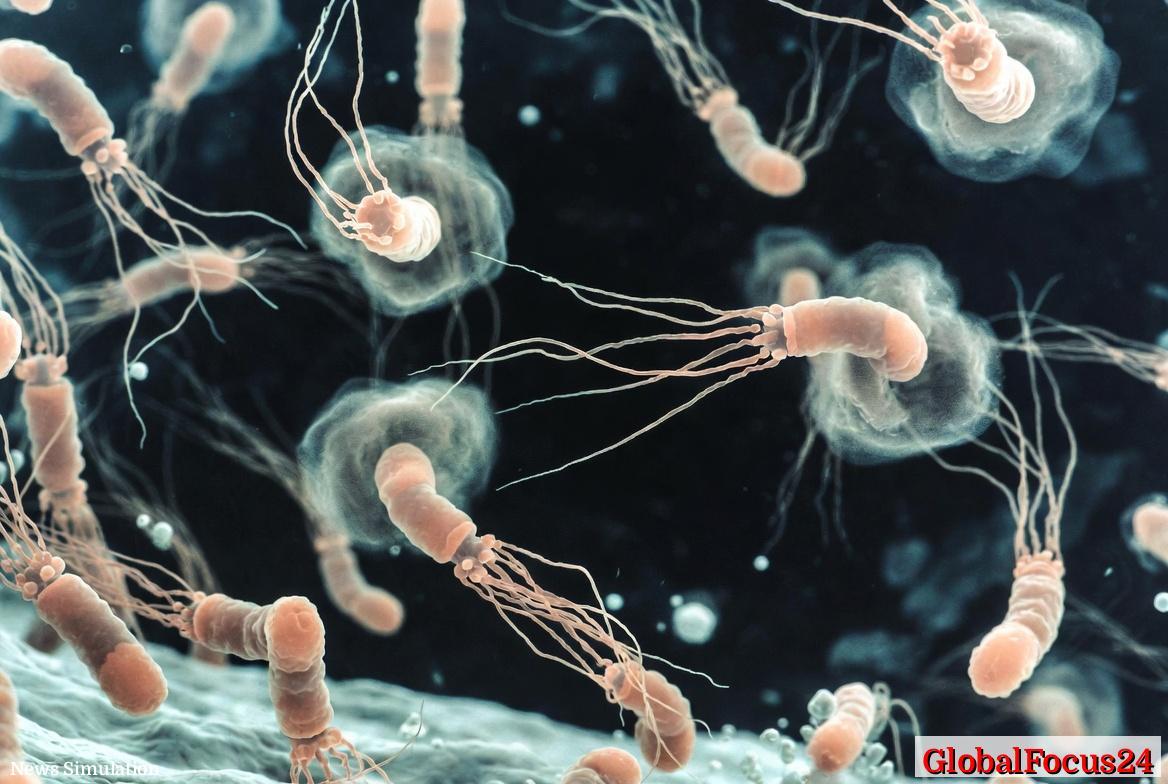
E. coli Spins Tiny Discs: A Fresh Look at Bacterial Locomotion and Micro-Motor Potential
In a breakthrough that merges microbiology with micro-engineering, researchers have demonstrated that Escherichia coli bacteria can drive microscopic discs, or “pucks,” to rotate without any physical contact between the bacteria and the discs. The phenomenon hinges on the collective motion of the bacteria’s cells and their flagella tails as they swim in the immediate vicinity of the discs, creating a subtle, sustained torque that sets the pucks in motion. In controlled laboratory tests, 3D-printed discs placed in a suspension of E. coli began to rotate, powered solely by the surrounding swimmers. High-speed imaging, played back at ten times normal speed, reveals the pucks turning slowly as the bacteria circulate around them, suggesting a previously overlooked mechanism of microbial locomotion that could inform the design of future micro-motors and biosensors.
Historical context and scientific lineage
The study sits at the intersection of microbiology, soft matter physics, and micro-mechanical engineering. Bacteria have long fascinated researchers for their motility, with flagella acting as microscopic propellers that enable navigation through viscous fluids. Early investigations focused on individual cell propulsion and chemotaxis—the ability of bacteria to move toward or away from chemical stimuli. Over time, scientists extended inquiry to collective behavior: swarming patterns, biofilm formation, and the emergence of mesoscale flows from many interacting microbes. The current observation adds a new dimension to that body of work by showing that the hydrodynamic field generated by a population of swimming bacteria can impart a net rotational motion to passive microstructures without direct contact.
The idea that microorganisms can influence their environment through fluid dynamics has deep roots in biophysics. The classic work on low-Reynolds-number hydrodynamics describes how tiny organisms operate in a world where viscous forces dominate inertial forces. In such regimes, the swimming motion of bacteria creates flow fields that decay with distance, yet collective interactions can synchronize and amplify effects in surprising ways. The present findings build on these principles, illustrating how a carefully configured microenvironment—specifically, a non-adhesive, rotating disc suspended in a bacterial bath—can convert the swirling, near-field flows around individual cells into a coherent, macroscopic rotation of a passive object.
Mechanism: how bacteria generate torque without contact
The key to the rotation lies in hydrodynamic coupling. As E. coli swim, their bodies rotate and their helical flagella beat in coordinated fashions. While most bacteria propel themselves forward, the surrounding fluid experiences vortical disturbances that extend into the immediate neighborhood. When a non-motile disk is placed into this reactive milieu, the local flow fields exert tangential forces on the disc. If the disc is free to rotate in response to these forces, the collectively oriented flows around a dense population of swimmers can produce a persistent torque, causing the puck to spin.
Crucially, the effect does not require adhesion or direct mechanical contact between bacteria and the disc. It relies on the continuous, stochastic, yet statistically biased motion of many cells. The ensemble of flow fields can, over time, impart angular momentum to the disc, overcoming viscous resistance from the surrounding fluid. The result is a slow, steady rotation that persists as long as the bacterial bath remains active and the disc remains free to rotate.
Experimental conditions and observations
In the reported experiments, researchers assembled a microfluidic-like setup in which 3D-printed discs—engineered to be smooth and non-adhesive—were submerged in a calibrated suspension of E. coli. The bacteria were kept in a controlled environment with carefully tuned nutrient levels, temperature, and oxygenation to sustain motility while preventing overgrowth that could confound results. The discs were suspended in a transparent chamber to enable high-resolution imaging.
A high-speed camera captured the motion, and advanced image analysis tracked the angular velocity of the discs over time. The rotation rate was initially modest, reflecting the balance between the driving hydrodynamic forces and the viscous drag of the surrounding fluid. As the bacterial crowd continued to swim, the discs maintained a measurable, persistent rotation. When the camera footage was slowed down to one-tenth of real time, researchers could observe subtle yet continuous torques arising from the dynamic interactions between the swimming cells and the disc surface.
The team also conducted control experiments to confirm causality. Samples without bacteria showed no rotation, while introducing dead or non-motile cells produced negligible effects, underscoring the role of active, motile bacteria in powering the motion. The researchers varied parameters such as bacterial concentration, disc size, and channel geometry to map how these factors influence rotational behavior. Across a range of conditions, the discs demonstrated repeatable rotation, reinforcing the robustness of the phenomenon.
Economic implications and potential applications
The demonstration of bacterially powered micro-rotation has several potential implications for the design and deployment of micro-electromechanical systems (MEMS). While the current work operates at the micro-scale under controlled laboratory conditions, it points to a broader concept: bio-hybrid actuation where living microorganisms supply functional energy to microdevices. Possible applications include:
- Microfluidic mixers and actuators: Bacteria-driven discs could serve as passive components that enhance mixing or create controlled flows in lab-on-a-chip platforms, potentially reducing the need for external power sources or complex circuitry.
- Biosensing and environmental monitoring: The rotation rate of a puck could act as a readout for changes in bacterial activity, nutrient availability, or toxin presence, enabling self-contained biosensors that respond to microbial states.
- Soft robotics at micro-scale: Integrating living organisms with flexible, biocompatible materials could yield soft robotic elements capable of performing tasks in confined spaces, such as targeted drug delivery micro-systems or miniature diagnostic tools.
- Education and research tools: Demonstrations of living-matter–driven motion provide tangible platforms for teaching hydrodynamics, microbiology, and materials science, inspiring new curricula and interdisciplinary collaboration.
However, translating this basic science into commercial technologies will require overcoming several hurdles. Maintaining stable, long-term motility in a device-ready environment, ensuring reproducibility across batches, and addressing biosafety and containment concerns are among the critical considerations. Additionally, power density and efficiency metrics for bio-hybrid actuation must be benchmarked against conventional micro-motors to identify niches where living systems offer unique advantages.
Regional comparisons and broader landscape
The broader field of bio-hybrid and bio-inspired micro-actuation has seen parallel advances across regions with active microfluidics and nanotechnology ecosystems. In tightly regulated, research-intensive hubs, laboratories have explored magnetic, electrokinetic, and acoustic methods to drive micro-scale motion. The bacterially powered puck approach stands out for leveraging a natural, self-sustaining energy source—the swimming bacteria themselves—without external fields or reservoirs of reagents directly attached to the moving component.
Compared to other micro-motor concepts, bacterially driven systems emphasize sustainability and responsiveness to biological health indicators. Regions with strong life-science industries may find synergistic opportunities to pair microbial actuators with sensors and data analytics platforms. In addition, the economic implications extend beyond device fabrication: bio-hybrid technologies could influence downstream markets in diagnostics, environmental monitoring, and custom research tools, potentially reshaping supply chains for microfabrication, biocompatible materials, and containment technologies.
Public reaction and scientific relevance
Public interest in microbial locomotion and bio-hybrid devices has grown as researchers probe the practical boundaries of what living systems can power. Science communication around these findings emphasizes both the elegance of natural processes and the imaginative potential of engineering at the smallest scales. Newss often frame such work as a glimpse into futuristic devices, yet the underlying science remains firmly grounded in well-established principles of fluid dynamics, microbiology, and materials science. For scientists and engineers, the results reaffirm the importance of studying collective behaviors, not merely individual cell action, because emergent phenomena can yield unexpected, usable outcomes.
Environmental and ethical considerations also accompany the excitement. Maintaining safe laboratory practices, ensuring responsible use of microbial cultures, and exploring encapsulation strategies to prevent unintended release are essential when moving toward any application that could intersect with real-world environments. Transparent risk assessments and adherence to biosafety guidelines help sustain public trust while enabling innovation.
Takeaways for researchers and industry watchers
- Emergent math in biology: The study highlights how collective hydrodynamic interactions among swimmers can produce macroscopic effects on nearby objects, even without direct contact.
- Micro-scale energy sources: Living systems remain a rich frontier for powering devices at scales where conventional energy harvesting is challenging.
- Interdisciplinary collaboration: Success hinges on integrating microbiology, fluid dynamics, materials science, and microfabrication know-how.
- Path to application: Demonstrations are a first step; real-world deployment will require robust control of living systems, scalable manufacturing, and rigorous safety frameworks.
Conclusion: a evolving frontier in micro-actuation
The discovery that Escherichia coli can spin 3D-printed discs through purely hydrodynamic means marks a notable milestone in the exploration of bio-hybrid micro-actuation. It reinforces the value of looking beyond single-organism propulsion to the rich, collective behaviors that emerge in dense microbial populations. While practical commercialization remains several steps ahead, the concept offers a vivid glimpse into how living systems could inform and empower the next generation of micro-machines, sensors, and smart materials. As researchers continue to map the parameter space—from bacterial strains and environmental conditions to disc geometry and fluid properties—the potential to harness microscopic life for macroscopic function moves from theoretical curiosity toward tangible engineering prospects.