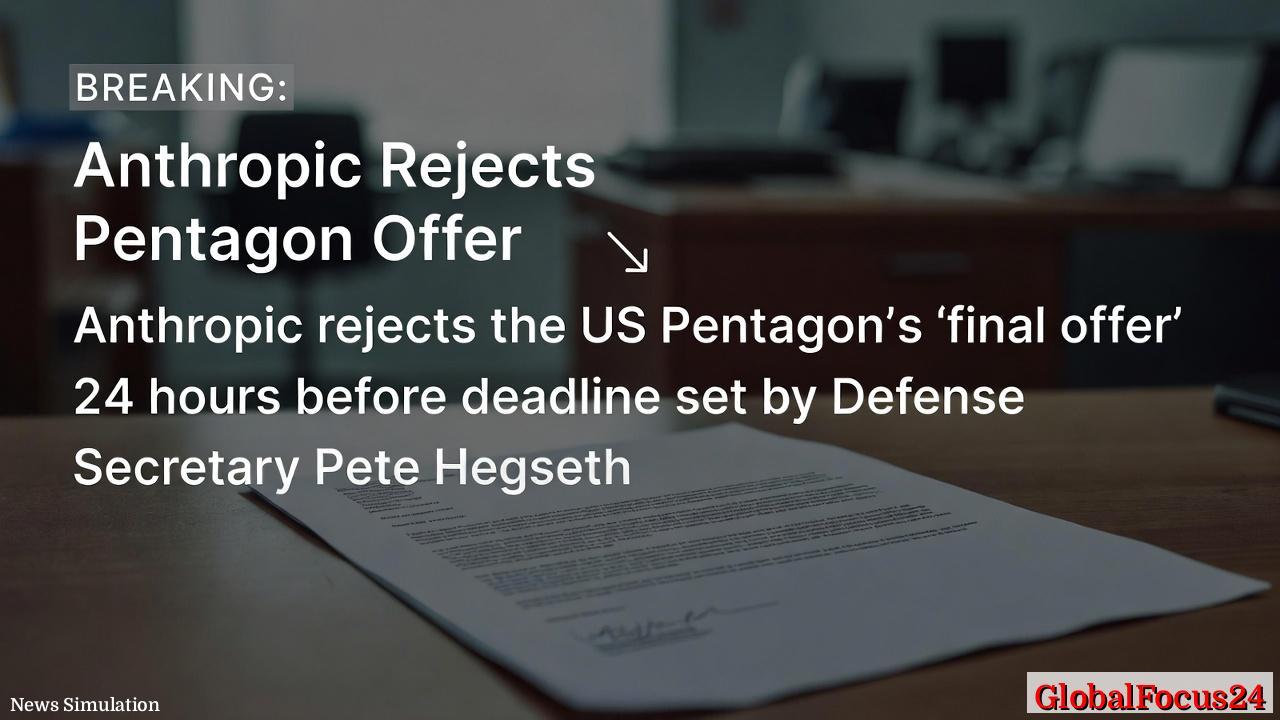
Anthropic Rejects Pentagon Final Offer, Signals High-Stakes Pause in Military-AI Talks
In a decisive move that reverberates across the defense and technology sectors, Anthropic—the San Francisco-based AI safety startup—has rejected the United States Pentagon’s latest attempt to broker a formal engagement around its foundational artificial intelligence platform. The rejections come just 24 hours ahead of Defense Secretary Hegseth’s imminent deadline, according to reporting from Axios. The standoff highlights a rift over ethical guardrails, surveillance limits, and the governance of autonomy in modern warfare, while underscoring broader tensions between national defense ambitions and private-sector risk management.
Historical context: a long arc of defense partnerships with private AI firms The current moment did not emerge in a vacuum. Over the past decade, the U.S. defense establishment has increasingly relied on partnerships with major technology firms and academic labs to accelerate capabilities in artificial intelligence, data analytics, and autonomous systems. Early collaborations often centered on dual-use research—technologies with both civilian and military applications—but escalating concerns about misuse, privacy, and existential risk have pushed many firms to sharpen their internal ethics reviews and export-control practices. Anthropic’s stance echoes a broader industry trend toward stricter governance, particularly for technologies with potential for rapid, high-stakes deployment.
Anthropic’s position: safeguards over speed Publicly expressed concerns from Anthropic emphasize a commitment to preventing surveillance overreach and avoiding deployment of lethal autonomous weapons without stringent oversight. The firm has repeatedly underscored that its platform should not be used to track, profile, or surveil American citizens, nor to execute autonomous lethal missions without robust human-in-the-loop controls and transparent accountability mechanisms. This stance reflects a broader industry shift toward responsible AI, where safety, explainability, and governance are treated as first-order requirements rather than afterthoughts.
Defense implications: timing, risk, and capability gaps The Pentagon’s final-offer approach, if validated, would have signaled a move toward rapid fielding of advanced AI capabilities under clear operational guidelines. However, Anthropic’s rejection introduces a pause that could reverberate across several fronts:
- Technical readiness vs. ethical constraints: The tension between advancing capabilities and maintaining stringent safety standards is at the core of this dispute. Agencies may need to recalibrate timelines or seek alternative partners that can demonstrate both high performance and rigorous governance.
- Compliance and civil-liberties considerations: The national debate over privacy protections and civil liberties shapes how the defense sector can deploy AI technologies. Anthropic’s position provides a high-profile example of how ethical constraints influence procurement and deployment decisions in national security contexts.
- Supply chain and innovation dynamics: If high-profile firms opt to withhold certain capabilities from defense programs, the U.S. may see a shift toward more diverse partnerships or increased investment in in-house resources. This could alter the pace of innovation, potential cost structures, and risk distribution within the national-security tech ecosystem.
Regional comparisons: the AI defense landscape around the world Beyond the United States, several regions are navigating similar crossroads between military ambitions and ethical guardrails. In Europe, for example, national and union-level regulations increasingly demand transparency and risk assessment for dual-use AI technologies used in security contexts. In Asia, some governments pursue accelerated modernization of defense AI while negotiating sensitive issues around privacy, surveillance, and civilian impact. These regional dynamics influence how multinational tech firms choose to engage with defense customers, and they shape the competitive landscape for AI safety leaders.
Economic impact: funding signals and market consequences The standoff carries notable economic implications for both Anthropic and the broader AI sector:
- Investor sentiment and funding trajectories: Publicly visible refusals to participate in defense programs can affect access to venture funding, especially for startups aiming to balance commercial growth with safety mandates. Investors increasingly reward companies that demonstrate robust governance alongside performance, potentially impacting valuations and strategic partnerships.
- Public-private collaboration models: The situation underscores a potential shift toward more modular and auditable defense AI programs. Instead of broad, endpoint-level licensing, agencies may pursue tiered partnerships with defined governance milestones, independent audits, and external safety verifications.
- Industry resilience and talent mobility: The high-stakes nature of defense dialogues with stringent safety requirements can attract talent focused on responsible AI, while also influencing where engineers and researchers decide to work. Firms may expand safety-centric roles and formal governance committees to attract and retain expertise.
Public reaction: a range of views on safety, security, and innovation Public sentiment on AI in defense is diverse and often polarized. Some observers view the pivot as a prudent safeguard that prevents rapid deployment of potentially destabilizing technologies. Others worry that excessive caution may slow critical defense modernization, leaving the country vulnerable to adversaries who move quickly with less-regulated innovations. Community discussions around civil liberties, ethical AI, and the transparency of government procurement practices add texture to the national discourse.
What could come next Several pathways could unfold in the wake of Anthropic’s rejection:
- Reassessing procurement terms: The Pentagon and allied agencies could revisit requirements, potentially offering more granular safeguards, independent audits, or time-bound pilots designed to test safety protocols in controlled environments.
- Alternative partnerships: The defense sector might pursue collaborations with other AI developers who can align more closely with governance standards while still delivering high-performance capabilities. This could diversify the supplier base and create a more resilient supply chain.
- In-house capability development: The defense establishment might accelerate internal AI initiatives, emphasizing safety-by-design and scenario-based testing to reduce reliance on external providers for sensitive tasks.
- International collaboration: Multilateral discussions with allied nations could lead to shared standards for the military use of large-scale AI systems, helping harmonize requirements and reduce duplication of effort.
Historical iterations of defense technology adoption offer a cautionary lens Historically, rapid adoption of new technologies without robust governance has led to unintended consequences. The current moment reflects a maturing of the defense-tech interface, with safety, ethics, and civil-liberties concerns now entwined with capability and speed. The outcome of these negotiations could set a precedent for how private firms approach national-security engagements in the era of artificial intelligence, potentially influencing future disclosures, licensing models, and risk-management frameworks.
Operational and strategic considerations for stakeholders
- For government procurement offices: Clarify expectations around human oversight, accountability, and post-deployment monitoring. Establish objective benchmarks for safety performance and incident response protocols.
- For AI developers and startups: Balance innovation with transparent governance. Communicate clearly about safeguards, data handling practices, and the limits of platform use in sensitive contexts.
- For civil society and policymakers: Continue to evaluate the societal impacts of military AI deployments. Support independent oversight mechanisms that can accompany advanced technologies without inhibiting legitimate security needs.
Conclusion: a turning point in the AI defense dialogue The rejection of the Pentagon’s final offer by Anthropic marks more than a single organizational stance; it signals a broader recalibration of how high-stakes AI is integrated into national security. As the United States weighs its options, the balance between rapid capability development and rigorous safety governance will likely shape forthcoming contracts, partnerships, and policy developments. The industry is watching closely to see whether the defense sector can adapt to a new norm—one where powerful AI systems are deployed with transparent safeguards, accountable oversight, and a steadfast commitment to protecting civil liberties while strengthening national security. The next moves from both the public and private sectors will reveal how resilient and adaptable the AI governance ecosystem can be in a time of rapid technological change.