Ancient Hand Stencil on Sulawesi Reveals Earliest Known Rock Art, Redefining Human Artistic Beginnings
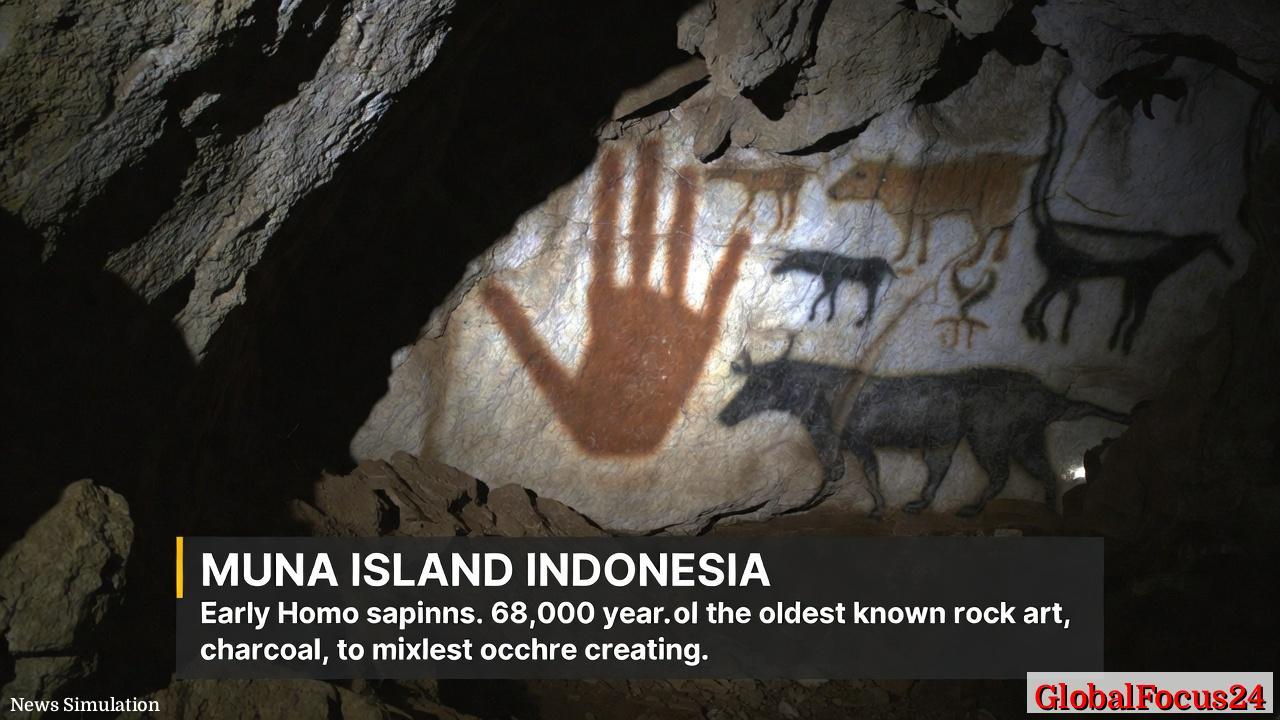
A newly dated hand stencil on Muna Island, part of Indonesia’s Sulawesi archipelago, has been identified as the oldest known rock art, dating to roughly 67,800 years ago. The preservation of this faint image—a hand pressed against a cave wall and then surrounded by spray-painted pigment—offers a window into a distant creative impulse that predated many previously recognized benchmarks in human artistic expression. The discovery, announced after careful dating of calcium carbonate deposits on multiple cave paintings across satellite islands in southeast Sulawesi, marks a pivotal moment in our understanding of where and when sophisticated symbolic behavior emerged in early Homo sapiens.
A window into early creativity The Metanduno Cave hand stencil sits among hundreds of later paintings, including figures of animals and geometric motifs, rendered with ochre and charcoal. What makes this stencil notable is its age and its context within Sulawesi’s broader cave-art sequence. The researchers used uranium-series dating on carbonate layers that form over the paintings, allowing them to establish a chronology for the hand stencil relative to other works on nearby islands. This method places the stencil well within a timeline that predates earlier European cave art traditionally attributed to Neanderthals, and it pushes back the emergence of symbolic behavior in this region by tens of thousands of years.
The hand stencil’s posture—slightly rotated so the fingers appear narrowed or almost claw-like—echoes motifs that recur in Sulawesi’s cave-art tradition for tens of thousands of years. This persistent stylistic thread provides a tangible through-line from the earliest marks to later, more elaborate representations on the same landscape. For researchers, such continuity bears on broader questions about how ancient communities communicated, codified knowledge, and maintained shared cultural repertoires across generations.
Regional context and historical background Sulawesi’s caves have long been recognized as a focal point in discussions about early human artistic innovation. Notably, earlier discoveries on the same island include paintings dated to around 44,000 years ago and depictions of animals and scenes that appear to tell stories or convey symbolic ideas. The new finding adds a crucial earliest anchor point to Sulawesi’s art chronology, suggesting that the region was home to a vibrant tradition of visual expression at a time when modern humans were expanding their range across Island Southeast Asia.
In a broader historical arc, the Sulawesi art record intersects with the long-standing narrative of human migration into Sahul—the ancient land and sea bridge that connected Australia and New Guinea during lower sea levels in the Pleistocene. The presence of an 67,800-year-old stencil on Sulawesi aligns with models in which early Homo sapiens undertook maritime voyaging and island-hopping to reach Sahul. The new evidence reinforces the view that these early navigators possessed not only the means to travel across water but also the cognitive capacity to carry and reproduce symbolic ideas across distances.
Economic and cultural implications While rock art itself is not an economic activity in the modern sense, its emergence has historically influenced the organization of labor, trade networks, and social structures in many human communities. Artistic practices can serve as markers of shared territory, group identity, and social cohesion—factors that indirectly shape regional economies through the aggregation of groups around resource-rich landscapes or ceremonial sites. In the Sulawesi context, early artists may have contributed to a cultural landscape that supported collaborative exploration, collective memory, and knowledge transfer across generations.
From a regional development standpoint, the dating of such ancient artwork adds to Sulawesi’s long-standing archaeological significance, attracting scholarly attention and potentially expanding research funding and conservation efforts. These dynamics can influence regional tourism strategies centered on prehistoric sites, while also supporting educational programs that highlight humanity’s deep-seated creativity. As researchers continue to excavate and preserve these sites, local communities can benefit from heightened awareness of their region’s ancient heritage and the value of safeguarding cultural resources.
Regional comparisons and broader patterns The Sulawesi discovery sits alongside a growing corpus of prehistoric rock art around the world that is reshaping timelines for symbolic behavior. In Europe, Neanderthal hand stencils and other artworks are dated to roughly 66,000 years ago or older, prompting debate about the emergence of abstract art and the possible transmission of ideas between hominin groups. The Sulawesi find, however, emphasizes that complex artistry was not confined to a single geographic corridor but occurred in diverse locales within a relatively short window in human prehistory.
This global pattern invites a reconsideration of how early Homo sapiens developed and disseminated cultural technologies. It suggests a scenario in which symbolic thinking—and the ability to represent it visually—arose independently in multiple regions or was rapidly shared through early networks of interaction, possibly aided by maritime travel and inter-island exchange. The discovery also underscores how environmental contexts—coastal landscapes, reefs, forests—may have shaped the themes and motifs artists chose to depict, as well as the methods by which pigments were produced and applied.
Scientific method and interpretation Dating ancient rock art is notoriously challenging due to factors such as pigment composition, weathering, and overpainting by later generations. In this case, scientists relied on uranium-series dating of calcium carbonate layers that formed above the artwork. This approach yields ages that anchor the stencil within a defined timeframe, even when the pigment itself may have degraded or been reworked by subsequent visitors. The placement of the Metanduno Cave stencil amid other dated works on nearby islands allows researchers to construct a more coherent regional chronology for Sulawesi’s prehistoric art.
Interpretation remains careful and nuanced. While the hand stencil is a striking image and a powerful symbol, the precise meanings and intentions behind its creation remain speculative. Some hypotheses propose ritual or communicative functions, while others suggest a social practice of marking territory, recording events, or simply capturing an act of play and exploration. The absence of direct textual evidence makes these interpretations inherently cautious, but the consistency of motifs and the long duration of the Sulawesi art tradition strengthen the case for a sophisticated symbolic culture among early Homo sapiens in the region.
Public reaction and public history -artifacts of this age commonly evoke a sense of awe and a renewed appreciation for humanity’s enduring creativity. For communities connected to Sulawesi’s archaeological heritage, such discoveries reinforce the narrative of a shared human past and the ingenuity of our ancestors. Museums, educators, and cultural institutions often respond by developing exhibitions, outreach programs, and digital reconstructions that translate these ancient images into engaging stories for contemporary audiences. The public dialogue surrounding such finds typically emphasizes preservation, scientific curiosity, and the timeline of human curiosity that predates written records by tens of thousands of years.
Environmental and conservation considerations Ancient rock art sites face threats from natural erosion, human vandalism, uncontrolled tourism, and climate-related pressures. Protecting these sites requires a combination of on-site conservation, controlled access, and community involvement. Advances in non-invasive survey techniques and digital documentation help researchers monitor changes over time while minimizing disruption to fragile pigments and mineral crusts. The Sulawesi discoveries reaffirm the need for sustained preservation efforts to ensure that future generations can study and appreciate these windows into early creative expression.
Conclusion: a milestone in the story of human creativity The 67,800-year-old hand stencil on Muna Island stands as more than an archaic image etched on stone. It marks a foundational moment in the trajectory of human artistic practice, illustrating that symbolic expression emerged well before many previously recognized milestones and across a broad geographic expanse. As researchers continue to refine dating techniques and uncover additional sites, the global narrative of prehistoric art will likely evolve, highlighting the resilience and ingenuity of early communities who, thousands of years ago, used color and form to communicate, connect, and endure.
In the end, this discovery underscores a timeless truth: creativity is a defining feature of humanity, present from the earliest memories of our species and continuing to inspire curiosity about who we are and where we came from.
Would you like a concise sidebar highlighting the key dates and regional comparisons for quick reference?