U.S. Artificial Intelligence Boom Confronts Hardware Supply Bottleneck
Data Center Growth Collides With Equipment Shortage
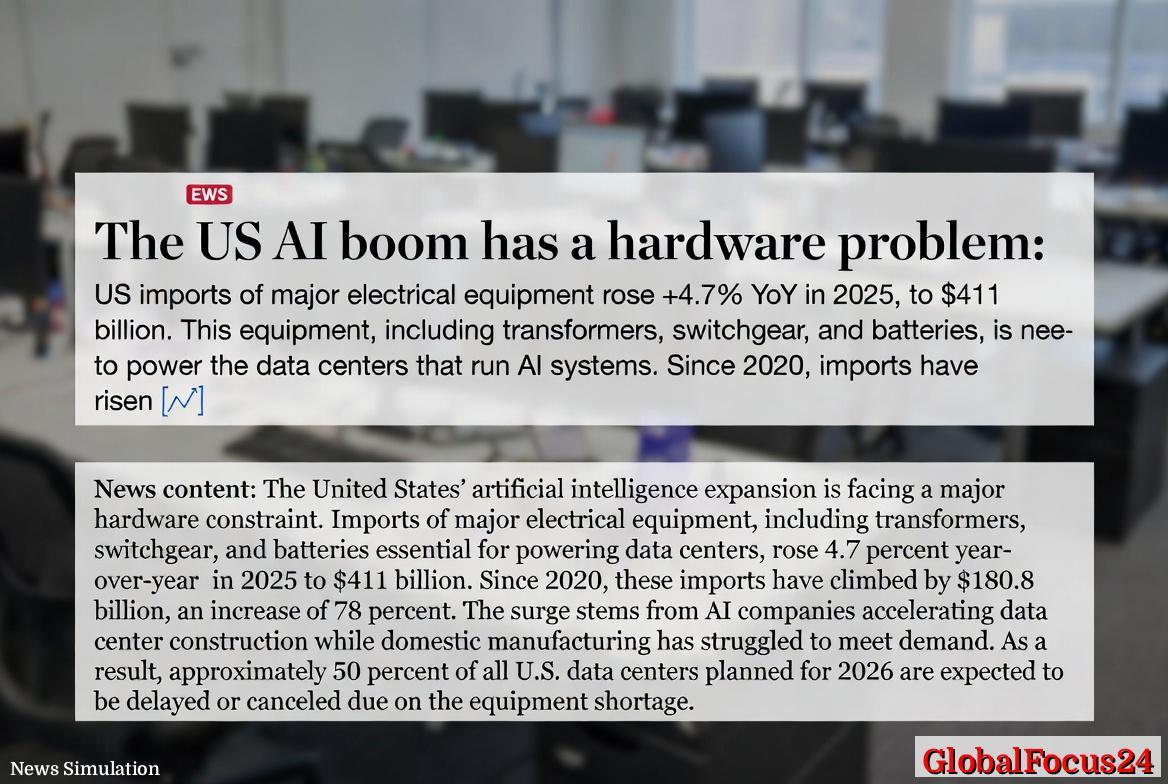
The United States’ rapid acceleration in artificial intelligence development is colliding with a critical hardware constraint that could slow the entire sector’s momentum. Imports of vital electrical infrastructure—ranging from power transformers and high-voltage switchgear to industrial batteries—climbed 4.7 percent in 2025, totaling $411 billion. Since 2020, that figure has surged by $180.8 billion, marking a staggering 78 percent increase in just five years.
The need for these components stems from the rising power demands of hyperscale data centers, which now sit at the heart of the nation’s AI expansion. Yet despite years of planning, the domestic supply chain for such heavy electrical equipment remains constrained. Analysts now estimate that roughly half of data center projects planned for 2026 could face significant postponements or outright cancellations, potentially slowing the training and deployment of next-generation AI systems across industries.
The Power Behind AI: Energy Infrastructure in Crisis
At the core of the AI economy lies a simple physical truth: vast computing clusters require vast amounts of energy. Training a single frontier model can consume megawatt-hours equivalent to what hundreds of U.S. homes use in a year. That power must travel through an intricate web of substations, transformers, and backup systems—equipment that takes months, and sometimes years, to produce.
Transformers, in particular, have become a choke point in the supply chain. Large power transformers rely on specialty steel and copper, both of which are experiencing global shortages. Domestic manufacturers often require lead times exceeding 24 months to fulfill complex orders. For large-scale AI data centers, which may draw between 100 and 500 megawatts, these delays can paralyze construction schedules and financing cycles.
Battery systems, once considered secondary to primary grid connections, have grown increasingly vital. They stabilize grid reliability and provide energy storage to balance fluctuating load from data-intensive operations. However, the global supply of industrial-grade lithium-ion and sodium-based battery systems is constrained by competing demand from the electric vehicle sector. As a result, the AI industry now finds itself competing directly with automakers for similar high-performance battery components.
A Decade of Demand Outpacing Supply
The data center boom began well before the AI explosion of the early 2020s. Cloud service providers, social media companies, and streaming platforms all expanded their digital infrastructure to meet rising global connectivity needs. But the magnitude of demand unleashed by large language models, generative systems, and advanced analytics has redefined growth expectations overnight.
From 2020 to 2025, the U.S. added dozens of hyperscale facilities across states like Virginia, Texas, and Oregon—each requiring hundreds of millions of dollars in specialized energy infrastructure. At the same time, domestic investment in heavy electrical manufacturing lagged behind. Smaller suppliers catering to regional utilities could not easily pivot to produce equipment at the scale demanded by hyperscale clients.
The mismatch between soaring demand and limited production capacity has led to record import levels. Asia and Europe now supply the majority of large electrical components used in the U.S. AI ecosystem. According to industry estimates, imported transformers now account for over 60 percent of new data center infrastructure, up from just 40 percent in 2018. This heavy reliance on foreign manufacturing exposes U.S. developers to geopolitical risks, currency fluctuations, and extended shipping times that can add months to project delivery.
Regional Impact: The Data Center Hotspots Under Pressure
The shortage is being felt most acutely in regions with dense concentrations of planned data centers. Northern Virginia’s “Data Center Alley,” home to the world’s highest capacity of interconnected computing facilities, faces escalating grid stress and permitting delays. Utility companies are struggling to secure sufficient transformer capacity to support new AI-driven expansions.
In Texas, which has emerged as a key hub thanks to renewable power availability and favorable tax policies, construction timelines have doubled in some areas. Developers report waiting up to 18 months for critical switchgear shipments—a delay that halts progress even when land, labor, and local permits are fully secured.
Meanwhile, in the Pacific Northwest, where lower temperatures offer natural cooling advantages, utilities are encountering competition between AI developers and industrial users seeking renewable power allocations. Without sufficient electrical infrastructure, projects cannot advance, even if energy resources technically exist.
A Global Problem With Local Consequences
The equipment shortage is not unique to the United States. Across Europe and Asia, power-constrained nations are also scaling AI infrastructure, leading to international bidding wars for the same high-grade transformers and batteries. Germany, for example, has prioritized local production of grid equipment to protect its renewable transition plans, while South Korea and Japan continue to ramp up exports to meet global tech demand.
Yet the U.S. is uniquely exposed due to its scale and the pace of AI rollout. While global manufacturers race to expand capacity, engineering bottlenecks persist. Transformer manufacturing requires specialized facilities and a skilled workforce trained in high-voltage assembly, both of which take years to develop. Building new domestic capacity cannot happen overnight, leaving developers in a prolonged balancing act between growth and feasibility.
Economic Stakes: Billions in Delayed Investment
The potential delays to 2026 projects represent more than logistical headaches—they threaten to reshape the AI industry’s financial outlook. Each hyperscale data center can represent investments upward of $2 billion, including land acquisition, construction, and power infrastructure. If half of planned facilities are delayed, as current projections suggest, total deferred capital expenditure could exceed $50 billion.
The economic ripple effects extend well beyond technology companies. Construction contractors, electricians, steel producers, and regional utilities all rely on the momentum of large infrastructure commitments. Cities that have positioned themselves as emerging technology corridors—such as Columbus, Phoenix, and Salt Lake City—may see slower job growth and reduced tax revenue in the near term.
Venture capital and institutional investors with exposure to AI-adjacent infrastructure are already recalibrating their models. Rising hardware costs and uncertain timelines have fueled a reassessment of project viability, particularly for mid-sized data center operators that cannot easily absorb extended build schedules.
A Turning Point for Domestic Manufacturing
Policymakers and industry executives increasingly view the situation as a wake-up call for U.S. manufacturing resilience. The Biden administration’s industrial policy initiatives in renewable energy and semiconductors spurred some progress in onshoring strategic production, but similar measures for heavy electrical components have lagged behind.
Industry groups are now urging targeted incentives to expand transformer and switchgear manufacturing domestically. These incentives could resemble those used for the semiconductor sector—investment tax credits, direct grants, and workforce training programs. Without such measures, the U.S. risks remaining dependent on volatile global supply chains for infrastructure that underpins its AI and clean energy ambitions.
Some domestic manufacturers have already announced expansion plans, though most are years away from completion. For example, several companies are developing new transformer plants in the Midwest to serve both utilities and data center developers. The challenge lies in sustaining the necessary capital flow and labor pipeline to make these facilities economically viable long-term.
Innovation at the Edge: The Search for Alternatives
In response to shortages, AI companies are exploring new forms of efficiency. Some data centers are pivoting toward modular or distributed power systems that reduce reliance on large-scale transformers. Others are revisiting on-site renewable generation paired with advanced storage technologies to bypass grid bottlenecks altogether.
Technology firms are also deploying AI-driven energy management systems to optimize power usage in real time, allowing operators to extract more capacity from existing infrastructure. While these innovations may soften the immediate impact, they cannot fully replace the industrial equipment required to expand national capacity.
Balancing Growth and Sustainability
The AI sector’s energy footprint is emerging as one of the defining industrial challenges of the decade. The hardware shortage now forces a fundamental reckoning: growth cannot outpace the physical limits of available infrastructure. As data center development becomes ever more entwined with the broader electricity grid, decisions made today will shape the sustainability of U.S. technological leadership for years to come.
Industry experts warn that unless domestic production of essential electrical components accelerates, the United States could face recurring capacity crunches similar to those that once plagued semiconductor and chip supply chains. For the AI revolution to maintain its current trajectory, investment in physical infrastructure must match the speed of software and innovation that it aims to power.
The race to build the infrastructure of intelligence, it appears, is only as fast as the transformers that can bring it to life.