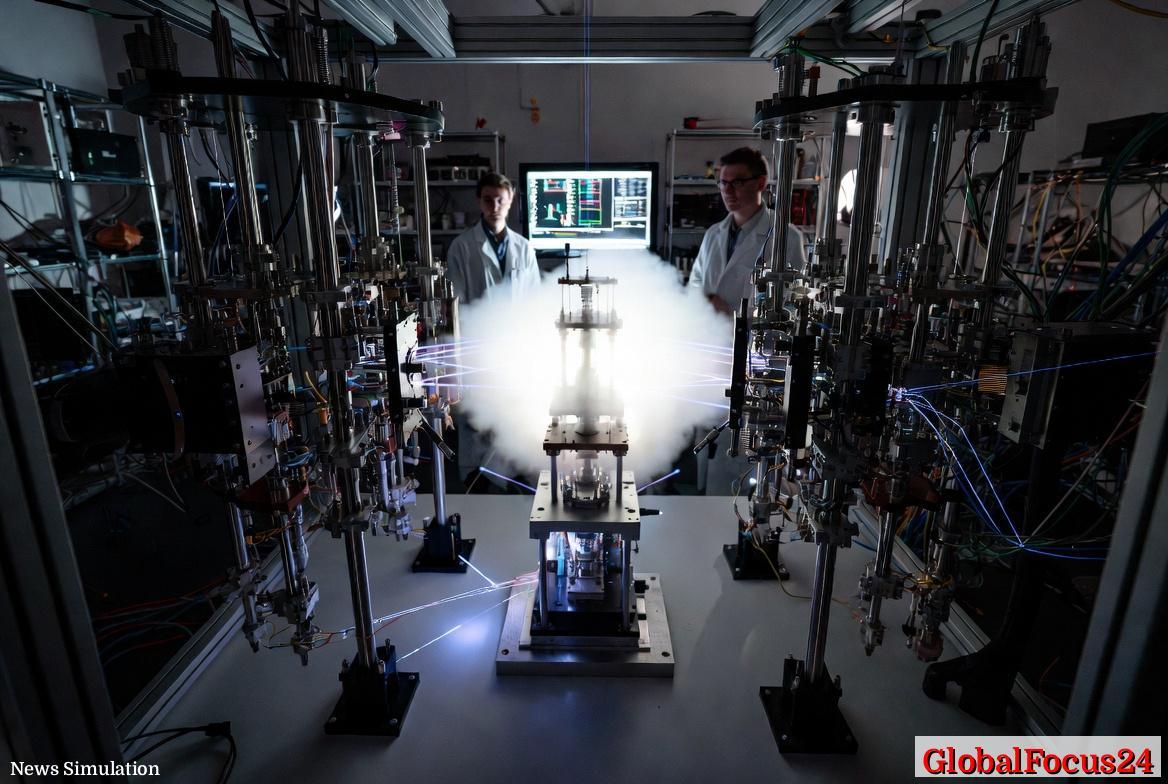
Quantum superpositions reach new macroscopic milestone as Vienna team demonstrates 7,000-atom clusters in multi-location states
The physics community has achieved a landmark in the study of quantum mechanics, pushing the boundaries of macroscopic quantum phenomena to an unprecedented scale. Researchers at the University of Vienna have successfully placed clusters of approximately 7,000 sodium atoms into a single quantum superposition, allowing the clusters to occupy multiple spatial locations at once. The work, conducted in a state-of-the-art ultra-high vacuum facility and analyzed with a laser-based interferometer, represents a tenfold improvement in macroscopicity compared with prior demonstrations and marks a significant step in bridging quantum and classical descriptions of nature.
Historical context: tracing the arc from atoms to aggregates Quantum superposition—the idea that a system can exist in multiple states simultaneously—has been a foundational principle since the early days of quantum mechanics. Early demonstrations focused on single particles, such as electrons and photons, with progressively larger and more complex systems relevant to both foundational questions and potential technologies. In the past decade, scientists have extended interference experiments to increasingly massive objects, testing the limits of quantum behavior in the presence of environmental interactions. The Vienna achievement continues a trend that began with cold atoms and molecules, moved through organic and inorganic nanoparticles, and now encompasses clusters with thousands of atoms. Each milestone has refined our understanding of decoherence, the process by which quantum possibilities gradually become classical realities due to interactions with the surrounding environment.
Experiment overview: how the larger superposition was created In the reported study, the researchers cooled sodium atom clusters—each cluster comprising about 7,000 atoms—to 77 kelvin within an ultra-high vacuum chamber to minimize disruptive air, radiation, and thermal effects. The clusters were then directed through a three-grating laser interferometer. The first grating functioned as a beam splitter, causing the quantum wave associated with the cluster to spread and travel along multiple paths. The second grating induced interference between these paths, constructing an interference pattern that is the hallmark of wave-like quantum behavior. The final grating served as a detector, translating the interference into measurable spatial correlations. The resulting pattern confirmed that the clusters behaved coherently as quantum objects, occupying multiple positions simultaneously while maintaining phase relations characteristic of quantum states.
Key metrics: mass, separation, and the scale of macroscopicity The experiment achieved a spatial separation between the superposed paths of about 133 nanometers, a figure that sits alongside the clusters’ substantial mass as a core component of macroscopicity metrics. Macroscopicity, as used in quantum studies, accounts for the object’s mass, the coherence time (or duration) of the superposition, and the separation between its constituent states. By increasing any of these factors—mass, coherence time, or separation—scientists extend the “size” of the quantum object in a meaningful sense. This particular effort represents a notable leap forward along all three axes, establishing a higher bar for future attempts to demonstrate quantum coherence in larger and more complex systems.
Comparative landscape: where this fits among prior records Previous records included demonstrations with heavier single entities but smaller separations, or larger separations with lighter objects. A 2023 experiment showcased a heavier crystal, indicating the possibility of macroscopic quantum states in more massive systems; however, the separation achieved in the Vienna study is substantially larger, highlighting a distinct achievement in spatial coherence. The current results thus complement prior work by emphasizing that quantum mechanics remains robust for systems whose mass approaches that of complex biomolecules, while maintaining sizable spatial separations that challenge conventional intuitions about the quantum-classical boundary.
Economic and practical implications: from fundamental science to technology While the immediate output is fundamental physics, the broader implications touch several high-impact domains:
- Quantum sensing and metrology: larger coherent superpositions can enhance sensitivity to gravitational, inertial, or electromagnetic fields, potentially enabling more precise measurement tools in navigation, mineral exploration, and geophysics.
- Quantum information science: understanding how to preserve coherence in larger aggregates informs strategies for building scalable quantum processors and memories, where maintaining entanglement and superposition across many particles is essential for computational advantage.
- Materials science and nanotechnology: refining the control mechanisms that sustain macroscopic quantum states supports experimental platforms for studying quantum effects in complex materials, potentially guiding the design of novel devices with quantum-enhanced performance.
- Industrial R&D ecosystems: breakthroughs of this kind can stimulate funding cycles and cross-disciplinary collaborations among physics, chemistry, materials science, and engineering, reinforcing local and regional innovation clusters.
Regional comparisons: how Vienna’s achievement resonates beyond Austria Institutions around the world are pursuing parallel paths to extend quantum coherence to larger systems. In regions known for strong physics research ecosystems—ranging from Western Europe to North America and parts of Asia—teams are racing to demonstrate quantum interference in increasingly massive objects. Vienna’s result reinforces the feasibility of macroscopic quantum phenomena and may spur reciprocal initiatives, including shared facilities for low-temperature physics, advanced vacuum systems, and precision laser interferometry. The cross-border resonance of such work helps attract international talent, foster collaborative experiments, and contribute to regional science diplomacy—an often overlooked yet meaningful economic byproduct of frontier research.
Environmental and methodological considerations: reducing decoherence A central challenge in macroscopic quantum experiments is environmental decoherence. Any interaction with the surrounding environment—air molecules, stray photons, or even subtle electromagnetic fields—can rapidly erode quantum coherence. The Vienna team mitigated these risks by operating in a vacuum chamber and operating at cryogenic temperatures. Beyond that, the design of the interferometer with laser gratings helps preserve phase information long enough to observe clear interference. Ongoing work in this arena focuses on isolating the system further, improving detection fidelity, and exploring how different materials or isotopes influence decoherence rates. These methodological advancements are not merely technical details; they determine the practicality of scaling quantum superpositions to ever larger systems.
Biological matter and future directions: the path toward viruses and biomolecules Looking ahead, researchers intend to extend these techniques to biological matter, including similarly sized viruses. Achieving quantum interference in biological particles would mark a substantial expansion of the domain in which quantum mechanics operates, with potential implications for both fundamental science and applied biophysics. If successful, such experiments could illuminate the quantum behavior of living matter components and contribute to the development of large-scale quantum systems that leverage complex, multi-component architectures. The convergence of quantum physics with virology and biochemistry could also drive novel approaches to quantum simulation and potentially inspire new lines of research in quantum-enabled biotechnology.
Public perception and societal relevance: understanding quantum limits Public interest in quantum science often centers on futuristic technologies, yet foundational experiments like this one illuminate the boundaries of our classical world. Demonstrating quantum coherence in more massive aggregates helps demystify the quantum-to-classical transition and clarifies why the world appears classical at everyday scales. This kind of research can inform science education by providing concrete examples of how abstract principles translate into measurable phenomena. Moreover, it helps policymakers and funding bodies appreciate the value of long-term, curiosity-driven research that builds the groundwork for transformative technologies years or decades down the line.
Technical notes: what makes the setup feasible The impressive scale of this achievement rests on several technical choices:
- Ultrahigh vacuum environment to minimize particle collisions and contamination that could disrupt coherence.
- Cryogenic cooling to suppress thermal fluctuations that degrade quantum phase information.
- A laser-grating interferometer that provides precise, tunable control over beam splitting, phase accumulation, and detection, enabling clear readouts of interference patterns.
- Careful calibration and isolation to ensure reproducibility and to allow researchers to distinguish genuine quantum interference from classical artifacts. Together, these elements create a robust platform for probing quantum effects in systems that lie well beyond single atoms or simple molecules.
Ethical and governance considerations: responsible advancement As quantum experiments scale up, institutions increasingly engage with governance frameworks to address safety, ethics, and data integrity. While this research is foundational and non-political in nature, it nonetheless benefits from transparent reporting, independent replication, and open scientific dialogue. International collaboration and standardization of measurement methodologies can help ensure that results are credible, comparable, and verifiable across laboratories, which in turn supports responsible investment and public trust in science.
Conclusion: a new checkpoint in quantum mastery The University of Vienna’s demonstration of a macroscopic quantum superposition involving about 7,000 sodium atoms represents a pivotal checkpoint in the quest to understand quantum mechanics at larger scales. By achieving both substantial mass and a meaningful spatial separation in a coherent superposition, the experiment tightens the link between quantum theory and the classical world we experience daily. The work not only enriches our fundamental comprehension of quantum behavior but also lays groundwork for future technologies that depend on maintaining quantum coherence across many-particle systems. As researchers continue to push these boundaries—potentially into biological matter like viruses—the coming years may reveal new regimes of interference and coherence, with wide-reaching implications for science, industry, and society at large.