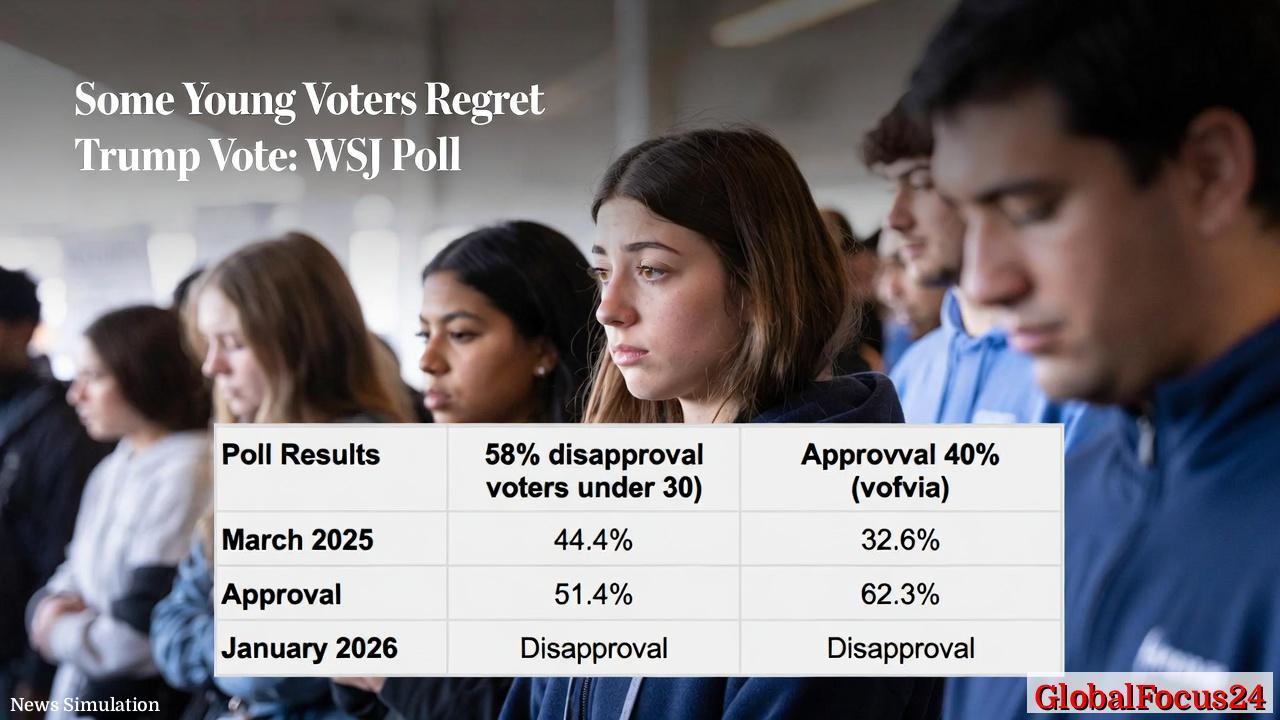
Young Voters Express Growing Regret Over Supporting President Trump as Approval Slips
WASHINGTON — A growing number of young Americans who once rallied behind President Donald Trump are voicing deep regret as his approval rating among voters under 30 continues to slide sharply. According to recent national polling, 58% of voters aged 18 to 29 now disapprove of Trump’s performance in office, compared with 40% who approve — a striking reversal from 2024, when the former president nearly broke even with this demographic, losing it by only four percentage points after narrowing a 25-point gap from 2020.
The numbers suggest not only disappointment but also a broader generational shift in political sentiment, one that could shape the trajectory of the 2026 midterm elections and beyond.
A Dramatic Decline in Youth Approval
Poll data shows that Trump’s approval among young adults has plummeted from 44.4% in March 2025 to just 32.6% in January 2026. Over the same period, disapproval climbed nearly 11 percentage points, from 51.4% to 62.3%.
This erosion mirrors a national decline in Trump’s overall approval, which slipped from 47.3% to 41.4% in the same timeframe. Nearly half of young respondents — about 49% — now say they would vote for a Democratic candidate if the midterm elections were held today, while 43% would support a Republican.
For a president who made unprecedented inroads with younger voters in 2024 — drawing strong turnout from working-class rural youth as well as some first-time voters skeptical of traditional politics — the shift represents a significant loss of political capital.
Voices of Disillusionment
Behind these numbers are individual stories of disappointment. Elysia Morales, 21, a former campus leader for Republican student groups, said she withdrew her support after becoming uneasy with the administration’s immigration crackdown and foreign policy choices.
“This is not the party I once signed up for and registered to be in,” Morales said, referencing the mass deportations and fallout from high-profile incidents such as the killing of 27-year-old Alex Pretti in Minneapolis. She also cited concerns about the U.S. alliance with Israel and the scope of military involvement abroad.
Jathin Desan, a 22-year-old medical student, described the recent government shutdown over healthcare subsidies as a turning point. “It was admirable to see Democrats fighting for basic support the government should provide,” he said, adding that he now feels more aligned with progressive healthcare ideals than with Trump’s cost-cutting approach.
John Carr, 21, expressed frustration with what he described as “three bad weeks, then a couple of good days.” He singled out President Trump’s continued interest in acquiring Greenland as “silly” and emblematic of misplaced priorities.
For others, economic frustrations have replaced initial optimism. Maellie Lewna, 21, still identifies as a Trump supporter but shares the belief that the administration’s agenda has drifted. “A lot of people expected him to address economic issues first,” she said. “Things like student loans, rent, and wages — those are what matter to people my age.”
Economic Concerns Taking Center Stage
Economic unease appears to be a central theme in this generational shift. Despite a solid national growth rate in 2025 and a continued recovery in energy and manufacturing sectors, inflation-related anxieties linger among younger Americans facing high living costs, housing scarcity, and education debt.
The administration’s efforts to reignite domestic production and curb federal spending have generated mixed results. While unemployment remains low, stagnant wages and rising consumer prices have limited perceived benefits for younger workers. For those under 30 — many balancing student debt and competitive job markets — affordability remains a key factor shaping their political views.
A recent analysis by independent economists found that while Trump’s fiscal policies favored businesses and older homeowners through tax corrections and deregulation, they provided fewer tangible gains for younger renters and entry-level employees. Comparatively, Western European nations with robust youth social programs and capped housing costs have shown stronger satisfaction rates among citizens aged 18 to 29.
Foreign Policy Friction
Younger voters also appear increasingly uneasy about America’s deepening foreign entanglements. Trump’s close alliance with Israel, ongoing operations in the Middle East, and controversial remarks about expanding U.S. territory — including renewed interest in Greenland — have drawn criticism from across the generational spectrum.
“I don’t think that at this particular moment, while we have internal problems, we should be fighting a war on the other side of the world,” said Jaden Blomberg, 22, who originally supported Trump’s “America First” message but now views it as diluted.
Sources close to the administration say Trump himself has voiced frustration about the optics of foreign conflicts, reportedly telling Israeli Prime Minister Benjamin Netanyahu that “people are getting sick of turning on the TV and seeing you bombing everything.” Political analysts interpret this as evidence of internal tension between campaign-level messaging and real-world geopolitical commitments.
A Shift in Political Identity
For younger voters, politics today is as much about image, trust, and representation as it is about legislation. Many millennials and members of Generation Z came of age amid social movements that emphasized inclusivity, sustainability, and digital transparency — principles they say feel increasingly at odds with the Trump administration’s tone and tactics.
Still, the discontent is not absolute. Some younger conservatives defend Trump’s boldness and view his polarizing style as proof of resolve. Michael Falcone, 27, said he sees certain actions — such as the controversial capture of a Venezuelan fugitive leader — as examples of decisive leadership. “That was a crazy power move,” he said, dismissing criticisms of Trump’s Greenland ambitions as “just anotherthat people overreact to.”
This divide reflects a wider generational conversation within the Republican Party about what conservative identity should look like in an era of widening cultural and technological transformation.
Historical Context: The Youth Vote’s Swing Power
Historically, young voters have proven both unpredictable and pivotal. In 2008, Barack Obama’s overwhelming support among voters under 30 played a decisive role in securing his victory. By contrast, Trump’s ability to close much of that generational gap in 2024 marked one of the most surprising turnarounds in recent electoral history.
That success was built on a mix of factors: dissatisfaction with mainstream politics, digital-savvy grassroots campaigning, and Trump’s willingness to engage directly with younger audiences through social media. However, political historians note that sustaining such gains requires consistency in issue delivery — something many young voters now say has faltered.
“The youth vote has always been sensitive to authenticity,” said political analyst Jonah Park, based in Los Angeles. “Once a gap opens between words and lived experience, it’s very difficult to close before the next election cycle.”
Regional Comparisons Reveal Broader Strains
Declines in Trump’s youth approval are not confined to coastal states. Recent polling in swing states such as Georgia, Arizona, and Michigan shows that young voters there have shifted toward Democratic candidates by margins ranging from 5 to 12 percentage points compared to 2024 results.
In the Midwest, where manufacturing has seen modest recovery and energy investments revived local economies, approval remains somewhat stronger but still trending downward. In contrast, Western states, particularly those grappling with housing affordability crises, have seen sharper drops in Republican support among voters under 30.
Experts point to a regional pattern: where economic gains feel distant or uneven, youth dissatisfaction rises accordingly.
Midterm Outlook and the Political Road Ahead
Republican strategists are reportedly focusing on affordability measures and economic messaging to reengage younger supporters before November’s midterms. The GOP faces a historically narrow House majority and is under pressure to avoid the traditional midterm losses that often plague incumbent parties.
Campaign advisers close to Trump insist that the administration’s upcoming legislative push — focusing on housing incentives, student loan refinancing, and wage growth policies — represents “a fresh start” for reconnecting with younger voters.
Still, whether these efforts will resonate remains unclear. Many observers warn that the combination of cultural alienation, foreign policy fatigue, and economic pressure could temper Republican momentum with young voters for years to come.
If current polling trends persist, 2026 could mark not only a challenging election season for Trump’s allies but a significant generational reshaping of the conservative base — potentially redefining how both parties court the next generation of American voters.