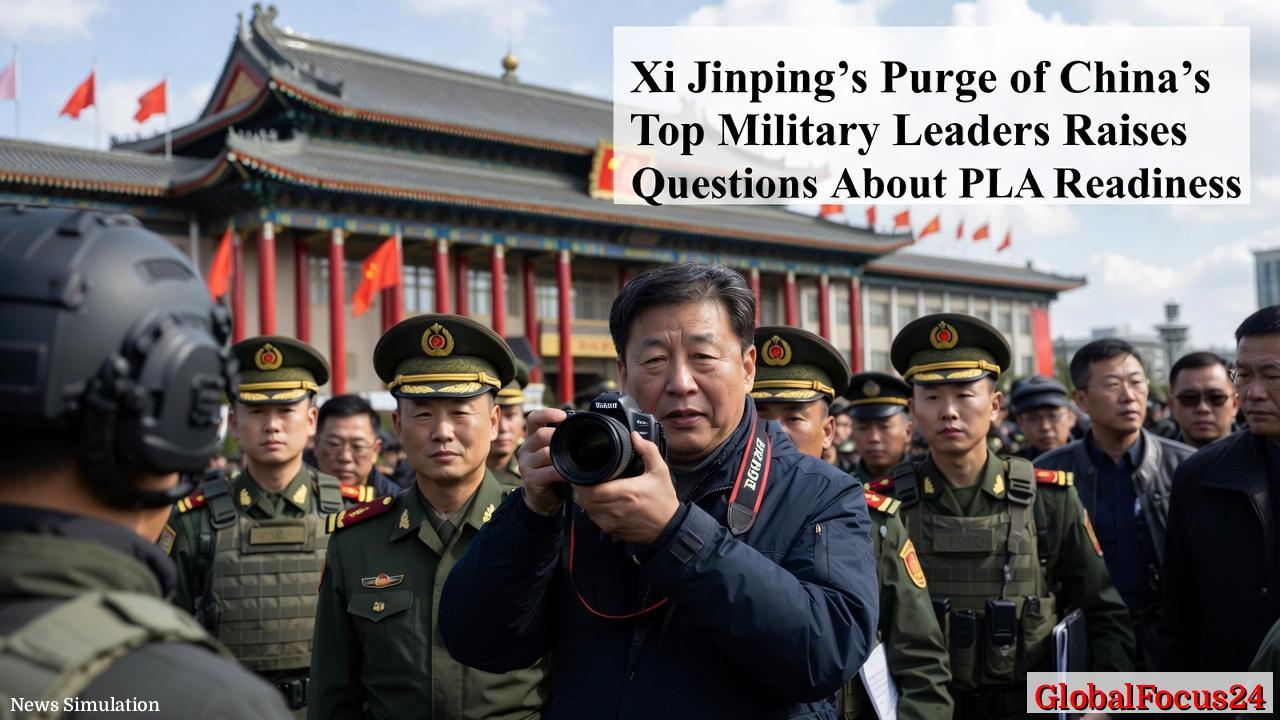
Xi Jinping’s Military Purge Reshapes PLA Leadership and Readiness
A sweeping set of investigations into two of China’s most senior military leaders signals a decisive, if controversial, shift in how the People’s Liberation Army (PLA) is governed and modernized. As the highest-profile retreat of influence from generals who have long been central to China’s security strategy, the actions point to a broader effort by Xi Jinping to consolidate authority, root out corruption, and accelerate structural reforms aimed at improving combat effectiveness. The developments also raise questions about the PLA’s readiness, strategic timing regarding Taiwan, and the regional implications for neighboring economies and security architectures.
Historical context: decades of reform and discipline To understand the current moment, it helps to recall the PLA’s recent history. Since the early 2010s, Xi has pursued an ambitious reform program designed to streamline command, reduce redundancy, and boost operational capabilities across a force of roughly 2 million personnel. The centerpiece has been the “chairman responsibility system,” introduced in 2014 to ensure that party leadership remains the ultimate authority within the military. This framework places political reliability alongside professional competence, aligning military modernization with the Communist Party’s strategic objectives.
Within this trajectory, the PLA has seen notable reorganizations, including the creation of new service branches and the reconstitution of command bodies to improve joint operations. The Rocket Force, which maintains China’s strategic nuclear arsenal, has been a particular focal point, reflecting both deterrence aims and the desire for a more integrated, rapid-response force structure. Yet even as structural changes accelerated, reports of corruption and mismanagement within various branches persisted, underscoring a persistent governance challenge.
The latest purge comes as Xi consolidates power at a moment when analysts have been closely watching whether the PLA can balance assertive signaling with credible, sustainable readiness. The precise legal and disciplinary grounds cited by the defense ministry remain limited, but the accompanying editorial in a state-aligned outlet accused the targeted leaders of corruption and actions that could undermine the PLA’s ability to wage modern warfare. The combination of public investigations and the removal of senior figures highlights a long-standing tension in China’s security establishment: how to maintain unwavering political control while preserving professional autonomy and operational effectiveness.
Key figures and the leadership shake-up General Zhang Youxia, a veteran of past border confrontations and a longstanding fixture at the apex of Chinese military leadership, and General Liu Zhenli, who heads the joint staff department, stand at the center of the probes. Their careers have intertwined with China’s strategic ambitions in Asia, including cross-strait relations, power projection in the seas around China, and the modernization timeline tied to expected operational scenarios.
The removal of Zhang and Liu from active roles, combined with the dismantling of the Central Military Commission (CMC) as it existed, underscores a broader centralization effort. The CMC, formed in its current, highly integrated form in 2022, has effectively seen a recalibration in which Xi’s leadership has become the dominant, if not sole, decision maker within the PLA’s top echelons. Three other CMC-level generals have already been relieved of their duties, signaling a potential larger relay of leadership that could involve younger officers with tighter ideological alignment to Xi’s strategic priorities.
Operational implications: readiness, reform timelines, and Taiwan scenarios Observers are evaluating how the purge might ripple through the PLA’s day-to-day readiness and long-term modernization timeline. On one hand, removing entrenched leaders tied to past corruption or governance practices may strengthen the force’s discipline and ethical standards, a goal central to Xi’s reformist agenda. On the other hand, abrupt leadership changes at the highest levels can induce short-term uncertainty within command echelons, potentially affecting training continuity, joint exercises, and the execution of high-stakes plans that require seamless coordination across branches.
A particularly sensitive dimension is how the leadership transition could influence strategic calculations regarding Taiwan. Analysts have long tracked the PLA’s timeline for possible cross-strait operations, with varying estimates about readiness windows and logistical capacity to mount a complex campaign. The purges may introduce a temporary pause or recalibration as new leaders set priorities, reallocate resources, and reassure cadres about the central party’s commitment to reform. In regional terms, a more transparent crackdown on corruption could be interpreted by neighbors as a commitment to professionalizing the force, while skepticism remains about the pace and scope of real reform.
Economic impact: defense modernization, supply chains, and regional markets China’s defense modernization program has implications beyond the barracks. A credible and field-ready PLA affects regional security dynamics, investment flows in defense sectors, and the broader economic environment. Firms supplying military hardware, cyber and space capabilities, and advanced materials often adapt to shifts in procurement priorities that accompany leadership transitions and reform drives. The consolidation of power within the PLA’s civilian leadership also suggests potential changes in procurement policies, contract allocations, and oversight mechanisms, which can alter risk profiles for domestic and international suppliers.
Beyond procurement, the reform agenda interacts with China’s broader industrial strategy. The emphasis on joint operations and rapid decision cycles tends to favor capabilities such as precision-guided weapons, autonomous systems, and robust logistics networks. Regions with significant defense manufacturing clusters—already a driver of regional employment and innovation—may experience acceleration as state-led demand intensifies and private-sector ecosystems respond to evolving specifications and export controls.
Regional comparisons: how China’s approach stacks up Comparative analysis with other major powers reveals distinct features of Beijing’s approach. In some democracies with civilian oversight, leadership transitions within the defense establishment occur with transparent processes and broad parliamentary scrutiny, reducing the risk of abrupt strategic shifts. China’s model centers on centralized party authority, where the chairman’s prerogatives are legally reinforced through constitutional and party structures. This often results in swifter, more opaque decisions but can heighten risk if governance gaps emerge during transitions.
Within the Asia-Pacific region, neighboring powers monitor China’s reform pace closely. Countries with longstanding security agreements, alliance commitments, and robust defense budgets tend to calibrate their own procurement and readiness plans in response to perceived shifts in China’s signaling. Some regional economies seek to diversify supply chains and reduce exposure to any single source for critical military technologies, while maintaining open markets for commercial goods that thrive in a dynamic, technology-forward ecosystem.
Public reaction and cultural undercurrents Public sentiment around such high-profile purges typically includes a mix of concern, caution, and support for anti-corruption efforts. State media portrayals emphasize discipline, loyalty to the party, and the imperative of transforming the military into a modernized force capable of protecting national interests. In urban and coastal regions, where security considerations weigh on business confidence and investment decisions, the purge may reinforce a narrative of continued stability and reform. In other parts of the country, families and veterans with ties to the military may watch developments with heightened interest, given the potential implications for veterans’ benefits, pension administration, and the distribution of resources to military spenders.
Strategic resilience: lessons for policymakers and the public Several takeaways emerge for policymakers, defense analysts, and the public:
- Centralization can accelerate reform but may introduce transitional risk. The consolidation of control under a single strategic framework can speed up decision-making and policy alignment, yet the initial period may see heightened internal uncertainty as new leaders assume roles and confirm loyalties.
- Anti-corruption efforts can strengthen long-term readiness. If corruption is reduced or eliminated, resources can be redirected toward modernization, training, and maintenance—crucial elements for sustaining credible deterrence.
- Talent pipelines matter. Replacing senior leaders requires effective succession planning, mentorship, and oversight to ensure that capable, apolitical, and mission-focused officers fill critical positions in a timely manner.
- Communication and transparency influence regional calculations. Clear, steady messaging about reform aims and timelines can help regional partners calibrate their own defense and economic strategies in a world of changing security risk.
What comes next: potential trajectories and benchmarks Looking ahead, several scenarios appear plausible:
- Accelerated leadership refreshment. New officers aligned with Xi’s reform agenda could begin implementing a more aggressive modernization plan, potentially speeding up the adoption of joint command structures, professionalization programs, and procurement modernization.
- Stabilized transition with measured reforms. The PLA could stabilize under a core group of trusted leaders, gradually integrating reforms while preserving continuity in ongoing training, operations planning, and international exercises.
- Delayed operational timelines for high-stakes signaling. If internal realignments consume bandwidth and resources, ambitious operational timelines—such as contingency plans related to Taiwan—could face postponements or recalibrations to maintain readiness across critical domains.
In the broader geopolitical landscape, the events are a reminder that military modernization and political governance remain deeply intertwined in shaping regional security dynamics. For markets and communities with exposure to Asia’s manufacturing hubs and defense-adjacent industries, the evolving leadership landscape warrants attention to how procurement cycles, regulatory oversight, and technology transfer policies may adapt in the months ahead.
Conclusion: a turning point in the PLA’s modernization journey The investigations into General Zhang Youxia and General Liu Zhenli, and the consequential restructuring of the Central Military Commission, mark a pivotal moment in China’s ongoing effort to align its military power with its political vision. While the immediate effects on operational readiness are still unfolding, the broader implication is clear: Xi Jinping’s leadership continues to pursue a centralized, reform-driven path designed to strengthen the PLA’s capabilities, discipline, and strategic coherence. How quickly and effectively those reforms translate into tangible military performance remains a question for the months ahead, with real-world consequences for regional security, economic activity, and global strategic calculations.