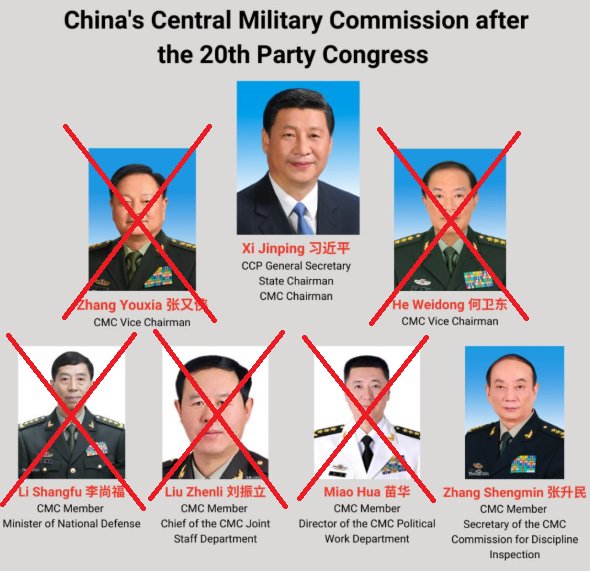
China’s Central Military Commission undergoes reshuffle after the 20th Party Congress
In the wake of China’s 20th Party Congress, the Central Military Commission (CMC) has experienced a notable leadership reshuffle that underscores ongoing efforts to tighten oversight within the country’s armed forces. Xi Jinping remains the CMC Chairman, steering one of the world’s most powerful military establishments through a period of heightened vigilance and strategic recalibration. The changes involve high-profile departures and a narrowed cadre of uniformed leadership, signaling a deliberate step to align the military with broader party discipline goals while maintaining operational continuity for China’s security and strategic objectives.
Historical context and succession patterns
To understand the significance of the current shift, it helps to situate it within a longer arc of military oversight in China. The CMC has long functioned as the apex organ directing the People’s Liberation Army (PLA), with the Chairman acting as the commander-in-chief and the Vice Chairmen and other members coordinating the services’ top-level planning and execution. Over decades, leadership transitions within the CMC have often reflected broader governance priorities: consolidating authority, codifying obedience to party directives, and reinforcing institutional controls in response to internal and external pressures.
The most recent changes follow the political cycle initiated by the 20th Party Congress, a moment when the leadership emphasizes loyalty, anti-corruption campaigns, and strategic clarity in doctrine and modernization. Historically, such moments have produced a mix of personnel rotations, retirements, and, at times, investigations that aim to curb malpractice and ensure that military leadership remains aligned with the Party’s core objectives. The current reshuffle fits this pattern, signaling both a reaffirmation of Xi’s strategic priorities and a continuing effort to standardize discipline at the top of the PLA hierarchy.
Scope of the changes
The leadership transitions within the CMC involve several senior figures who previously held prominent roles within the defensive establishment:
- Zhang Youxia, formerly the CMC Vice Chairman, has been removed from his post. As a long-standing figure in PLA modernization efforts and strategic planning, his departure marks a significant turnover at the highest levels of military governance.
- He Weidong, who also served as a CMC Vice Chairman, is among those removed. His tenure, which included leadership responsibilities across multiple service branches, is notable for its breadth and for the signals it sends about the party’s oversight mechanisms.
- Li Shangfu, who previously held the post of Minister of National Defense before his service within the CMC, is removed. His case underscores the ongoing focus on anti-corruption and discipline within the armed forces, highlighting how political investigations can intersect with military leadership.
- Liu Zhenli, former Chief of the CMC Joint Staff Department, has been removed. His role placed him at the core of the PLA’s operational decision-making, making his departure a meaningful reconfiguration of war-fighting and readiness processes.
- Miao Hua, who previously led the CMC Political Work Department, is also among those removed. The political work apparatus has historically been central to ensuring party loyalty within the military, and his removal signals a recalibration of how political work is integrated with other functional areas.
- Zhang Shengmin remains in position, continuing as Secretary of the CMC Commission for Discipline Inspection. His position preserves a continuity thread focused on enforcing party discipline and addressing violations within the military ranks.
Implications for military modernization and readiness
The changes come at a moment when China is actively pursuing comprehensive modernization of its armed forces. Modernization initiatives span force structure reform, technology-driven capabilities, and enhanced expeditionary reach. The removal of several senior officers, particularly those tied to high-level operational and political roles, could influence the pace and prioritization of modernization programs, including areas such as joint operational command structures, information warfare, and strategic deterrence capabilities.
From a practical standpoint, leadership transitions at the top can affect how quickly new directives are translated into training, procurement, and doctrine updates. The presence of Xi Jinping as CMC Chairman provides a stable, centralized governing voice to maintain strategic continuity while the PLA adapts to evolving security challenges. Yet the absence of some longtime uniformed leaders may also reallocate influence toward different service branches or technocratic perspectives within the CMC, potentially shaping how resources are allocated and how risk is assessed across regional theaters and potential contingencies.
Economic and regional impact
China’s military developments are closely watched by regional partners and global markets, given the PLA’s influence on regional security dynamics and the broader economy. An assertive modernization program is often coupled with strategic signaling, ensuring that defense spending supports both deterrence and industrial development. In the near term, the leadership changes could influence procurement cycles, defense-industrial partnerships, and the pace at which new platforms—ranging from next-generation fighters to advanced missile systems—move from concept to production. In a broader sense, stability within the military leadership can help reassure markets about continuity in strategic direction, even as internal discipline efforts unfold.
Regional comparisons illuminate how similar processes unfold in other large, modernized militaries. For instance, many major powers balance a cycle of personnel renewal with mechanisms to sustain doctrine consistency and readiness. In democracies, this often occurs through transparent, multi-branch committees and routine inspections. In China, the party-state model concentrates authority within the CMC and the central leadership, making leadership changes a potent signal of policy direction and risk management priorities. Observers watch how these shifts influence interoperability with regional partners, joint exercises, and the ability to respond to potential flashpoints in adjoining seas, airspace, or land borders.
Discipline and anti-corruption emphasis
The emphasis on discipline within the CMC aligns with a broader campaign to deter corruption, enhance accountability, and ensure that capabilities are optimized for the party’s strategic aims. The role of the Commission for Discipline Inspection, led by Zhang Shengmin, remains central to this process. The ongoing focus on integrity and governance within the military has implications for recruitment, training, and the professionalization of the forces. For international observers, it raises important questions about transparency in defense processes and the long-term effects on military efficiency, morale, and public trust.
Public reaction and societal implications
Public sentiment in China often reflects a pragmatic appreciation for a strong, disciplined military as a guarantor of national security and regional stability. News of leadership changes at the highest levels tends to be parsed through the lenses of national pride, strategic deterrence, and perceptions of governance effectiveness. In surrounding regions, analysts weigh these signals against potential shifts in defense postures, including how China might adjust its maritime and aerial patrol routines, information-sharing practices, and military diplomacy. While residents may not see day-to-day changes in uniformed leadership, the long-run effect can manifest in policy emphasis, industrial incentives, and regional security calculations.
Core takeaways for stakeholders
- Centralized leadership under Xi Jinping reinforces a consistent strategic direction for modernization and readiness.
- The removal of multiple senior officers signals ongoing discipline and anti-corruption efforts within the military establishment.
- Continuity is preserved through the retention of certain figures, enabling stable policy execution while transitions unfold.
- The reforms are likely to influence defense procurement, joint operations planning, and regional security dynamics over the medium term.
- Market and regional partners will be watching for changes in defense collaboration, industrial partnerships, and transparency measures related to defense processes.
Looking ahead: potential trajectories
Analysts anticipate that the PLA will continue pushing forward with its multi-year modernization plan, emphasizing joint operations, enhanced command-and-control capabilities, and a more integrated logistics and information-networked warfare capability. Leadership transitions at the CMC could speed up or recalibrate the implementation of modernization projects, depending on how newly appointed leaders prioritize resource allocation and inter-service coordination. In parallel, ongoing discipline measures are expected to shape institutional culture, with implications for how the PLA recruits, trains, and retains top-tier talent.
From a regional security perspective, the changes may influence how China engages with neighboring countries in complex theaters such as the South China Sea, East China Sea, and broader Indo-Pacific domain. For partners and competitors alike, the reshuffle reinforces the importance of monitoring shifts in command structure, doctrine emphasis, and risk management practices. It also underscores the enduring reality that China’s military modernization is as much a political process as a technical one, with party oversight and discipline playing a decisive role in shaping future outcomes.
Conclusion
The recent changes within China’s Central Military Commission mark a significant moment in the ongoing evolution of the PLA under the party’s leadership. As Xi Jinping maintains centralized control of the CMC, the removal and reassignment of senior officers reflect a deliberate effort to strengthen discipline, streamline command, and accelerate modernization within a framework of political alignment. The long-term effects will hinge on how the new leadership translates policy directives into tangible improvements in readiness, interoperability, and strategic deterrence, while sustaining stability and confidence across regional security ecosystems. For observers, the development offers a critical lens through which to assess China’s future military posture, economic implications, and regional diplomacy in an era of rapid geopolitical change.