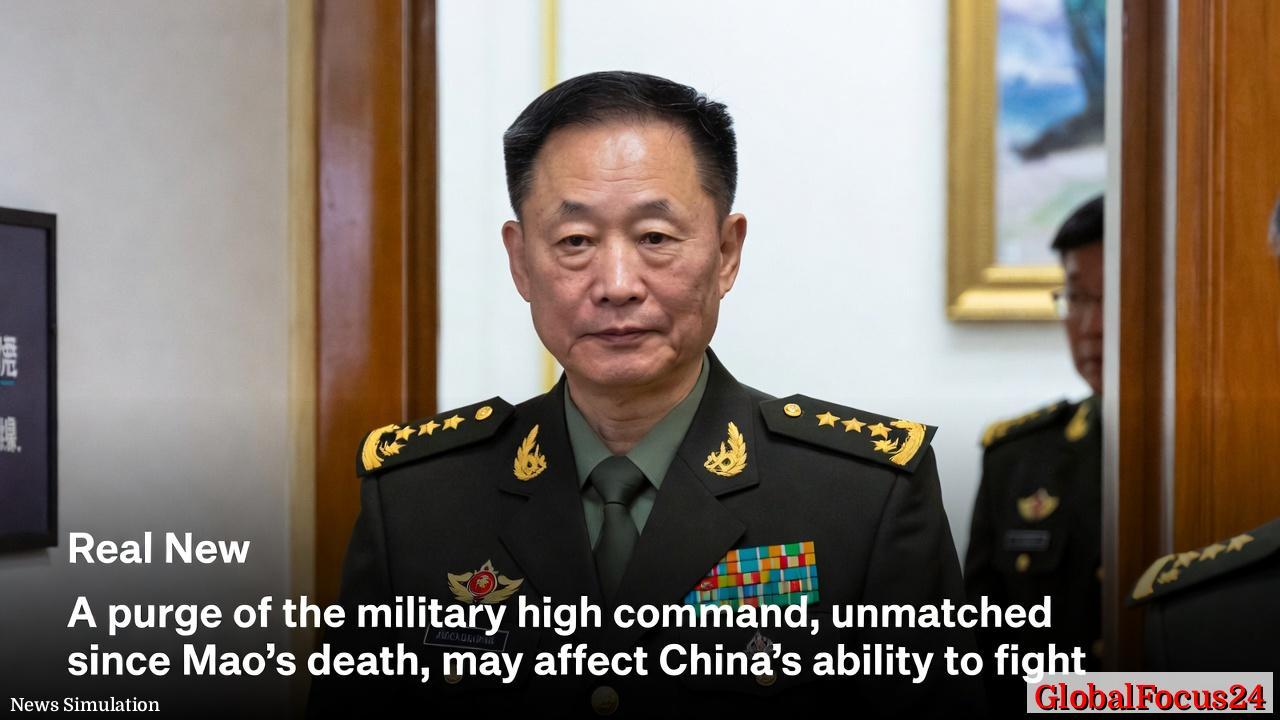
Xi Jinping’s Military Overhaul Intensifies: Years of Shake-Up Transforming China’s Defense Command
Beijing — A sweeping reshuffle within China’s military leadership has intensified concerns about strategic cohesion, readiness, and long-term planning as authorities remove senior figures from the Central Military Commission (CMC) and broader commands. The latest development, marked by the removal of General Zhang Youxia, underscores a rare and high-stakes realignment of the country’s top defense apparatus. Analysts describe the move as part of a broader, multi-year effort to consolidate political control over the armed forces while addressing perceived corruption, loyalty, and modernization priorities in a rapidly evolving security environment.
Historical context: a long arc of military reform
Since the early reform era, China has pursued periodic, high-level changes to its military leadership to ensure alignment with the Communist Party’s objectives and national strategy. The formation of the People’s Liberation Army (PLA) and its shift from a rebel force to a modern, technologically focused army has always intertwined political trust with military capability. In the years under Xi Jinping, the emphasis has shifted toward streamlining command, reducing factionalism, and accelerating modernization in areas such as missiles, cyber operations, space, and joint operational capability. The current purge reflects both a continuity of this approach and a willingness to eclipse established power centers within the PLA’s senior ranks when the leadership deems it necessary for strategic signaling and operational discipline.
From regional contingencies to global competition, the historical lens reveals how leadership changes can ripple through doctrine, budget, and procurement decisions. Past eras of turnover often coincided with major defense white papers, new modernization timelines, and reorganizations of theater commands to reflect shifting risk calculations. The present moment sits within that continuum, but with heightened visibility thanks to the scale of personnel changes and their potential impact on long-range acquisition programs, training pipelines, and alliance considerations.
Impact on defense budgets and modernization timelines
Any significant leadership transition at the highest level of the PLA reverberates through national defense budgeting and procurement cycles. The central objective of Xi’s military reform has been to accelerate the modernization of strategic forces, boost joint operations across services, and enhance the PLA’s capacity to project power regionally and globally. Analysts note that leadership stability at the top can influence the pace of weapon system development, including advanced fighters, ballistic missiles, and precision strike capabilities. Changes in senior command can recalibrate priorities, affect multi-year research and development (R&D) programs, and shape training regimens for officers and noncommissioned personnel alike.
A key consideration for regional economies is how military spending interacts with technology sectors, defense-industrial bases, and public research institutions. In many coastal provinces and urban hubs, defense-related contracts have long supported high-tech manufacturing, exportable components, and skilled labor pools. When leadership turnover coincides with an emphasis on national resilience and strategic deterrence, regional economic effects can include recalibrated vendor ecosystems, shifts in labor demand, and adjustments to regional development plans tied to defense activities. The net effect depends on how quickly the PLA translates leadership decisions into measurable program milestones and how international procurement markets respond to a changing strategic posture.
Operational readiness and military cohesion
A central concern in any high-level purge is how quickly the armed forces can maintain operational readiness and preserve unit cohesion. The removal of senior commanders can temporarily disrupt planning cycles, war-gaming scenarios, and the continuity of strategic initiatives. In China, where the PLA emphasizes integrated joint operations across land, sea, air, space, and cyberspace, leadership continuity at the apex can be a critical determinant of how smoothly joint campaigns are choreographed and executed.
Military observers look for indicators such as the pace of senior officer promotions, the speed of staff-to-field transitions, and the maintenance of training standards across theater commands. A rapid turnover at the top may signal a broader push to align officers with a tightened political-ideological standard or with new doctrine emphasis, while a slower, more deliberate transition could reflect careful succession planning intended to sustain confidence among troops and civilian administrators alike.
Regional comparisons: how other major powers manage military leadership transitions
To assess the implications of China’s leadership changes, it helps to compare with how other major powers handle analogous transitions. In some large military establishments, leadership turnover occurs within established, predictable cycles tied to retirement ages, disciplinary review processes, and annual defense policy plans. In others, leadership shifts are more tightly coupled with strategic recalibrations tied to evolving security environments, alliances, and cyber or space domain considerations.
- United States: Leadership transitions in the U.S. military often accompany shifts in defense strategy, with changes in the top civilian leadership paired with senior military confirmations. The U.S. approach emphasizes modular modernization programs, multi-domain operations, and global alliance coordination, with transitions typically reflected across service secretaries and combatant-command leadership.
- Russia: In periods of strategic recalibration, Russia has shown the capacity to replace senior military leadership while maintaining a consistent doctrine and operational tempo. Organizational changes can align with new arms programs and shifts in regional posture, particularly around European and Eurasian theaters.
- Europe: NATO member states frequently rotate senior officers to refresh leadership with broader exposure to allied interoperability and joint exercises. These transitions are often framed within alliance defense plans and interoperability standards rather than as unilateral political power consolidations.
Economic implications for regional ecosystems and global supply chains
The PLA’s modernization trajectory is closely linked to China’s broader industrial and technological ambitions. As high-level leadership shifts influence the pace and focus of defense R&D, there can be secondary effects on global supply chains, particularly in sectors such as advanced manufacturing, semiconductors, aviation, and cybersecurity. Regions hosting defense-related facilities—ranging from coastal shipyards to inland research hubs—may experience a reorientation of investment priorities, workforce training, and ancillary services.
Translation of directives into real-world outcomes depends on the execution of modernization programs, the reliability of procurement timelines, and the collaboration between military and civilian sectors. Efficient translation supports not only national security objectives but also regional economic resilience, especially in areas that have become specialized in defense technologies. Conversely, prolonged uncertainty at the highest level can introduce caution among suppliers, potentially slowing some programs and prompting firms to diversify to mitigate risk.
Public reaction and social resilience
As with any major political-military development, public sentiment often traces the news through regional lenses, media narratives, and expert analysis. The community closely watching the PLA’s trajectory typically seeks clarity on how leadership transitions affect national security, regional stability, and daily life. In major urban centers and tech corridors, conversations may focus on the balance between modernization and stability, the impact on job markets tied to defense industries, and the perceived resilience of the country’s strategic posture.
Public messages from officials tend to emphasize the uninterrupted readiness of the armed forces, reaffirmation of loyalty to the party, and a commitment to the long-term modernization roadmap. Observers monitor how these statements align with long-term strategic goals, including deterrence capability, crisis management readiness, and international engagement within the broader security environment.
Strategic implications for regional rivals and allies
China’s evolving leadership landscape within the PLA is likely to influence regional geopolitics and the calculus of neighboring powers. Allies and partners will assess whether the leadership changes translate into more aggressive postures, more predictable signaling, or increased engagement in joint exercises and defense dialogues. Regional observers will be looking for shifts in force posture, baseline doctrine, and the tempo of international defense collaborations. The overall assessment will hinge on visible adjustments to training, procurement milestones, and communication about strategic intent.
National security experts emphasize that a robust and clear modernization plan, accompanied by transparent milestones, can help reassure allies while signaling resolve to potential adversaries. In this context, the leadership changes may serve as a signal that the PLA intends to sustain a formidable, technologically advanced force capable of multi-domain operations. How this translates into regional stability will depend on the clarity of doctrine, the effectiveness of command and control, and the speed at which new capabilities are fielded and integrated.
Conclusion: balancing reform, readiness, and resilience
The removal of a senior military commander in China marks a pivotal moment in the ongoing effort to reshape the PLA’s command structure. As Xi Jinping’s administration advances its broader modernization agenda, leadership transitions at the highest levels are a visible reminder of the intertwining between politics, technology, and security. For regional economies, defense contractors, and global markets, the unfolding changes will likely influence budgets, procurement cycles, and strategic planning for years to come.
In the broader arc of Chinese military reform, the current purge can be seen as a continuation of a long-running project: to harmonize political objectives with cutting-edge defense capabilities while maintaining a credible deterrent posture. The practical outcomes will depend on how swiftly and effectively the new leadership aligns existing programs with the stated modernization timeline, how it preserves operational readiness across services, and how it communicates its strategic intent to allies, partners, and the broader international community. The stakes are high, and the path forward will be watched closely by policymakers, industry leaders, and observers around the world.