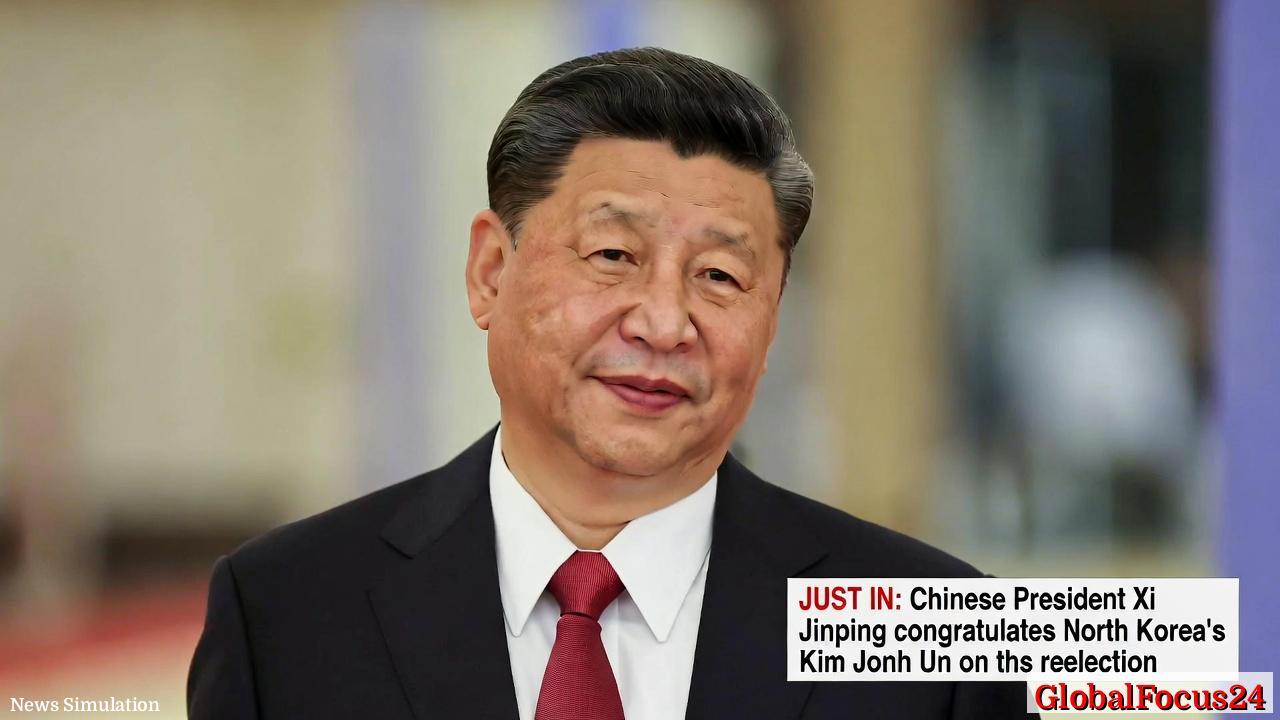
Xi Jinping Congratulates Kim Jong Un on Reelection, Underscoring Enduring Sino-North Korean Alliance
Historic Allies Reinforce Diplomatic Ties
Chinese President Xi Jinping has extended formal congratulations to North Korean leader Kim Jong Un on his reelection as the general secretary of the Workers’ Party of Korea, reaffirming the resilience of a relationship that has endured through more than seven decades of geopolitical transformation. In an official message, Xi praised Kim’s leadership and pledged to deepen strategic cooperation and “traditional friendship” between Beijing and Pyongyang—a signal of continuing solidarity between the two communist neighbors amid shifting global dynamics.
The exchange reaffirms China’s longstanding role as North Korea’s closest ally and economic lifeline, even as the isolated state faces ongoing international sanctions. According to the public statement, Xi emphasized the “mutual understanding and trust” that have sustained bilateral ties since their establishment in 1949, when China became one of the first nations to recognize the newly formed Democratic People’s Republic of Korea (DPRK).
A Relationship Forged in War and Revolution
The roots of the China–North Korea relationship trace back to the Korean War (1950–1953), during which Chinese troops, acting as the “People’s Volunteers,” crossed the Yalu River to support Pyongyang against U.S.-backed South Korean forces. The war solidified a bond forged in blood and ideological kinship. Although that alliance has evolved considerably since the Cold War, the foundations of political loyalty and mutual security still define much of the interaction between the two capitals.
In economic and strategic terms, China remains North Korea’s primary benefactor and most important trading partner. Estimates suggest that over 90 percent of North Korea’s external trade is conducted with China, even though official figures fluctuate due to sanctions and the clandestine nature of some transactions. For Beijing, North Korea serves simultaneously as a buffer zone against Western military presence in South Korea and a strategic counterweight in regional diplomacy.
Xi’s Message: Stability Over Change
Xi’s letter, delivered through official diplomatic channels, emphasized continuity and stability—two themes central to China’s regional posture. By congratulating Kim on his reelection, Xi implicitly endorsed the political continuity of North Korea’s leadership, signaling China’s preference for a predictable neighbor in a volatile part of East Asia. The tone of Beijing’s message also mirrored its broader regional strategy, which prioritizes regime stability, control over border dynamics, and influence over the Korean Peninsula.
While the message included warm words of friendship, its real weight lies in timing and context. North Korea’s domestic political theater—marked by Kim Jong Un’s consolidation of power through personnel reshuffles and military policy updates—coincides with growing tension in the Indo-Pacific, including heightened U.S.–China competition and renewed joint military drills involving South Korea and Japan. In this environment, China’s congratulatory note functions not only as a diplomatic gesture but also as a reassurance that the traditional Beijing–Pyongyang axis remains intact.
Economic Interdependence Amid Isolation
For North Korea, China’s backing is critical to economic survival. Following a period of near-total border closure during the COVID-19 pandemic, trade between the two nations has shown cautious signs of revival. Cross-border commerce through Dandong, a key trading hub, has increased modestly over the past year as freight train services resumed and limited exports of Chinese goods—ranging from industrial machinery to grain—were authorized.
Despite the gradual reopening, North Korea remains heavily sanctioned due to its weapons programs. International restrictions have strangled foreign investment and constrained access to energy, technology, and banking systems. Beijing’s challenge lies in balancing its economic support for Pyongyang with a need to avoid breaching United Nations sanctions it formally endorses.
Observers note that China’s trade with North Korea often manifests in non-transparent channels—small-scale barter deals, informal market exchanges, and humanitarian aid transfers—that allow both countries to sidestep the most damaging aspects of international restrictions while maintaining plausible deniability.
Regional Comparisons: The Sino-North Korean Distinction
China’s continued engagement with North Korea contrasts sharply with its relationships with other East Asian nations. While Beijing maintains deep economic ties with South Korea, those relations remain politically tense over issues such as U.S. missile defense systems and maritime security. Japan, for its part, remains wary of both Pyongyang’s missile activities and China’s maritime ambitions.
By contrast, the China–North Korea partnership operates within a distinct ideological framework. Both countries invoke narratives of shared revolutionary heritage and anti-imperialist struggle—rhetorical themes that resonate strongly in their state media. This ideological alignment, combined with strategic calculus, ensures that even as both nations modernize in vastly different ways, their alliance endures as one of necessity rather than mutual affection.
A Diplomatic Message with Strategic Subtext
Beyond symbolic celebration, Xi Jinping’s congratulatory message serves practical diplomatic purposes. The communication reinforces mutual assurances between two regimes facing external pressure—China from Western powers over trade and technology, and North Korea over nuclear ambitions. By publicly reaffirming the relationship, Xi positions Beijing as a protective elder partner, while Kim gains international acknowledgement amid diplomatic isolation.
Analysts interpret the exchange as part of a broader effort by both leaders to demonstrate unity in the face of perceived Western encirclement. The message subtly reasserts China’s role as Pyongyang’s interlocutor to the outside world—particularly at a time when North Korea’s own diplomatic outreach remains minimal, and dialogue with the United States has been dormant since 2019.
The Historical Continuum of Party Diplomacy
Party-to-party correspondence between the Chinese Communist Party (CCP) and the Workers’ Party of Korea (WPK) holds ceremonial importance in both political cultures. The exchange represents more than a routine diplomatic dispatch; it is an affirmation of ideological kinship rooted in socialism’s revolutionary past.
In recent years, as China has grown into a global economic superpower and North Korea has remained largely isolated, the tone of these exchanges has subtly shifted. Beijing increasingly frames the relationship in terms of “mutual respect and cooperation,” while Pyongyang continues to emphasize “comradeship in struggle.” Despite occasional friction—such as North Korea’s frequent missile tests that complicate China’s foreign policy—both sides have learned to manage disagreements within the bounds of strategic necessity.
Geopolitical Implications and Future Trajectory
Looking ahead, the renewed affirmation between Xi and Kim suggests that the regional security structure surrounding the Korean Peninsula will continue to mirror Cold War divisions, albeit in a modernized form. Beijing’s support ensures that Pyongyang maintains at least one major diplomatic lifeline, while China leverages its influence for regional stability—or at minimum, predictability.
For neighboring countries like South Korea and Japan, this lingering alliance reinforces the difficulty of isolating North Korea completely. It also limits the ability of Western-led sanctions to generate significant political change inside the DPRK. On the contrary, China’s stabilizing influence might enable Pyongyang to sustain its military infrastructure while avoiding large-scale economic collapse.
The continued partnership could also have implications for Beijing’s broader regional ambitions. As China expands its Belt and Road Initiative across much of Asia, analysts speculate that a stable North Korea could play a peripheral yet symbolically important role—especially in overland logistics networks connecting Northeastern China with the Korean Peninsula. Although Pyongyang has yet to formally participate in Belt and Road projects, discussions around joint infrastructure development have quietly persisted.
Public and Policy Reactions
Public reaction to Xi’s message within both nations has reflected official narratives. Chinese state media highlighted the exchange as evidence of enduring socialist solidarity, while North Korean broadcasts framed it as validation of Kim’s leadership on the global stage. International observers, meanwhile, view the gesture as a reaffirmation of strategic patterns rather than a shift in policy direction.
Diplomats in Seoul and Washington are unlikely to interpret the development as a surprise. For them, China’s approach reinforces its dual role: supporting sanctions enforcement outwardly while maintaining backstage support for its northern neighbor. This careful balancing act allows Beijing to preserve stability along its northeastern border while avoiding an outright rupture with Western partners on the issue.
Conclusion: A Relationship Rooted in Resilience
Xi Jinping’s congratulations to Kim Jong Un symbolize more than diplomatic courtesy—they mark the continuity of one of Asia’s most enduring alliances. Anchored in shared history, mutual strategic benefit, and cautious pragmatism, the China–North Korea relationship has withstood ideological shifts, economic divergence, and international scrutiny. As both nations navigate the complexities of a changing world order, their partnership remains a cornerstone of regional geopolitics—an axis of resilience amid uncertainty.