Five Tech Titans Face New Era as U.S. Signals Greater Oversight of Artificial Intelligence
A Turning Point for the AI Industry
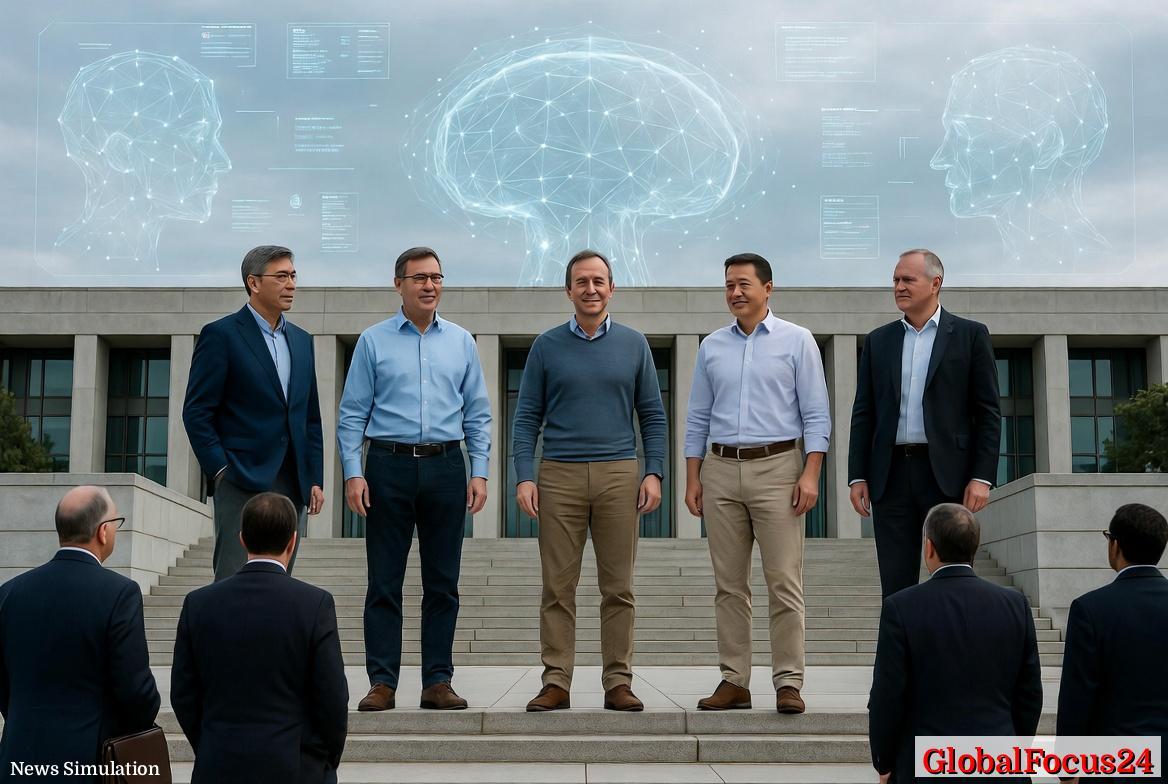
For much of the past decade, the rapid evolution of artificial intelligence in the United States has been driven largely by private enterprise. A small group of influential leaders—known widely by their first names alone: Sam, Elon, Sundar, Mark, and Jensen—have led companies that now sit at the center of the global AI race. Their technologies underpin everything from search engines and social platforms to autonomous systems and advanced computing infrastructure.
Until recently, the U.S. government adopted a relatively hands-off approach, allowing innovation to flourish with minimal direct intervention. That era appears to be ending. Policymakers are signaling a shift toward more active oversight as AI systems grow more powerful, more pervasive, and more economically consequential.
The transition marks a critical inflection point not only for the companies involved but also for the broader global technology landscape.
The Leaders Behind the AI Boom
Each of the five figures represents a distinct pillar of the modern AI ecosystem:
- Sam has become synonymous with generative AI, spearheading the development of large-scale language models that are now embedded in enterprise workflows and consumer tools alike.
- Elon has pushed AI into physical systems, from autonomous vehicles to robotics, emphasizing real-world deployment and long-term existential considerations.
- Sundar has integrated AI deeply into search, cloud computing, and productivity software, shaping how billions of users interact with information daily.
- Mark has focused on AI-driven social platforms and immersive digital environments, investing heavily in machine learning to personalize content and build virtual ecosystems.
- Jensen has enabled the entire sector through advanced semiconductor technologies, providing the computational backbone necessary for training and deploying modern AI systems.
Together, their companies account for a significant share of global AI investment, infrastructure, and talent.
Historical Context: From Open Innovation to Strategic Concern
The U.S. technology sector has long benefited from a regulatory environment that prioritized innovation. In the early days of the internet, minimal oversight allowed companies to scale rapidly and experiment freely. A similar pattern emerged with artificial intelligence in the 2010s, when breakthroughs in deep learning accelerated progress across industries.
During that period, government involvement was largely limited to research funding, academic collaboration, and national security applications. Private firms led the commercialization of AI, investing billions into research labs, data centers, and specialized hardware.
However, as AI capabilities advanced—from image recognition to natural language reasoning and autonomous decision-making—concerns began to grow. Issues such as data privacy, algorithmic bias, labor displacement, and system reliability moved into public focus. At the same time, geopolitical competition intensified, with other regions investing heavily in AI as a strategic priority.
The result is a shift in perception: AI is no longer just a technological breakthrough but a foundational infrastructure with far-reaching societal implications.
Economic Impact of AI Expansion
Artificial intelligence is now a central driver of economic growth. Analysts estimate that AI could contribute trillions of dollars to global GDP over the next decade, transforming industries including healthcare, finance, manufacturing, and logistics.
In the United States, AI-related investments have surged:
- Technology companies are allocating unprecedented capital toward AI research and infrastructure.
- Demand for high-performance computing has fueled growth in semiconductor manufacturing and cloud services.
- Startups focused on AI applications are attracting record levels of venture funding.
- Enterprises across sectors are adopting AI to automate processes, enhance productivity, and reduce costs.
The influence extends beyond Silicon Valley. Regions across the country, including Texas, Washington, and North Carolina, are seeing increased activity in AI-related development and talent recruitment.
At the same time, the economic benefits are accompanied by disruption. Automation is reshaping job markets, particularly in roles involving routine cognitive tasks. While new categories of employment are emerging, the transition is uneven, raising questions about workforce adaptation and long-term stability.
Why the U.S. Government Is Stepping In
The decision to increase oversight reflects several converging factors:
- The scale of AI systems has grown dramatically, with some models requiring vast datasets and computational resources that only a handful of companies can provide.
- The integration of AI into critical infrastructure—such as healthcare diagnostics, financial systems, and transportation—has elevated the stakes of reliability and safety.
- Concerns about misinformation, deepfakes, and automated content generation have intensified as generative AI tools become more accessible.
- International competition, particularly from Asia and Europe, has highlighted the strategic importance of maintaining leadership in AI development.
Regulators are now exploring frameworks that balance innovation with accountability. Proposed measures include transparency requirements, safety testing standards, and guidelines for responsible deployment.
Regional Comparisons: U.S., Europe, and Asia
The evolving U.S. approach contrasts with regulatory strategies in other parts of the world.
In Europe, policymakers have taken a more proactive stance. The European Union has introduced comprehensive AI regulations aimed at categorizing systems by risk level and imposing strict requirements on high-risk applications. This approach emphasizes consumer protection and ethical standards but has raised concerns about potential constraints on innovation.
In Asia, countries such as China have pursued a state-driven model, combining significant government investment with centralized oversight. This strategy has enabled rapid deployment of AI technologies across sectors, though it operates within a different regulatory and societal framework.
The United States has historically positioned itself between these models, favoring market-driven innovation while maintaining targeted oversight. The current shift suggests a move toward a more structured approach, though likely still less restrictive than Europe’s.
Industry Response and Public Reaction
The prospect of increased regulation has elicited mixed reactions from industry leaders and the public.
Some executives have expressed support for clearer guidelines, arguing that standardized rules can build trust and reduce uncertainty. They contend that responsible oversight could prevent misuse while ensuring long-term sustainability of AI development.
Others caution that excessive regulation could slow innovation, particularly in a competitive global environment. They emphasize the importance of flexibility and collaboration between government and industry.
Public sentiment is similarly divided. Many welcome stronger safeguards around privacy, security, and transparency. At the same time, there is widespread interest in the benefits AI can deliver, from improved healthcare outcomes to more efficient services.
The Road Ahead for AI Leadership
As the U.S. government prepares to take a more active role, the five leaders at the center of the AI revolution face a new set of challenges. Their companies must navigate evolving regulatory landscapes while continuing to innovate at a rapid pace.
Key questions will shape the next phase of AI development:
- How can companies ensure transparency without exposing proprietary technologies?
- What standards should govern the deployment of AI in sensitive sectors?
- How can innovation be sustained while addressing societal concerns?
The answers will not only determine the future of individual firms but also influence the global trajectory of artificial intelligence.
A Defining Moment for Technology
The shift from minimal oversight to structured engagement represents a defining moment for the AI industry. It signals recognition that artificial intelligence is no longer an emerging technology but a core component of modern society.
For Sam, Elon, Sundar, Mark, and Jensen, the transition marks a new chapter—one in which technological leadership must be balanced with accountability and public trust.
As governments, companies, and communities adapt to this new reality, the decisions made in the coming years will shape how AI integrates into daily life, drives economic growth, and influences the global balance of innovation.