Video Appears to Show Don Lemon Among Anti-ICE Activists Before Church Incident
Footage Raises Questions About Media Involvement
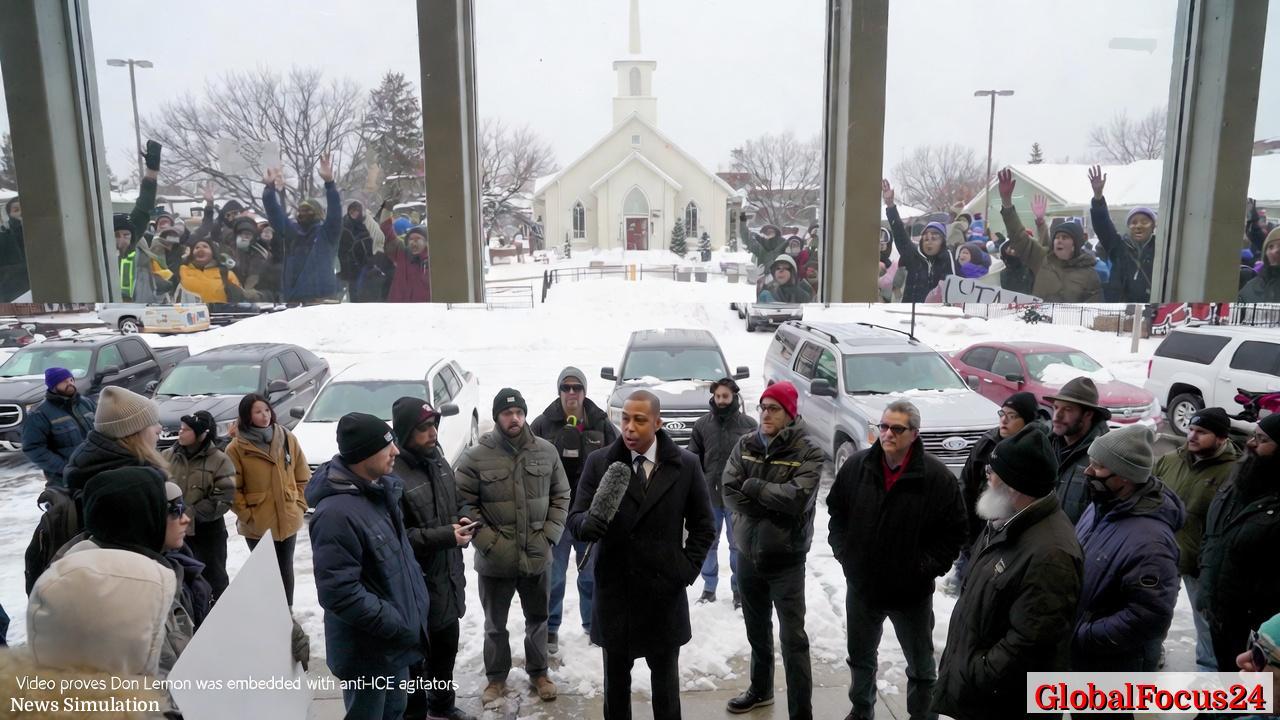
A newly surfaced video has reignited public debate over media impartiality after appearing to show television journalist Don Lemon embedded with anti-ICE activists prior to a disruptive protest at a local church. The footage, captured in snowy conditions outside the property, shows Lemon standing among demonstrators while holding a microphone and speaking to camera crews as tensions rose in the parking lot. Within the hour, activists entered the church, where congregants and protesters clashed verbally during a chaotic scene that drew nationwide attention.
Lemon has publicly denied having any affiliations or coordinating with the protest group. However, the video suggests proximity and possible real-time engagement with organizers, prompting questions about journalistic boundaries and the role of reporters covering politically charged demonstrations.
Background on the Anti-ICE Protests
The event unfolded amid an ongoing wave of protests targeting U.S. Immigration and Customs Enforcement (ICE), an agency that has been the focus of sustained activism over its immigration enforcement tactics. Demonstrations have grown increasingly confrontational over the past decade, particularly following incidents in cities where ICE conducted high-profile raids or detained undocumented migrants near places of worship.
Churches have historically played symbolic roles in such movements, often seen as sanctuaries for immigrant families seeking refuge. However, federal authorities emphasize that ICE’s enforcement practices fall within the bounds of federal law, even in religious spaces. The church involved in the incident had previously hosted prayer vigils and outreach programs supporting migrant communities, making it a focal point for advocacy—and, eventually, protest.
What the Footage Reveals
The newly circulated video, viewed widely across social media platforms over the weekend, shows Lemon standing near demonstrators in a snow-covered lot as organizers shout chants critical of ICE operations. Vehicles, signs, and protest materials are visible in the background. The footage indicates that Lemon was present during the buildup phase of the demonstration, speaking into a microphone as activists congregated before advancing toward the church entrance.
When protesters entered the building, cameras captured a vivid scene of raised hands, chanting, and confrontational exchanges between activists, parishioners, and security staff. The footage does not show Lemon inside the church during the altercation. Nonetheless, critics argue that his proximity and engagement outside blurred the line between observer and participant.
Lemon’s Response and Media Reaction
Lemon addressed the controversy early Monday, reiterating his denial of any involvement with activists. He stated that his presence was for journalistic purposes and that he was following standard newsgathering practice. “I was there to cover what was happening, not to participate in it,” Lemon said in a brief statement. “My job as a journalist is to witness and report.”
The statement did little to quell debate online. Media analysts are divided on whether coverage embedded with activist groups compromises neutrality or is an essential part of field reporting. Some point to historical precedents—such as journalists embedded with military units during the Iraq War or reporters covering civil rights marches in the 1960s—as examples where close access to subjects yielded fuller context. Others caution that such proximity risks undermining trust if audiences perceive alignment with one side.
Ethical Boundaries in Modern Reporting
The controversy underscores the evolving ethics of journalism in the digital era, where livestreams, social media clips, and unverified footage often blur distinctions between reporter and participant. Traditional newsroom guidelines emphasize independence and detachment, advising journalists to avoid situations where their presence could influence events. However, modern reporting demands have shifted, particularly in volatile or fast-moving protests where reporters must stay close to the action to provide timely coverage.
Experts argue that maintaining transparency about intent is key. “What matters is whether the journalist’s actions are clear to the audience,” said one media ethics professor. “If a reporter is there solely to document, that can be defensible. But if there’s coordination, that crosses an ethical line.”
Historical Context of Church and Immigration Protests
Throughout U.S. history, places of worship have been common stages for social advocacy and protest. In the 1980s, sanctuary movements across the Southwest sheltered Central American refugees fleeing civil wars. Religious leaders then, as now, framed their actions as moral obligations to protect the vulnerable, even as they risked federal obstruction charges.
In modern immigration debates, ICE-related demonstrations at churches recall those same tensions between moral resistance and legal enforcement. The 2019 and 2021 sanctuary incidents in California and New York saw large crowds gather at religious sites, prompting local police and federal agents to establish security perimeters after protests led to property damage and public disorder. Comparatively, the recent incident mirrored earlier ones in its scale and tone—peaceful intentions at the start that devolved into confrontation once crowds surged indoors.
Legal and Community Reaction
Local law enforcement confirmed that they responded to reports of trespassing and disorderly conduct after demonstrators entered the building but noted that no serious injuries occurred. Authorities did not indicate any arrests connected to the journalist seen on site. The church released a statement calling for “respectful engagement” and urging activists to pursue dialogue instead of disruption.
Community leaders expressed mixed reactions. Immigrant rights advocates defended the protesters’ motivations while condemning any disruptive or unsafe behavior. Longtime residents, meanwhile, described frustration that religious sanctuaries—traditionally viewed as neutral ground—had become scenes of political confrontation.
Public reactions on social media ranged from criticism of Lemon’s alleged involvement to calls for greater accountability in how reporters approach sensitive live events. Supporters of the journalist have emphasized the need for first-hand reporting and argued that visual proximity does not prove bias or complicity.
Economic and Social Impact
Beyond the immediate controversy, the episode carries broader implications for both local communities and the national conversation surrounding immigration enforcement. In regions where anti-ICE activism has intensified, businesses and municipal governments often record spikes in security costs, street closures, and temporary disruptions to community services.
For faith-based organizations, the fallout can include strained donor relationships and declining attendance as worshipers seek less politically charged environments. Economists studying civic stability note that even short-term disruptions can ripple across small communities, particularly where religious institutions play central roles in providing aid, education, and support networks.
Church administrators have also expressed concern that heightened tensions deter families, including immigrant congregants, from attending regular services. Some religious leaders have proposed regional mediation programs to prevent future confrontations, emphasizing cooperation between advocacy groups, law enforcement, and media outlets.
Comparisons with Other Regional Incidents
Similar patterns have appeared across the Midwest and New England, where wintertime demonstrations against ICE enforcement have intersected with local political activism. In Chicago and Boston, journalists covering such events have faced scrutiny over how embedded access influences public perception. While some reporters choose distant observation to maintain neutrality, others argue that immersion is vital for accuracy, especially when participants refuse to engage through formal interviews.
Analysts note that the current controversy mirrors earlier debates over activist-journalist overlap during the protests for racial justice in 2020, when footage often captured reporters moving amid crowds. Those cases sparked newsroom discussions about how safety, transparency, and ethics intersect in high-intensity environments.
The Broader Question of Trust in Journalism
Ultimately, the Lemon footage controversy comes amid a broader erosion of trust in media institutions. Surveys by independent research organizations show a steady decline in public confidence in news coverage of politically or socially sensitive topics. Critics attribute this decline to perceived bias and the blending of commentary with reporting.
Professional journalism associations continue to stress adherence to verification and detachment principles, even as new digital formats challenge old conventions. The rise of citizen journalism and unfiltered livestreams has put additional pressure on established reporters to demonstrate neutrality in real time.
Whether the video of Don Lemon reshapes public attitudes remains to be seen. However, it has provided a sharp illustration of the fine line journalists walk between access and advocacy. As audiences scrutinize who is standing beside whom in moments of civic tension, the incident serves as a reminder that credibility in news coverage depends not only on what is reported—but on where the reporter stands when the story unfolds.