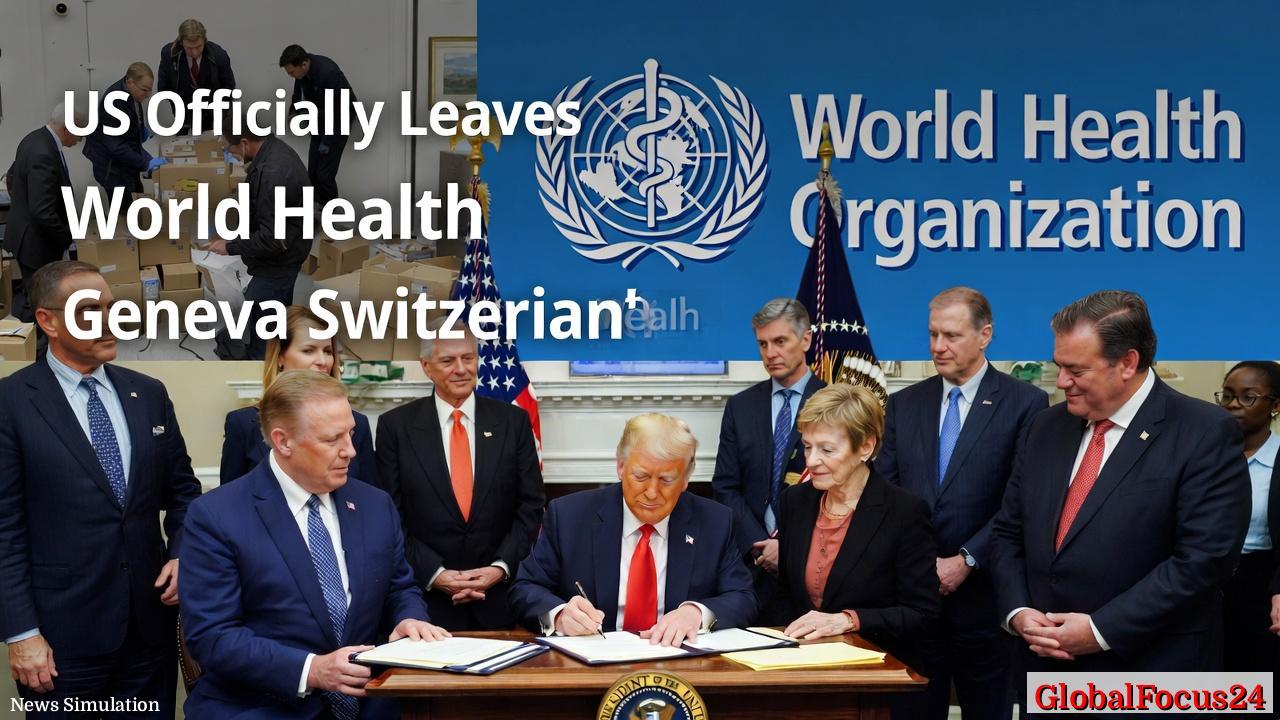
United States Officially Withdraws from World Health Organization
In a landmark move that reverberates through global health governance, the United States has formally withdrawn from the World Health Organization (WHO), severing decades of financial and strategic partnership that helped shape international public health responses. The decision marks a dramatic reorientation in health diplomacy and raises questions about how global health crises will be managed in a world where major powers diverge on multilateral institutions.
Historical context and the arc of U.S.–WHO relations
The United States has a long history of engagement with the WHO, dating back to the organization's founding in 1948. For decades, Washington contributed substantial funds to support the WHO’s efforts to combat infectious diseases, improve maternal and child health, and strengthen health systems in low- and middle-income countries. The collaboration helped catalyze critical programs, from polio eradication campaigns to responses to emerging outbreaks that crossed borders in an era of rapid travel and urbanization.
The pathway to withdrawal began in earnest during the COVID-19 era, when political leadership in the United States accused the WHO of being overly influenced by China and of mishandling pandemic information and guidance. Critics argued that the organization’s perceived missteps and delays magnified the global toll of the crisis, while supporters contended that the WHO faced extraordinary pressures and limited sovereignty of member states. In this environment, the administration issued an executive order a year ago to begin disengaging from the agency, setting in motion a process that culminated in formal withdrawal.
Economic impact and fiscal realignment
The financial repercussions of the withdrawal are substantial. The United States had been one of the WHO’s largest donors, and moving away from the organization has triggered a reallocation of public health resources and strategic funding priorities. The decision has implications for the organization’s ability to sustain programs such as polio eradication, HIV/AIDS treatment and prevention efforts, tuberculosis control, and maternal and child health initiatives. Analysts note that funding volatility can disrupt long-running programs, complicate planning cycles, and necessitate the redirection of staff and infrastructure toward bilateral arrangements and alternative international partnerships.
Withholding dues in 2024 and 2025—reported to total around $260 million—has already forced staff reductions and programmatic pauses within the WHO’s Geneva headquarters and regional offices. Legal experts have pointed to the likelihood that arrears will be settled in some form in the future, while officials in Washington have argued that no immediate obligation compels payment. The withdrawal, therefore, introduces a period of financial recalibration not only for the WHO but for partner governments and non-governmental organizations that relied on multilateral coordination.
Regional and global health dynamics
The withdrawal reshapes regional health governance in several ways. For many countries, multilateral institutions like the WHO provided a neutral platform for technical assistance, data sharing, and coordinated responses to outbreaks that transcended borders. In the absence of the United States as a formal participant, regional alliances and donor dynamics may shift toward other major funders and governance bodies. The resulting realignment could intensify competition for resources and influence, while also accelerating interest in bilateral cooperation that emphasizes national interests and mutual aid without an overarching multilateral framework.
Nevertheless, the world’s health landscape remains interconnected. Pathogens do not respect borders, and rapid information exchange on surveillance, laboratory capacity, and vaccine development remains critical. The withdrawal places added emphasis on transparency, rapid data sharing, and standardized protocols among states and non-state actors. Private foundations, non-governmental organizations, and academic researchers are likely to play increased roles in sustaining health initiatives that historically relied on broader international support.
Historical milestones that shape current expectations
Polio eradication stands as a defining success story for the international health regime that includes the WHO. The collaboration helped reduce polio incidence dramatically in multiple regions, bringing the world closer to eradication than ever before. HIV/AIDS programs, tuberculosis control, and maternal and child health initiatives have likewise benefited from coordinated global responses, technical guidelines, and cross-border vaccination campaigns. The organization’s leadership in global tobacco control—through the Framework Convention on Tobacco Control—illustrates how health policy has extended beyond clinical care to address social determinants of health and risk behaviors at scale. These achievements underscore why many health professionals view multilateral cooperation as essential to sustained progress.
In the wake of the COVID-19 pandemic, negotiations culminated in the drafting of a new global treaty designed to strengthen preparedness for future health emergencies, including equitable access to vaccines and treatments. The agreement, finalized last year, represents a collective effort to close gaps in financing, supply chains, and information sharing during crises. The United States’ decision to remain outside this framework signals a shift in how it envisions global crisis response and the distribution of health resources.
Public reaction and societal implications
Public sentiment surrounding the withdrawal has been mixed. Proponents argue that reasserting national sovereignty over health policy can foster more agile, domestically focused responses and reduce reliance on international institutions that may be perceived as hampered by consensus constraints. Critics warn that withdrawal could weaken the global health architecture, slow routine disease surveillance, and hinder rapid mobilization of resources when crises occur in regions with fragile health systems. Civil society organizations and healthcare professionals emphasize the need for continued collaboration through bilateral channels and non-governmental partnerships to mitigate potential gaps in coverage and to sustain progress on shared health goals.
Comparisons with other major economies
When evaluating how other large economies structure their involvement in international health governance, observers note a spectrum of approaches. Some countries maintain robust contributions to multilateral institutions alongside strong bilateral programs, aiming to balance global solidarity with national strategic interests. Others prioritize rapid bilateral cooperation and regional partnerships, seeking to enhance leverage in supply chains, vaccine distribution, and health data sharing without enduring commitments to a centralized global body. In this broader context, the United States’ withdrawal could prompt a reorganization of regional leadership roles and spur innovation in how health information is collected, analyzed, and disseminated across borders.
Operational prospects and future partnerships
Moving forward, Washington says it will pursue bilateral agreements with partner nations to support disease surveillance and pathogen information exchange. The administration also indicates a renewed emphasis on collaboration with non-governmental organizations, faith-based groups, and civil society to advance polio eradication and HIV control. The specifics of these partnerships remain to be disclosed, including funding levels, governance structures, and measurement of outcomes. The uncertainty surrounding participation in annual global flu vaccine development further underscores the complexity of transitioning from a multilateral framework to a mosaic of targeted initiatives.
While some observers anticipate a cycle of negotiation and renegotiation, others caution that the withdrawal could slow the momentum of ongoing global health efforts that rely on cross-border coordination. The coming months will likely reveal how the United States recalibrates its international health strategy, balancing national interests with the practical demands of a globally interconnected health ecosystem.
Legal and institutional considerations
From a legal standpoint, the withdrawal involves a complex set of procedures, including the cessation of dues and the disengagement of personnel and contractors from WHO headquarters in Geneva and regional offices. The administrative consequences extend to ongoing collaborative projects and data-sharing arrangements that have been cultivated over years. Institutional networks built through joint research, clinical trials, and policy development will need to be reexamined under new governance structures, with clear lines of accountability and performance indicators established for any ongoing engagements.
In the broader legal landscape, questions about treaty participation, intellectual property, and regulatory harmonization across borders will require careful navigation. Governments, international organizations, and the private sector will likely engage in dialogues to ensure continuity of essential health services, stockpiling of critical medicines, and maintenance of surveillance capabilities that are vital for early outbreak detection and rapid response.
Public health infrastructure and resilience
The resilience of national health systems remains a focal point for policymakers and health professionals. The withdrawal places greater emphasis on building robust domestic capabilities for disease detection, laboratory capacity, and health workforce development. Investments in digital health infrastructure, data analytics, and interoperable health information systems will be essential to sustain high-quality public health oversight absent a central international coordinating authority. Equitable access to vaccines, therapeutics, and diagnostics will continue to be a central concern, particularly for low- and middle-income countries that depend on pooled procurement and global equity mechanisms.
Conclusion
The United States’ formal withdrawal from the World Health Organization marks a defining moment in contemporary global health governance. While supporters of the decision emphasize renewed national sovereignty and flexibility in crisis management, critics warn of the risks to global solidarity, data sharing, and rapid response capabilities. The situation will unfold across a complex landscape of bilateral agreements, regional partnerships, and non-governmental collaborations that seek to fill the space left by a direct multilateral relationship.
As the international community monitors the implications for ongoing health initiatives, researchers, policymakers, and public health practitioners will be watching closely how funding streams, governance structures, and operational priorities adapt in a world where cross-border health threats demand coordinated attention more than ever. The coming months will reveal how effectively nations can maintain momentum in disease surveillance, vaccine distribution, and pathogen information sharing in the absence of a major multilateral participant that has long played a central role in shaping global health outcomes.