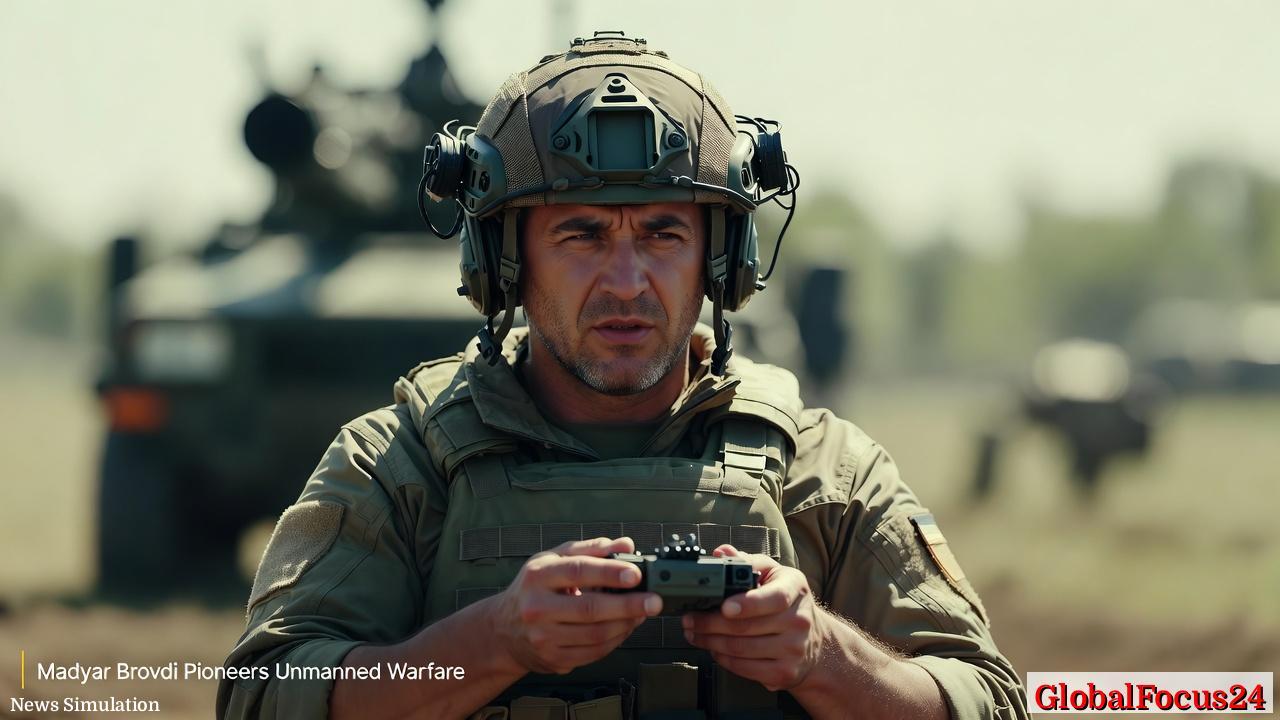
Ukraine’s Drone Commander “Madyar” Brovdi Rewrites Modern Warfare as Russia Faces Relentless Attrition
A New Era of Unmanned Conflict
On the war-scarred plains of eastern Ukraine, drone engines hum above shattered treelines and ruined villages, heralding a revolution in modern combat. At the forefront stands Colonel Robert “Madyar” Brovdi, Ukraine’s top drone commander, whose integrated network of unmanned aircraft has transformed the way Kyiv fights a larger, better-armed opponent.
Once an entrepreneur and volunteer drone operator, Brovdi is now leading some of Ukraine’s most advanced units in the field, executing tactics that military analysts describe as reshaping battlefield doctrine worldwide. His strategy — attritional drone warfare designed to erode Russian strength gradually — has drawn attention across NATO capitals, many of which acknowledge that Ukraine’s battlefield innovations have often outpaced Western military thinking.
The Commander Behind the Machines
Known for his call sign “Madyar,” a nod to his Hungarian roots, Brovdi operates at the intersection of technology, improvisation, and frontline necessity. He commands units under Ukraine’s Main Intelligence Directorate and works closely with volunteer drone battalions that have evolved from small, improvised teams into formalized, technology-driven assault groups.
Rather than relying solely on frontline assaults or heavy artillery barrages, Brovdi’s forces deploy modular fleets of first-person-view (FPV) drones customized for specific missions. From anti-armor strikes to aerial reconnaissance, his teams leverage autonomous and semi-autonomous drones for sustained pressure against entrenched Russian positions. This constant aerial harassment, often described by soldiers as a “drone storm,” disrupts supply routes and keeps Russian units under near-continuous threat.
The Strategy of Attrition
Brovdi’s doctrine is one of endurance rather than immediate conquest. By inflicting steady attrition — destroying vehicles, draining ammunition reserves, and demoralizing enemy infantry — he aims to wear down Russian forces over months rather than days. Ukrainian analysts have referred to the approach as “micro-attrition,” where smaller, cost-effective drones deliver outsized effects against costly Russian equipment such as tanks and self-propelled artillery.
The success of this strategy lies in its economy. FPV drones typically cost a fraction of a single artillery shell or missile, yet can destroy multimillion-dollar armored vehicles. Ukraine manufactures many of these drones domestically or through volunteer networks, giving it an advantage in both scalability and sustainability. With relatively low production costs and rapid turnaround, Brovdi’s units can maintain a tempo that Russia struggles to counter, forcing Moscow to spend significantly more on defense than Ukraine invests in offense.
Lessons NATO Is Still Learning
While Ukraine’s Western allies supply advanced systems such as long-range missiles and surveillance drones, Brovdi’s homegrown tactics represent an asymmetric model that even NATO planners are now studying carefully. His use of distributed drone swarms, real-time battlefield data sharing, and digital coordination platforms has provided a live laboratory for modern warfare.
NATO’s own drone programs remain highly centralized and technologically complex — ideal for large-scale operations but less adaptable to fast-changing battlefield conditions. Ukraine’s bottom-up model, by contrast, emphasizes flexibility and speed. Operators often modify commercial drones on-site, adjusting payloads or navigation software within minutes. For the Ukrainian military, this hands-on adaptability has become one of its most formidable weapons.
Military researchers in the United States, the United Kingdom, and Poland have acknowledged that Ukraine’s wartime experimentation is likely to influence future NATO doctrine. Some suggest that Brovdi’s operational model could become a blueprint for small-unit autonomy in future conflicts, where soldiers, supported by AI-assisted drones, act independently within a larger strategic network.
Historical Context: From Reconnaissance to Weaponization
Drones have long played a supporting role in global militaries, but Ukraine’s rapid weaponization of unmanned systems marks a historical shift similar to the introduction of artillery in the 19th century or tanks in World War I. When Russia launched its full-scale invasion in 2022, Ukraine’s drone program was largely composed of civilian enthusiasts and improvised workshops. Within two years, that informal network evolved into a massive military-industry hybrid producing thousands of drones per month.
This transformation recalls moments in history when necessity sparked technological revolutions — such as Britain’s radar program during World War II or Israel’s development of precision munitions in the 1970s. Ukraine’s civilian technology sector, honed by a decade of innovation and digital entrepreneurship, laid the groundwork for this rapid militarization. Companies and volunteers collaborated directly with military units, merging software engineering with combat experience in real time.
Economic and Industrial Impact
The economic implications of Brovdi’s drone doctrine extend far beyond the frontline. Ukraine’s domestic drone industry has become a pillar of wartime resilience, sustaining jobs and attracting investment even amid economic contraction. Thousands of workers, from engineers to 3D printing technicians, contribute to a decentralized production network that keeps the supply chain active despite Russian missile strikes on infrastructure.
According to government data, Ukraine produced several hundred thousand drones in 2025, and output continues to grow. Local manufacturing clusters have emerged in regions such as Lviv, Dnipro, and Kyiv, creating a diverse ecosystem of suppliers and innovators. The government’s “Army of Drones” program serves as the central hub, coordinating private and military procurement and funding R&D projects with a focus on affordability and rapid field deployment.
In contrast, Russia has relied heavily on Iranian imports and state factories to produce its Shahed and Lancet models, limiting its flexibility. The decentralized efficiency of Ukraine’s model not only strengthens its military capacities but also stimulates technological development that could endure beyond the war, potentially making Ukraine a major global hub for unmanned systems in the future.
Regional Comparisons: Lessons for Europe and Beyond
Across Eastern and Central Europe, defense planners are watching closely. Poland and the Baltic states have launched initiatives to replicate aspects of Ukraine’s drone warfare model, investing in smaller, modular production sites and flexible procurement policies. By contrast, Western Europe remains tied to defense industry giants and longer production cycles.
The Ukrainian experience has underscored a key lesson for regional security: technological agility can offset numeric inferiority. Countries with limited defense budgets can now develop effective deterrents by adopting Ukraine’s asymmetric approach — combining local innovation with real-time battlefield adaptation.
Even outside Europe, militaries in Asia and the Middle East are studying Ukraine’s tactics. From Taiwan to Israel, defense analysts cite Brovdi’s methods as an example of how small-scale drone swarms and electronic warfare integration can help counter conventional military advantages.
The Human Dimension of the Drone War
Behind the technology lies a deeply human struggle. Brovdi’s drone operators, often young men and women from civilian tech backgrounds, face immense psychological pressure. They watch battles unfold live through camera feeds, guiding drones toward enemy positions with precision that leaves little room for error. For many, this close yet distant form of combat blurs the line between operator and frontline soldier.
Ukrainian commanders have begun integrating mental health support and rotation systems to prevent burnout among drone pilots, acknowledging the emotional toll of continuous remote combat. Each lost drone represents not only destroyed equipment but also a soldier’s shattered creation — a connection that lends the war a personal dimension unseen in traditional artillery duels.
The Future of Unmanned Warfare
As the conflict grinds through its fourth year, Brovdi’s tactical innovations continue to evolve. New efforts focus on AI coordination, allowing multiple drones to navigate and attack targets collectively without direct human control. Autonomous navigation, powered by computer vision and battlefield mapping algorithms, enables drones to operate even when GPS signals are jammed — a frequent challenge due to Russian electronic warfare.
These developments hint at a future where unmanned systems act as fully integrated components of digital war networks. Rather than serving as auxiliaries, drones could become the backbone of entire operational doctrines. Analysts predict that air superiority will no longer depend solely on manned aircraft but on real-time aerial swarms capable of overwhelming air defenses through sheer coordination and persistence.
A War Laboratory for the 21st Century
Ukraine’s battlefields now serve as an open-air testing ground for military innovation, where theory meets reality daily. Within this environment, Madyar Brovdi has emerged not only as a commander but as a symbol of adaptation in the face of overwhelming odds. While NATO and other global powers continue to study and integrate these lessons, Ukraine remains a step ahead — driven by necessity, creativity, and the uncompromising will to survive.
The legacy of Brovdi’s drone warfare may reach far beyond the ongoing conflict. It is redefining what military power means in the 21st century, proving that technological improvisation and strategic endurance can rewrite the dynamics of war. As Ukraine’s drones continue to fly undeterred across the contested sky, their buzz signals more than an immediate threat to Russian trenches — it marks the dawn of an entirely new era in global defense.