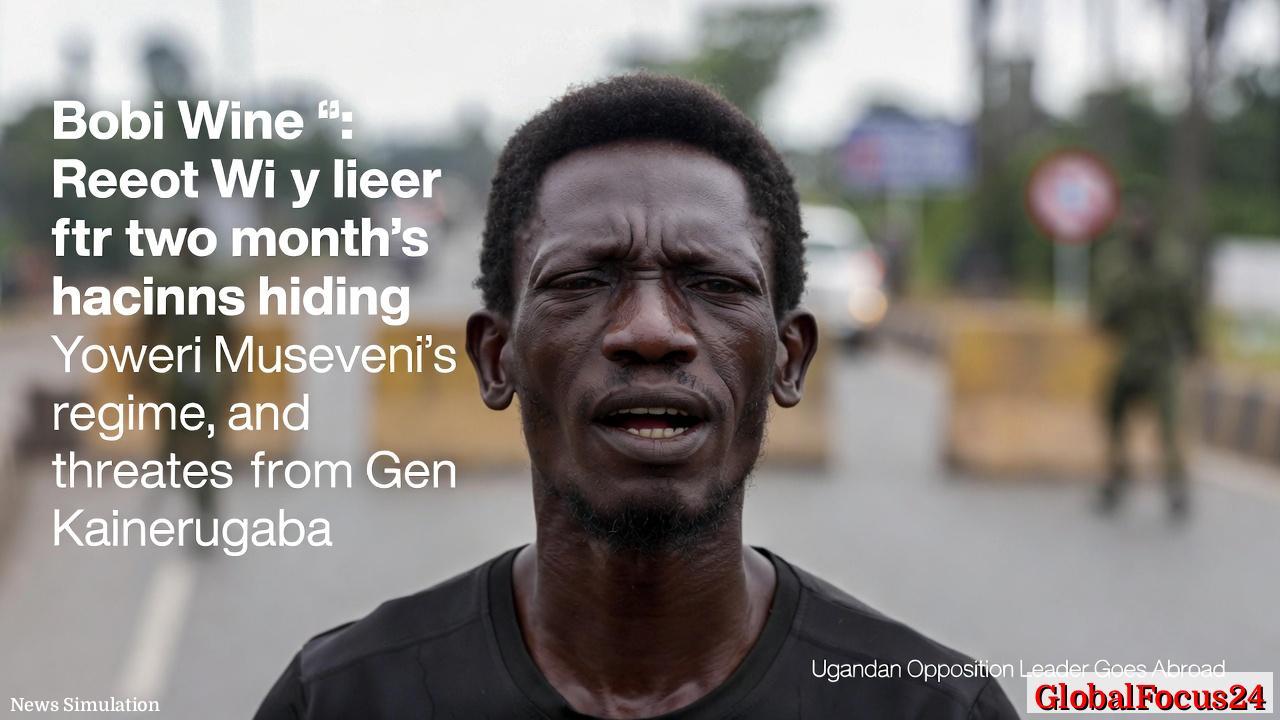
Ugandan Opposition Leader Bobi Wine Flees Country After Two Months in Hiding
A Dramatic Escape Amid Political Tension
Ugandan opposition leader Bobi Wine has fled the country following two months in hiding, citing an imminent threat to his life after January’s disputed presidential election. The 44-year-old, whose real name is Robert Kyagulanyi Ssentamu, described his departure as a measure of last resort, saying he faced relentless persecution by the government of President Yoweri Museveni.
Wine, a former pop star turned politician, accused the authorities of orchestrating a campaign to eliminate him, alleging that the security forces had orders to capture or kill him. His supporters reportedly provided him with shelter, food, and basic necessities while he evaded arrest. His departure marks the latest chapter in Uganda’s complex political landscape, where challenges to Museveni’s four-decade rule have repeatedly been met with repression.
The Election That Sparked a Crisis
Uganda’s presidential election in January was one of the most highly contested in recent years. Official results declared Museveni, 81, the winner with 72% of the vote, extending his tenure that began in 1986. The National Electoral Commission dismissed opposition complaints, calling the election fair and transparent. However, Wine and his National Unity Platform (NUP) alleged widespread irregularities — including ballot stuffing, intimidation at polling stations, and an internet blackout that lasted several days.
Observers from several African nations noted that while the voting process appeared orderly in some regions, opposition strongholds experienced heavy military presence. The events mirrored previous elections in Uganda where opposition figures, such as Kizza Besigye in the early 2000s, also faced arrests and allegations of intimidation during campaigns.
Life Underground: Fear and Defiance
During his two months underground, Wine said he lived in constant fear of discovery. According to his statements, the president’s son, General Muhoozi Kainerugaba, publicly labelled him “wanted dead or alive” and threatened him in social media posts that were later deleted. Wine claimed these threats reflected the regime’s broader intent to silence dissent through force.
His accounts describe a network of loyal supporters who secretly rotated his location to evade state surveillance. Wine said food and hygiene supplies were passed through intermediaries, while his communications were tightly guarded to protect his associates. Despite the uncertainty, he continued releasing recorded statements online, calling for nonviolent resistance and urging international allies to pressure Museveni’s government for accountability.
The Role of the Army and Security Forces
Uganda’s security forces have long played a decisive role in maintaining state power. Museveni, himself a former guerrilla commander, has relied heavily on military structures to suppress political opposition. Reports from the past decade show recurring instances of armed personnel patrolling opposition rallies, detaining activists, and dispersing protests with tear gas and rubber bullets.
After the January election, General Kainerugaba, who commands the army, claimed that 30 “terrorists” allegedly associated with Wine’s movement had been killed. Government spokespeople later downplayed those comments but did not deny security operations targeting opposition figures. Analysts note that Uganda’s security strategy reflects a pattern seen in several African nations where ruling parties justify crackdowns as counter-terrorism measures.
Family in Exile and Party Leadership in Peril
Wine’s family left Uganda before his escape, an acknowledgment of escalating danger. He declined to reveal how or when he fled, citing safety concerns for those who helped him. In a public statement, he named his deputy, Lina Zedriga, as acting leader of the National Unity Platform and urged her to maintain the party’s organizational structures inside Uganda.
Zedriga, a lawyer and rights activist, faces significant risks as the authorities continue to monitor NUP activities. Several party officials have reportedly been detained or interrogated in recent weeks. Wine’s residence in Kampala remains surrounded by soldiers, according to witnesses in the capital’s Magere suburb. His departure has left many of his followers demoralized but also galvanized, as online movements amplify calls for international intervention.
Historical Context: Museveni’s Enduring Rule
President Yoweri Museveni’s tenure is one of the longest in Africa. Coming to power in 1986 after a five-year insurgency, he was initially hailed as a reformer for restoring stability following the turbulent regimes of Idi Amin and Milton Obote. Over time, however, his administration has faced mounting criticism for restricting political freedoms and allowing corruption to flourish.
Since Uganda’s return to multiparty politics in 2005, opposition figures have faced persistent barriers ranging from police brutality to opaque electoral regulations. Constitutional amendments in 2005 and 2017 removed term and age limits, allowing Museveni to extend his rule indefinitely. His current term, if completed, would mark 45 consecutive years in power — a near-record on the continent.
Political observers draw parallels between Uganda and countries such as Zimbabwe under Robert Mugabe and Cameroon under Paul Biya, where aging leaders remained entrenched through tight control of state institutions. In all cases, opposition figures faced similar patterns of intimidation, curtailed media coverage, and manipulated legal systems.
Economic and Social Ramifications
Uganda’s political instability carries significant economic consequences. The nation’s $45 billion economy depends largely on agriculture, manufacturing, and remittances from abroad. Periodic unrest discourages foreign investment and disrupts tourism, one of Uganda’s most important income sources.
Following the disputed elections, business confidence has waned. Data from the Bank of Uganda indicates slower growth projections this year, fueled by uncertainty over political continuity and international pressure. Western nations, particularly the European Union and the United States, have previously expressed concern over human rights abuses, occasionally imposing aid restrictions or reviewing trade agreements.
Local traders report declining sales during security crackdowns, especially in urban centers like Kampala and Jinja, where roadblocks and curfews have limited commerce. Ugandan youth — who make up more than 70% of the population — express growing frustration at the lack of job opportunities and rising living costs. Support for Wine among younger demographics stems in large part from his message of economic reform and generational change.
Public Reaction and International Response
Reaction to Wine’s flight has been mixed. His supporters describe it as a necessary step to preserve his life and leadership, while government officials accuse him of spreading falsehoods to attract foreign sympathy. Social media platforms across East Africa have lit up with messages of solidarity, many under the hashtags calling for justice and democracy.
Internationally, rights organizations have urged investigations into alleged abuses against opposition figures. Western diplomats in Kampala, including representatives of the European Union, have called for restraint and respect for political freedoms. Still, tangible foreign action remains limited, as many nations maintain security cooperation with Uganda on regional counterterrorism efforts.
Wine himself has called for targeted international sanctions against Museveni’s inner circle, echoing measures once used against leaders in Sudan and Zimbabwe. It remains unclear whether such calls will gain momentum, though past precedents suggest external pressure alone seldom achieves democratic transition without domestic grassroots persistence.
Lessons from Regional Neighbors
Uganda’s predicament resembles challenges seen in neighboring states navigating post-liberation politics. In Rwanda, Paul Kagame has maintained power through a tightly centralized system justified by national security concerns. In Tanzania, opposition leaders have recently experienced increased tolerance after a period of repression, offering a contrasting path toward reconciliation. Kenya’s experience with contested elections and power-sharing agreements demonstrates another model for diffusing political tension without long-term authoritarian entrenchment.
For Uganda, analysts argue that genuine reform would require revisiting the role of the military in governance, reestablishing judicial independence, and upholding press freedom — areas where little progress has been made since the early 2000s. The National Unity Platform’s ability to survive this setback could determine the future of opposition politics in the country.
The Uncertain Road Ahead
Bobi Wine’s future remains uncertain. In exile, he promises to return “soon,” asserting that seeking the presidency is not a crime. Yet history offers sobering examples: many African opposition leaders who fled under similar circumstances struggled to regain influence once outside their countries.
For now, Wine’s flight underscores a broader truth — Uganda’s political balance is under strain. The government’s ongoing efforts to suppress dissent reveal a regime increasingly reliant on coercion to maintain control. Whether this marks the beginning of a new wave of resistance or the consolidation of Museveni’s enduring rule will depend on how Ugandans at home and abroad navigate the fragile moment unfolding before them.