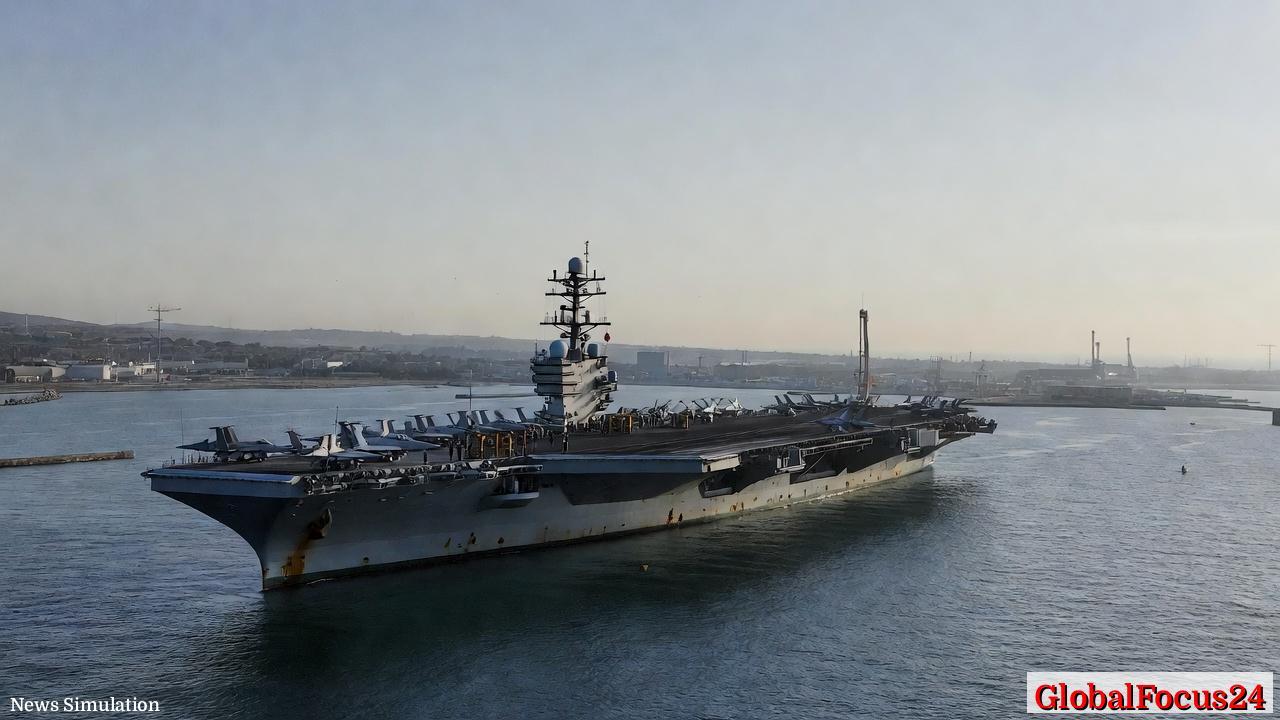
USS Gerald R. Ford Arrives Off Israel’s Northern Coast Amid Regional Tensions
The USS Gerald R. Ford, the world’s largest and most advanced aircraft carrier, arrived off Israel’s northern coast on Friday in a move that has drawn global attention amid heightened tensions in the eastern Mediterranean. The nuclear-powered carrier, accompanied by its strike group, was spotted near Haifa port after departing Souda Bay on the Greek island of Crete on Thursday following a brief resupply stop. Its arrival marks another significant U.S. naval deployment to the region at a time of renewed security volatility and shifting strategic alignments.
A Modern Symbol of Maritime Power
Commissioned into active service in 2017, the USS Gerald R. Ford (CVN-78) represents the first of a new generation of U.S. supercarriers. It displaces more than 100,000 tons and stretches over 1,092 feet in length, capable of carrying more than 75 aircraft, including F/A-18E/F Super Hornets, EA-18G Growlers, and E-2D Advanced Hawkeyes. Crewed by more than 4,500 sailors, the vessel embodies the pinnacle of modern naval engineering — integrating advanced radar systems, electromagnetic aircraft launch technology, and improved power generation for future weapons systems.
Its presence off Israel’s coast underscores the enduring strategic value of carrier power projection in maintaining stability and deterrence across critical waterways. The Gerald R. Ford Carrier Strike Group is likely engaged in regional operations and exercises intended to signal readiness and ensure maritime freedom in the Eastern Mediterranean, where NATO allies and regional actors continue to navigate a complex web of competing interests.
Strategic Timing and Regional Context
The timing of the Gerald R. Ford’s arrival carries strategic significance. In recent months, maritime security in the Mediterranean has faced renewed challenges due to the spillover effects of regional conflicts and global trade disruptions. The Eastern Mediterranean, long a crossroads between Europe, North Africa, and the Middle East, has gained new importance as an energy corridor following expanded natural gas discoveries along Israel’s coast and in Cypriot waters.
Israel has grown closer in recent years to Mediterranean allies such as Greece and Cyprus, strengthening defense cooperation and hosting regular joint naval drills. The Gerald R. Ford’s docking near Haifa — a primary base for the Israeli Navy — reinforces these existing ties and reflects the United States’ continued commitment to ensuring open sea routes and regional stability.
Defense analysts note that the carrier’s deployment follows an uptick in regional tensions and naval movements, with multiple nations increasing their maritime presence. Its visit, while routine in a military sense, carries strong symbolic weight: it signals both support and deterrence, projecting assurance to allies and caution to adversaries.
Historical Background: A Legacy of U.S.-Israeli Naval Cooperation
The sight of an American aircraft carrier off Israel’s coast is not unprecedented. U.S. Navy vessels have routinely visited Haifa over past decades, particularly during periods of regional instability. During the Cold War, U.S. carriers frequently patrolled the Mediterranean to balance Soviet influence and maintain NATO’s southern flank.
In the early 2000s, visits by the USS Harry S. Truman and the USS Dwight D. Eisenhower reinforced joint training operations and logistical cooperation between the U.S. 6th Fleet and Israel’s naval command. However, the Gerald R. Ford represents a new scale of technological sophistication and power, reflecting how the United States continues to adapt its naval posture to modern security demands and advanced threat environments.
The arrival of a ship named after President Gerald R. Ford — a former U.S. Navy officer himself — adds a layer of historical resonance, linking America’s naval traditions with current missions in defense of maritime stability.
Economic Dimensions of Naval Deployment
Beyond its military symbolism, the presence of the Gerald R. Ford carrier strike group bears economic implications for the broader region. The Eastern Mediterranean has become a critical conduit for energy trade, especially since discoveries in the Leviathan and Tamar gas fields off Israel’s coast. The protection of these maritime assets, alongside neighboring offshore installations, has become a top strategic priority not only for Israel but also for global energy markets reliant on steady supply routes.
Port cities like Haifa benefit directly from such visits through local service contracts, resupply needs, and logistical coordination. Each carrier deployment can inject millions of dollars into local economies, from port operations and hospitality services to technical maintenance and supply chain logistics. U.S. Navy personnel often engage in rest-and-replenishment stops that offer economic boosts to allied ports in the region.
Regionally, the carrier’s presence contributes to broader confidence in maritime trade security. This assurance can stabilize shipping insurance rates and reduce perceived risk for international operators navigating Mediterranean routes — an important factor as companies respond to instability in other chokepoints such as the Red Sea and Suez Canal.
Technological Superiority and Strategic Flexibility
The Gerald R. Ford’s presence also showcases the U.S. Navy’s evolving doctrine centered on distributed lethality and rapid response. Its electromagnetic catapult launch system (EMALS) and advanced arresting gear (AAG) replace decades-old steam systems, allowing faster, more reliable flight operations while reducing maintenance costs. The ship’s increased electrical generation capacity—three times greater than that of a Nimitz-class carrier—prepares it to integrate emerging weaponry, including directed-energy systems and advanced radar suites.
Such technological upgrades reflect a broader strategic shift toward flexibility in theatre operations. As U.S. Navy planners reorient toward multi-domain deterrence, including cyber and space-enabled systems, the Gerald R. Ford serves as both a platform for innovation and a mobile command hub capable of coordinating multinational missions.
In the Mediterranean context, this capability allows the strike group to conduct complex operations that integrate air, sea, and subsurface assets, supporting allied exercises or responding to evolving crises. Its modern communication infrastructure enables interoperability with regional partners, allowing real-time coordination during joint missions or humanitarian responses.
Regional Comparisons and Security Dynamics
While the United States remains the dominant naval power in the Mediterranean, several regional actors have increased their maritime activity. Turkey continues to assert its naval presence across the Aegean and Eastern Mediterranean, integrating its own indigenous frigates and drone technology into fleet operations. Egypt, leveraging its control of the Suez Canal, has expanded its naval capacity and deepened cooperation with European forces through joint drills.
Against this backdrop, the Gerald R. Ford’s presence off Israel’s coast highlights a broader strategic balancing act — ensuring that U.S. and allied interests remain safeguarded as new military and commercial dynamics reshape the region. The Eastern Mediterranean now sits at the intersection of energy politics, global shipping routes, and regional security challenges extending from North Africa to the Levant.
Compared with previous U.S. carriers deployed to the area, the Gerald R. Ford’s entry signals a deliberate message of technological superiority and sustained engagement. Its advanced strike group composition — including destroyers, support ships, and submarines — enables a versatile, layered defense posture capable of responding to a range of contingencies, from search-and-rescue operations to air defense coordination.
Local Reactions and International Observations
News of the carrier’s arrival spread quickly along Israel’s northern coast, where residents near Haifa could see the vast outline of the ship from shore. Local media reported a mix of curiosity and pride, noting the long history of cooperation between U.S. and Israeli forces. Defense officials in Tel Aviv described the visit as part of ongoing coordination with allied navies in maintaining regional readiness.
International observers have interpreted the deployment as a measured but clear strategic signal. Maritime watchers in Greece, Cyprus, and Egypt have noted that such maneuvers often coincide with multinational exercises aimed at enhancing interoperability among NATO and partner states. While military officials did not announce any particular exercise associated with the Gerald R. Ford’s presence, analysts suggest it could serve both training and deterrent functions as part of broader Mediterranean operations.
Conclusion: A Strategic Anchor in a Shifting Sea
The USS Gerald R. Ford’s stationing off Israel’s northern coast represents more than a routine naval stop — it stands as a potent reminder of how maritime power continues to shape regional balance in an era of global uncertainty. As conflicts, trade routes, and energy priorities converge across the Eastern Mediterranean, the forward deployment of the world’s most advanced aircraft carrier reinforces both deterrence and cooperation.
In the coming days, the carrier strike group is expected to continue operations in coordination with allied commands before repositioning for the next phase of its deployment. Whether viewed from Haifa’s harbor or across the expanse of blue stretching toward Cyprus and Crete, the massive presence of the USS Gerald R. Ford underscores an enduring truth of maritime strategy: control of the seas remains central to stability, commerce, and security in one of the world’s most strategically charged regions.