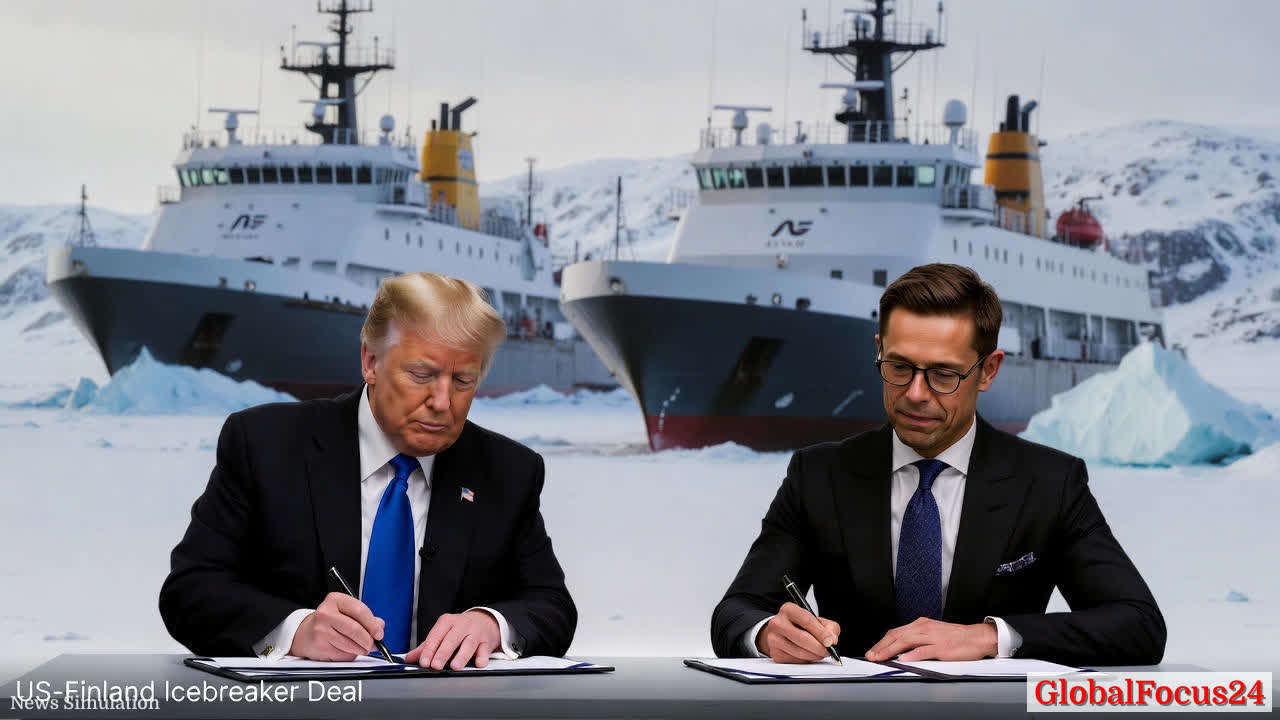
US Fortifies Arctic Presence with Finnish Icebreaker pact amid growing Polar Competition
In a high-stakes move to expand its Arctic capabilities, the United States has struck a landmark agreement with Finland to acquire up to four state-of-the-art polar icebreakers. Valued at approximately $6.1 billion, the deal represents a concerted effort to close a pronounced capability gap as geopolitical and economic interest in the Arctic intensifies. The strategic collaboration draws on Finland’s renowned shipbuilding expertise, aiming to bolster the U.S. Coast Guard’s ability to operate across ice-choked seas and to sustain missions in defense, research, and search-and-rescue roles.
Historical context sets the stage for today’s Arctic push. The region has long been a theater of strategic competition among major powers, with icebreakers serving as mobile platforms for sovereignty, safety, and scientific inquiry. The United States, historically a late entrant in the Arctic icebreaker race, has faced aging, maintenance-heavy vessels that constrain year-round operations. In contrast, Russia operates a sizable, and increasingly modernized, fleet—including nuclear-powered and weaponized icebreakers—that enables robust control of critical routes such as the Northern Sea Route. China has positioned itself as a “near-Arctic” power, expanding its presence through icebreakers, research vessels, and joint exercises that underscore its intent to diversify Arctic access and influence.
The core objective of this bilateral partnership is clarity and readiness. The icebreakers, each roughly 360 feet long, are designed to slice through three feet of thick ice at speeds around three knots, with a formidable range of approximately 12,000 nautical miles and endurance exceeding 60 days without resupply. They will incorporate flight decks and hangars for helicopters, extending operational reach for defense, law enforcement, environmental monitoring, and humanitarian missions. A key feature of the agreement is technology transfer, enabling U.S. shipyards to assume subsequent construction and procurement activities—an important step toward domestic capability growth and workforce development in the American maritime industry.
Economic impact and industrial spillovers are central to assessing the project’s broader significance. The initial contract amount, pegged at $6.1 billion, is expected to ripple through Finnish shipyards and associated suppliers, supporting jobs and sustaining advanced manufacturing capabilities. The initiative sits within a broader fiscal realignment that has seen considerable investments in polar capabilities, including a near $9 billion allocation for new icebreaker construction in recent years. The infusion of capital is anticipated to stimulate regional economies, particularly in coastal and northern communities tied to Arctic infrastructure and deployment readiness. In Alaska, new homeporting facilities, port enhancements, and maintenance facilities are poised to benefit from increased activity and steady employment, anchored by a longer, more capable icebreaker presence in U.S. waters.
Regional comparisons illuminate the scale of the Arctic muscularity race. Russia’s fleet, long the benchmark for polar mobility, comprises more than 40 icebreakers, with many nuclear-powered and configured for dual-use roles that combine scientific missions with strategic signaling. This breadth and power provide Moscow with an established ability to navigate and secure Arctic corridors, underpinning its asserts in resource-rich maritime zones. China’s evolving Arctic footprint includes four active icebreakers and a fifth under construction, reflecting a strategic trajectory toward greater polar engagement and capability. Beijing’s emphasis on dual-use technology and scientific collaboration signals an intent to shape Arctic norms and infrastructure in the longer term.
Against this backdrop, the United States seeks to recalibrate its polar posture. The current U.S. Coast Guard icebreaker fleet has been described as under-resourced for full Arctic and Antarctic demands. The three primary vessels—the venerable Polar Star, the Healy, and the newly integrated Storis—have faced mechanical issues, limited endurance, and high maintenance costs. Experts have argued for a fleet of eight to nine icebreakers to ensure consistent coverage of both polar regions, including the critical sea lanes that underpin international commerce and regional security. The new Finnish-build icebreakers are expected to help bridge that gap, expanding the service’s capacity to perform law enforcement, search and rescue, environmental monitoring, and disaster response in cold weather and heavy ice conditions.
Strategic implications extend beyond the immediate operational footprint. A stronger Arctic presence supports continuity of maritime traffic, safety at sea, and the enforcement of laws governing polar zones. It also has a diplomatic dimension, signaling alignment with allies and partners as growing activity from non-Arctic powers raises questions about access, governance, and the management of burgeoning resources. The ICE Pact, described in some quarters as a trilateral framework, underscores cooperative patterns with nations that share interests in safeguarding navigation routes, monitoring environmental changes, and advancing scientific discovery in the Arctic and sub-Arctic regions.
Technology transfer and domestic industrialization represent a central axis of the agreement’s long-term vision. The prospect of building additional vessels within U.S. shipyards promises to bolster American shipbuilding capabilities, create skilled employment opportunities, and foster resilience in critical supply chains. The integration of advanced materials, propulsion systems, and ice-cutting technologies is anticipated to yield spillover benefits for related maritime sectors, including offshore energy, maritime security, and environmental monitoring. While the initial delivery timeline targets three years for the first ships, planners emphasize a staged approach to ensure rigorous testing, training, and certification before full operational deployment.
Public reception to the Arctic expansion has been a blend of measured caution and strategic optimism. Supporters highlight the necessity of safeguarding national sovereignty and ensuring freedom of navigation through increasingly contested polar routes. They point to the Arctic’s wealth in hydrocarbons, minerals, and rare earth elements as a motivating factor for sustained research, responsible resource development, and critical infrastructure modernization. Critics, meanwhile, advocate for heightened attention to environmental stewardship, the rights of indigenous communities, and the potential risks associated with expanding militarization in a fragile, rapidly changing ecosystem. The dialogue surrounding the project reflects a broader conversation about balancing security objectives with responsible governance and sustainable development.
Operational forecasts suggest that the enhanced icebreaker fleet will be deployed to protect vital maritime corridors, support scientific missions, and respond to emergencies across the Arctic and Antarctic theaters. The multi-mission design—encompassing defense, search and rescue, law enforcement, and environmental monitoring—positions the United States to project power where sea ice conditions demand robust, reliable capability. At the same time, the strategic emphasis on collaboration with allied partners reinforces a shared approach to polar governance, data sharing, and capacity building, which are critical components of any long-term Arctic strategy.
The Arctic environment itself is undergoing rapid transformation, driven in part by climate change and evolving ocean dynamics. As sea ice retreats in certain seasons, new commercial routes emerge, bringing opportunities for faster global trade but also increasing the potential for maritime disputes and environmental risks. The United States’ investment in icebreaking capacity is intertwined with the broader imperative to monitor, protect, and responsibly manage Arctic waterways, ensuring that navigation remains safe and that environmental regimes are upheld. The interplay between economic development, regional security, and ecological health will shape policy debates in the coming years as governments navigate the complexities of Arctic governance.
In summary, the Finnish icebreaker agreement marks a pivotal milestone in the United States’ pursuit of a more robust Arctic presence. By combining Finnish engineering expertise with American shipbuilding capabilities, the arrangement aims to deliver a modern, capable, and flexible fleet that can operate across demanding ice conditions, extend mission reach, and support a wide spectrum of operations. The initiative aligns with broader strategic objectives to secure critical sea lanes, deter destabilizing activities, and ensure that Arctic futures are managed with a focus on safety, stability, and sustainable development. As delivery timelines unfold and additional collaborations mature, observers will watch how this partnership influences regional dynamics, alliance commitments, and the ongoing evolution of polar policy in a rapidly changing world.