Western Intelligence Warnings Ignored Before Russia’s 2022 Invasion of Ukraine
A Clear Warning That Went Unheeded
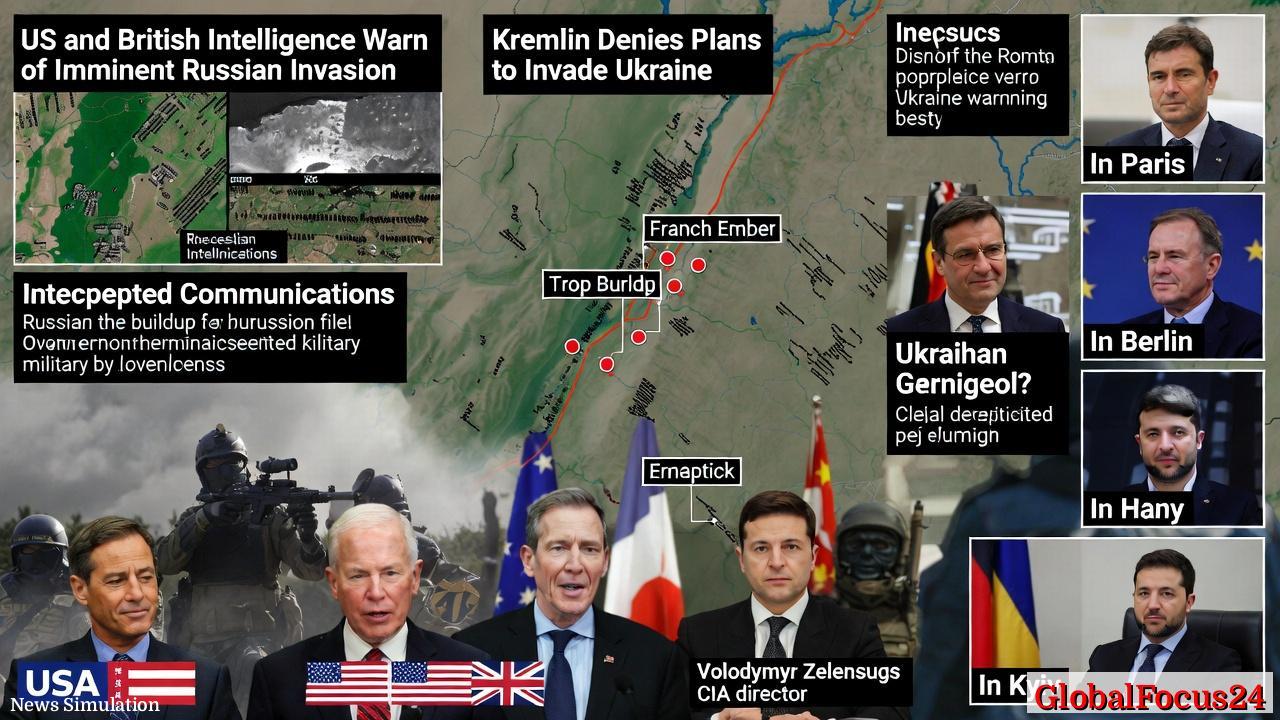
In the months leading up to Russia’s full-scale invasion of Ukraine in February 2022, Western intelligence services — particularly those in the United States and the United Kingdom — issued repeated, detailed warnings that Moscow was preparing for a major offensive. Satellite imagery, intercepted communications, and reconnaissance pointed to a coordinated military buildup of unprecedented scale along Ukraine’s borders. Yet, despite mounting evidence, key European capitals and Ukrainian officials underestimated the threat, believing that Russian President Vladimir Putin’s troop movements were an intimidation tactic rather than the prelude to war.
By late 2021, high-resolution satellite images captured tens of thousands of Russian troops assembling near Ukraine, along with heavy armor, artillery, and logistics infrastructure. Analysts noted telltale signs of offensive intent: mobile field hospitals, expanded rail logistics, and bridge-laying equipment — all prerequisites for sustained combat operations. U.S. and U.K. intelligence agencies warned that the configuration pointed not to a training exercise, but to a campaign designed to strike from multiple fronts, including Belarus.
Intelligence Insights and Early Warnings
Within intelligence circles, the assessment was stark. By early January 2022, American analysts had mapped Russian plans for simultaneous advances toward Kyiv, Kharkiv, and the Black Sea coast. One particularly alarming detail was a planned helicopter assault to capture Hostomel airport outside the Ukrainian capital — a move intended to enable a rapid strike at the heart of Ukraine’s leadership. Intercepted communications suggested Russian forces were preparing to decapitate the Ukrainian government and install a proxy administration.
The warnings culminated in an extraordinary visit to Kyiv by the director of the U.S. Central Intelligence Agency, who personally briefed President Volodymyr Zelensky on the operational intelligence. British officials echoed these alerts, providing satellite evidence and assessments indicating that an invasion was imminent. Yet, despite the precision and urgency of these warnings, Ukraine’s leadership remained skeptical. Zelensky reportedly feared that an overreaction could trigger panic, mass flight of capital, and economic collapse — outcomes that could, in his view, weaken the country even before the first shot was fired.
Diverging European Responses
The divide was not only between Kyiv and Anglo-American intelligence but also within Europe itself. Officials in Paris and Berlin viewed Washington’s warnings as alarmist. French and German intelligence services, emphasizing economic interdependence and diplomatic precedent, assessed that Putin’s mobilization aimed to pressure Ukraine and NATO into concessions. European leaders had long regarded the Russian president as pragmatic, not reckless — someone who wielded military force to secure leverage, not to launch full-scale invasions.
This divergence in assessment revealed a deeper structural gap in threat perception across the West. The United States and United Kingdom, drawing on decades of experience with Russia’s covert and hybrid strategies, were quicker to see patterns of escalation that European counterparts dismissed as posturing. Analysts in London and Washington recalled earlier invasions of Georgia in 2008 and Crimea in 2014, both masked by disinformation campaigns and sudden tactical offensives that were initially downplayed by local observers. By contrast, much of continental Europe viewed those precedents as limited and regionally confined, unlikely to expand into a broader war.
The Failure of Strategic Imagination
In retrospect, the failure to act decisively on intelligence warnings stemmed not from a lack of information but from disbelief. Western Europe’s principal powers, heavily invested in diplomatic channels and energy ties with Moscow, could not easily imagine that Russia would launch a high-risk operation threatening the post–Cold War European order. A generation of policymakers had internalized the assumption that large ground wars on the continent were relics of the 20th century. For years, economic integration — particularly through gas pipelines and trade — was seen as a stabilizing force making conflict irrational.
When the invasion finally began on February 24, 2022, these assumptions crumbled overnight. Russian armored columns rolled into Ukrainian territory from the north, east, and south, confirming with eerie precision the battle plan Western intelligence had outlined weeks earlier. The assault on Hostomel airport matched the predicted airborne operation. Within hours, images of explosions near Kyiv underscored that the worst-case scenario had unfolded almost exactly as forewarned.
Economic and Strategic Consequences
The immediate global economic fallout was severe. Energy markets convulsed as natural gas prices in Europe surged to record highs. Nations that had relied on Russian gas for decades scrambled to secure alternative supplies, ushering in one of the most rapid energy realignments since the 1970s oil crisis. Inflationary pressures spread across the continent as transportation costs and food prices climbed, worsening the post-pandemic recovery.
Financial analysts estimate that the first six months of the war shaved more than a percentage point off projected European GDP growth in 2022. Countries heavily dependent on imported fuels, such as Germany and Italy, faced industrial slowdowns as factories struggled with rising energy expenses. Ukraine’s economy, unsurprisingly, contracted by more than 30 percent that year, its infrastructure and export routes devastated by bombardment.
In the United States and the United Kingdom, validation of their intelligence assessments strengthened domestic confidence in their agencies but also fueled debate over how to better communicate imminent threats to allies. Officials privately conceded that the credibility gap in Europe had hindered unified deterrence efforts. Washington’s pre-war strategy of declassifying intelligence — rare in scope and speed — aimed to counter Russian disinformation in real time. However, while transparency shaped public opinion and prepared NATO diplomatically, it did little to change the calculus in Moscow or in hesitant European capitals.
Comparisons Across Regions
The failure to heed warning signs before February 2022 has drawn comparisons to other intelligence misjudgments in modern history. Analysts have pointed to parallels with the 1973 Yom Kippur War, when Israeli intelligence was caught off guard by an Egyptian-Syrian offensive despite ample early indicators. In both cases, the obstacle was less the absence of data than the unwillingness of decision-makers to accept the magnitude of the threat.
Regional comparisons also highlight differences in strategic culture. Eastern European nations such as Poland and the Baltic states, drawing on long experience with Russian aggression, aligned earlier with U.S. warnings. Their governments accelerated preparations, fortifying borders and pushing NATO for forward deployments. Western Europe, by contrast, prioritized dialogue, fearing escalation. This east-west divide within Europe continues to shape security debates years later, as the continent reassesses its defense posture and investment in intelligence coordination.
The Intelligence Legacy
In the years since the invasion, Western intelligence agencies have studied the episode as a case study in predictive accuracy and political communication. The early indicators, now publicly documented, reveal a model of intelligence fusion that integrated satellite reconnaissance, cyber monitoring, and on-the-ground sources. Yet the ultimate failure lay not in the data but in the challenge of persuasion.
For Ukrainian and European leaders in late 2021, the risk calculus was shaped by competing priorities: avoiding panic, preserving economic stability, and maintaining diplomatic dialogue with Moscow. The notion that Russia would attempt to seize a major European capital was seen as implausible, even reckless. That misjudgment, however, allowed Moscow to achieve tactical surprise — at least in the initial hours of the war — a factor that proved costly in human and economic terms.
Lessons for Future Security Policy
Today, as NATO expands its intelligence-sharing frameworks, officials cite the Ukraine case as a lesson in the need for clarity of communication between allies. Intelligence is only as useful as the actions it enables; without political conviction to act, even the best early warnings can go unheeded. The events of 2021–2022 have reshaped European defense policy, prompting renewed spending commitments and efforts to reduce dependence on adversarial powers.
For Ukraine, the episode marked a painful lesson in trust and risk management. Zelensky’s initial skepticism is now understood less as negligence and more as a reflection of impossible circumstances: a president balancing existential warnings against the collapse of public morale. Still, the enduring reality is that Western intelligence foresaw the invasion with remarkable precision — and the tragedy of its dismissal serves as a reminder that foresight alone does not guarantee prevention.
A Shift in European Security Thinking
The reverberations from those months continue to influence Europe’s strategic orientation. Governments that once hesitated now advocate for deterrence through strength, accelerating rearmament and energy diversification. Intelligence agencies have gained broader political attention, and threat assessments from Washington or London are now weighed with renewed seriousness.
Four years on, the story of the ignored warnings stands as both a testament to analytical precision and a cautionary tale about political disbelief. It underscores how, in matters of national security, the barrier between foresight and foresight ignored can determine not only the fate of nations but the trajectory of global stability itself.