Underemployment Among Recent College Graduates Climbs to Highest Level Since 2020
Underemployment Rate Jumps to 42.5 Percent
The underemployment rate for recent college graduates has risen to 42.5 percent, reaching its highest level since 2020 and underscoring mounting challenges for young workers entering the U.S. labor market. This figure refers to graduates aged 22 to 27 who are working in jobs that do not typically require a college degree, such as roles where a high school diploma is considered sufficient. The latest increase marks a sharp reversal from improvements seen in the early 2020s, as the job market has cooled in several white-collar sectors while service, retail, and gig-economy roles remain more plentiful.
More than half of new college graduates now start their careers underemployed, with over 52 percent entering positions below their education level. That early misalignment between skills and job requirements can have lasting consequences, affecting wages, career trajectories, and confidence in the value of a college degree. As the labor market absorbs a new cohort of graduates each year, the rising underemployment rate is emerging as a critical barometer of how effectively the economy is using its most educated workers.
Long-Term Trends Since the Great Recession
The current spike in underemployment builds on a long arc that stretches back to the aftermath of the 2008 financial crisis. In the years following that downturn, underemployment for recent college graduates tended to fluctuate around 40 percent, remaining elevated even as the broader unemployment rate gradually declined. That pattern suggested that while jobs were returning, many were not at the skill level or pay grade that new graduates expected or were trained for.
In the late 2010s, a strong labor market briefly improved conditions. Underemployment dipped below 38 percent in some periods, offering cautious optimism that the economy was finally absorbing young degree holders into more appropriate roles. Those gains, however, proved fragile. The shock of the 2020 pandemic sent underemployment rates for young graduates soaring as businesses closed, hiring froze, and many entry-level professional roles disappeared or were delayed. Although there was a robust rebound as the economy reopened, the latest data show underemployment now surpassing the peaks seen during that pandemic period, indicating renewed pressure on young workers just as they step into the workforce.
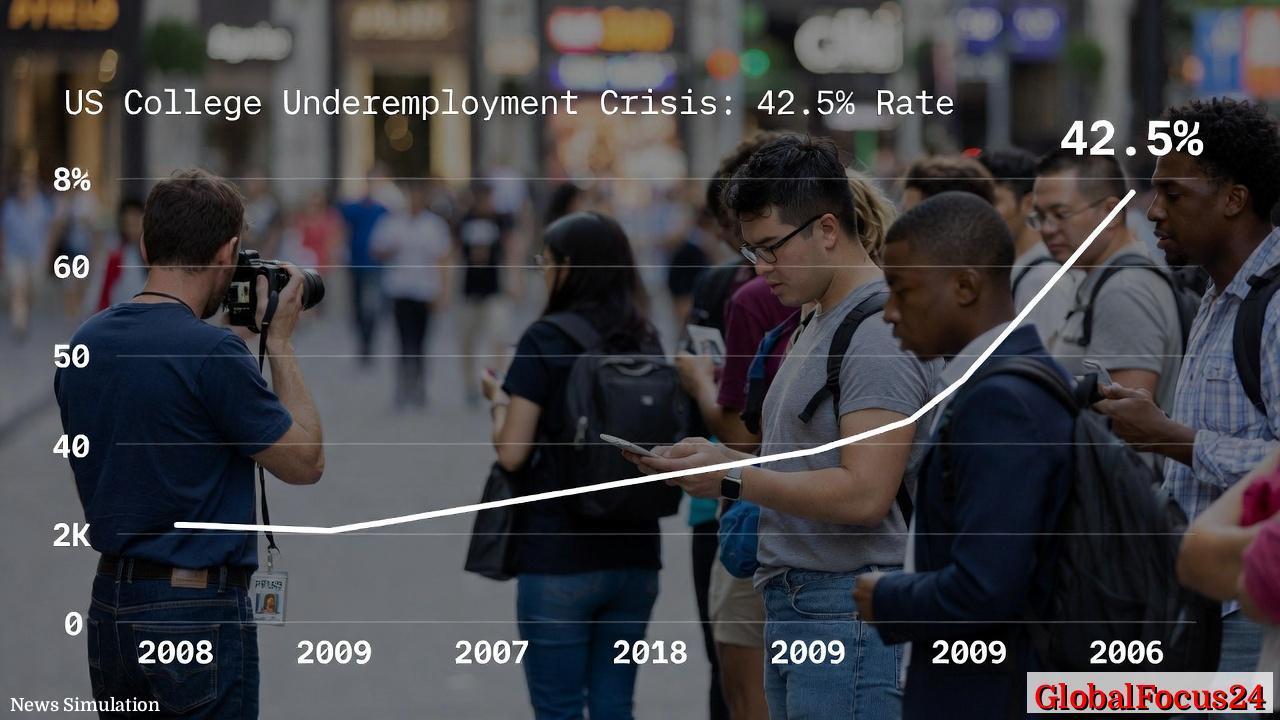
The charted data from 2008 onward depict a jagged but persistent challenge: underemployment rarely falls much below the high-30-percent range and often hovers near or above 40 percent. The current reading of approximately 42.5 percent stands out as a notable high point in this long-term pattern, raising concerns that underemployment is becoming a structural feature of the post-2008 labor market rather than a short-term anomaly.
Early Career Mismatch and Its Economic Costs
For recent graduates, starting a career in a job that does not require a degree is more than a temporary inconvenience. Early underemployment is closely associated with lower lifetime earnings, slower wage growth, and a higher likelihood of future job instability. When more than half of new graduates—over 52 percent—are underemployed in their first roles, the risk of an entire cohort experiencing long-term scarring rises significantly.
The economic costs are both personal and systemic. On an individual level, graduates working in roles that require only a high school diploma often earn lower wages, receive fewer benefits, and have limited opportunities for advancement. They may struggle to pay off student loans, delay major life decisions such as buying a home or starting a family, and face greater financial insecurity. On a broader scale, the economy absorbs the cost of years of education without fully utilizing the skills that education was meant to develop.
The mismatch also affects productivity and innovation. When highly trained workers spend their early years in lower-skill jobs, the economy loses potential gains in specialized sectors that depend on fresh talent and new ideas. Employers, in turn, may face shortages in critical fields even as a large pool of graduates remains stuck in roles below their abilities. Over time, this disconnect can widen gaps between the promise of higher education and the realities of the labor market.
Why Underemployment Is Rising Now
Several factors are driving the latest increase in underemployment among recent college graduates. The pace of hiring in traditionally sought-after sectors such as technology, finance, and some professional services has slowed compared with the rapid expansion seen earlier in the decade. Layoffs, hiring freezes, and more cautious workforce planning have reduced the number of entry-level positions in these areas, even as graduating classes remain large.
At the same time, many of the jobs that are growing most quickly are in sectors that historically do not require a bachelor’s degree. Hospitality, retail, logistics, and portions of the care economy continue to add roles, but these positions often emphasize flexibility and availability over specialized academic training. As graduates compete for a limited number of professional openings, a significant share accept roles in these lower-credential occupations to secure income, gain work experience, or bridge gaps while they search for better matches.
Another factor is the shifting nature of work itself. Automation, digital tools, and new business models are transforming entry-level professional jobs, sometimes reducing the number of positions available or changing the skills required to secure them. Employers increasingly seek prior experience, practical skills, or internships, raising the bar for new graduates and pushing some into less demanding roles even when they possess a degree.
Historical Context: From Crisis to Pandemic and Beyond
The current underemployment rate cannot be fully understood without looking at the sequence of economic shocks over the past two decades. The 2008 financial crisis marked a turning point, ushering in an era of slow wage growth and cautious hiring that particularly affected young entrants to the workforce. Graduates in the early 2010s found themselves competing not only with their peers but also with more experienced workers displaced from other sectors.
As recovery took hold, underemployment for recent graduates improved but never fully returned to pre-crisis norms. By the late 2010s, many indicators suggested a strong labor market, yet the persistently elevated underemployment rate indicated that the quality of jobs remained uneven. Then, in 2020, the pandemic delivered another sharp blow. Lockdowns and economic uncertainty led many employers to delay or cancel entry-level hiring, internships, and training programs, leaving a generation of graduates facing unprecedented obstacles.
The rebound that followed in 2021 and 2022 brought rapid job growth, but it was not evenly distributed. Many positions added during the recovery were in sectors where a college degree is not strictly necessary. As the economy normalized, the temporary surge in professional hiring tapered off, while the number of college graduates continued to rise. The current 42.5 percent underemployment rate reflects this layered history of crisis, partial recovery, and shifting labor demand, with recent cohorts still feeling the aftershocks of both the Great Recession and the pandemic.
Regional Patterns and Comparisons
Underemployment among recent college graduates does not play out evenly across the United States. Large metropolitan areas with diverse economies and strong professional services sectors often offer more opportunities that align with a four-year degree. Even in these regions, however, competition can be intense, and high living costs can pressure graduates to accept any available job, regardless of its skill level.
In parts of the country where economic growth is slower or more concentrated in industries such as manufacturing, agriculture, or tourism, graduates may find fewer entry-level professional roles. They may return to their hometowns after college and encounter local labor markets dominated by positions that require only a high school education or short-term training. This dynamic can especially affect smaller cities and rural areas, where employers may value practical experience or local knowledge over formal credentials.
States with large concentrations of colleges and universities can experience a local oversupply of degree holders, making it harder for each graduating class to find suitable work. In contrast, regions that are rapidly expanding in sectors like technology, healthcare, or advanced manufacturing may still struggle to fill specialized roles, even as graduates elsewhere remain underemployed. These regional disparities highlight how geography interacts with education and industry structure to shape early career outcomes.
Impact on Graduates’ Lives and Expectations
The rising underemployment rate is reshaping how many young people view the promise of higher education. For students who invested years and significant financial resources in earning a degree, starting out in a job that does not require one can lead to frustration, anxiety, and doubts about the return on that investment. Graduates may feel pressure to take on second jobs, gig work, or extended hours to manage living expenses and student loan repayments.
This environment also influences personal choices. Some graduates delay major milestones, such as forming households, moving out of shared accommodations, or relocating to higher-cost cities where more professional jobs might be available. Others reconsider their long-term plans, exploring additional certifications, graduate programs, or career changes in search of better alignment between their skills and the labor market.
Despite these challenges, many underemployed graduates continue to view their first jobs as stepping stones rather than permanent positions. Some use the time to build transferable skills, network, or develop portfolios that can eventually help them transition into roles that better match their degrees. However, the higher the underemployment rate, the more crowded those pathways become, and the more difficult it is for any one individual to break through.
Implications for Employers and Policymakers
The elevated underemployment rate carries important implications beyond individual graduates. Employers that rely on highly educated workers may need to reassess how they recruit and develop early-career talent. Expanding internship programs, entry-level roles, and on-the-job training could help bridge the gap between academic learning and workplace needs, providing clearer routes into professional occupations for new graduates.
Policymakers and education leaders face their own set of questions. The rise to 42.5 percent underemployment among recent college graduates renews debates about how well higher education is aligned with labor market demand. Some call for stronger ties between institutions and industry, including work-based learning opportunities, updated curricula, and better information for students about career prospects in different fields of study. Others emphasize the need for broader economic strategies that create more high-quality jobs across regions, rather than concentrating opportunities in a few major hubs.
At the same time, any response must balance immediate labor market needs with the broader purposes of higher education, which include critical thinking, civic engagement, and personal development. The challenge is not simply to reduce the underemployment rate, but to ensure that graduates can use their training in ways that contribute to both their own well-being and the strength of the wider economy.
Outlook for Upcoming Graduating Classes
With the underemployment rate already at its highest level since 2020, upcoming graduating classes are watching the labor market closely. Many are adjusting their strategies, pursuing internships earlier, seeking practical experience alongside academic work, or broadening their job searches across industries and locations. Career services offices on campuses report heightened concern among students about finding roles that align with their degrees and long-term goals.
The trajectory of underemployment in the coming years will depend on several forces: overall economic growth, sector-specific trends, the pace of technological change, and how quickly employers expand professional opportunities for early-career workers. If the current pattern continues, a significant share of graduates may spend their first years out of college in roles that underutilize their skills, with implications that could ripple through the economy for decades.
For now, the 42.5 percent underemployment rate stands as a stark indicator of the mismatch between higher education and the jobs many graduates can secure. As more than half of new college graduates begin their working lives underemployed, the question facing the country is not only how to lower that figure, but how to build a labor market that can fully harness the talents of its newest entrants.