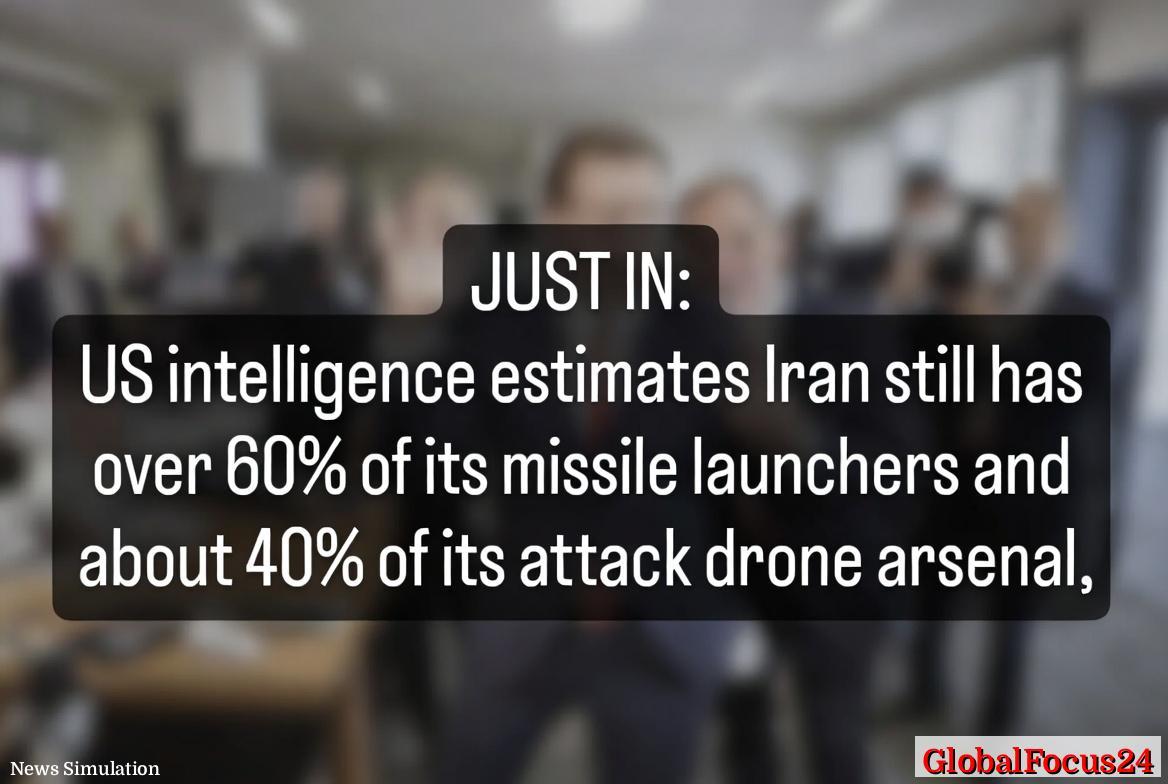
US Intelligence Says Iran Retains Majority of Missile Launchers After Weeks of Strikes
Assessment Signals Limited Degradation of Iran’s Arsenal
US intelligence agencies have concluded that Iran retains more than 60 percent of its missile launchers and roughly 40 percent of its attack drone arsenal following weeks of sustained US military strikes, according to officials familiar with the assessment. The findings suggest that while recent operations have inflicted measurable damage, a significant portion of Iran’s strategic capabilities remains intact.
The evaluation comes amid heightened tensions between Washington and Tehran, with both sides navigating a volatile security environment shaped by regional conflicts, maritime disruptions, and ongoing concerns about military escalation. Analysts say the figures underscore the resilience of Iran’s military infrastructure and its longstanding investment in dispersal, redundancy, and asymmetric warfare tactics.
Strikes Target Key Infrastructure
The US military campaign focused on a range of Iranian facilities linked to missile development, drone production, and launch operations. Targets reportedly included storage depots, manufacturing sites, and logistical hubs believed to support Iran’s expanding arsenal of precision-guided munitions and unmanned aerial vehicles.
Despite these efforts, intelligence assessments indicate that Iran’s strategy of decentralizing its military assets has limited the effectiveness of concentrated strikes. Mobile launch platforms, underground storage facilities, and concealed production sites have allowed Tehran to preserve a substantial share of its capabilities.
Military experts note that Iran has spent decades refining this approach, particularly in response to earlier conflicts and sanctions regimes that restricted access to advanced conventional weapons.
Historical Context of Iran’s Missile Program
Iran’s missile and drone programs date back to the 1980s, when the country faced significant constraints during the Iran-Iraq War. With limited access to modern air power, Tehran began investing heavily in missile technology as a means of deterrence and strategic reach.
Over the following decades, Iran developed one of the largest missile arsenals in the Middle East. Its inventory now includes short-, medium-, and potentially long-range ballistic missiles, as well as a rapidly evolving fleet of drones capable of reconnaissance and strike missions.
The emphasis on missiles and drones reflects a broader military doctrine centered on asymmetric warfare. Rather than matching adversaries in conventional force structures, Iran has prioritized systems that can operate flexibly, survive initial strikes, and impose costs on opponents through sustained pressure.
This doctrine has influenced not only Iran’s own capabilities but also those of allied groups across the region, many of which have adopted similar technologies and tactics.
Regional Security Implications
The latest intelligence findings carry significant implications for regional security dynamics. Iran’s ability to retain a majority of its missile launchers means it can continue to project power across the Middle East, including toward key maritime routes and strategic infrastructure.
Neighboring countries have long viewed Iran’s missile program as a central security concern. Gulf states, in particular, have invested heavily in air defense systems designed to counter potential missile threats. Israel has also developed layered defense networks, including systems capable of intercepting both rockets and ballistic missiles.
The persistence of Iran’s capabilities may reinforce existing defense postures and could prompt further investments in missile defense technologies across the region. At the same time, it highlights the challenges of neutralizing dispersed and mobile systems through airstrikes alone.
Comparatively, other regional powers maintain more conventional air forces but lack the same scale of missile deployment. Iran’s approach, while less technologically advanced in some respects, offers strategic advantages in survivability and cost-effectiveness.
Economic Impact and Strategic Calculations
The ongoing military activity and resulting tensions have had measurable economic effects, both within Iran and across global markets. Energy prices have shown periodic volatility as investors respond to the risk of disruption in key shipping lanes, particularly the Strait of Hormuz, through which a significant portion of the world’s oil supply passes.
For Iran, maintaining its missile and drone programs represents a substantial financial commitment, especially under conditions of economic sanctions. However, analysts say these systems are relatively cost-efficient compared to traditional military platforms such as advanced fighter jets or naval fleets.
The ability to produce drones domestically has further reduced costs and increased production flexibility. This has allowed Iran to scale its capabilities even under economic pressure, making its arsenal more resilient over time.
In contrast, the cost of intercepting missiles and drones can be significantly higher for defending countries, creating an economic asymmetry that factors into strategic planning on both sides.
Technological Evolution of Drone Warfare
Iran’s drone program has attracted increasing attention in recent years, particularly as unmanned systems have become more prominent in modern conflicts. The country has developed a range of drones with varying capabilities, including surveillance platforms and loitering munitions designed to strike targets after extended flight times.
The reported loss of approximately 60 percent of Iran’s attack drone arsenal indicates a notable impact from recent strikes, but not a decisive one. Experts note that drones can often be produced more quickly and at lower cost than missiles, allowing for faster replenishment.
This dynamic has been observed in other conflicts, where drone usage has expanded rapidly due to its affordability and operational flexibility. Iran’s continued investment in this area suggests that drones will remain a central component of its military strategy.
Challenges in Measuring Military Effectiveness
Assessing the true impact of military strikes on Iran’s capabilities presents inherent challenges. Intelligence estimates rely on a combination of satellite imagery, signals intelligence, and other sources, but uncertainties remain, particularly regarding concealed or underground assets.
Iran’s longstanding emphasis on secrecy and operational security complicates efforts to obtain a complete picture. Mobile launchers can be relocated quickly, while hardened facilities are designed to withstand or evade detection.
As a result, the figures indicating that over 60 percent of missile launchers remain operational and 40 percent of drones are intact should be understood as informed estimates rather than precise measurements.
Public Reaction and Strategic Messaging
The release of these intelligence findings has drawn attention from policymakers, defense analysts, and the broader public. In Washington, the assessment may influence ongoing discussions about the effectiveness of current military strategies and the potential need for adjustments.
In Tehran, officials have emphasized the resilience of their military capabilities, framing the outcome as evidence of strategic preparedness. Public messaging on both sides reflects a broader effort to shape perceptions and signal resolve.
Across the region, the developments have reinforced a sense of uncertainty, with governments closely monitoring the situation and evaluating potential risks.
Broader Regional Comparisons
Iran’s ability to sustain a large portion of its missile and drone arsenal stands in contrast to some other countries that rely more heavily on centralized military infrastructure. Nations with concentrated bases or limited redundancy may be more vulnerable to targeted strikes.
At the same time, Iran’s approach is not without limitations. Its systems may lack the precision or technological sophistication of those used by more advanced militaries. However, the combination of quantity, mobility, and cost efficiency creates a distinct strategic profile.
Other countries in the region have begun to adapt by investing in both defensive systems and their own unmanned capabilities, reflecting a broader shift in military priorities.
Outlook for Regional Stability
The persistence of Iran’s missile and drone capabilities suggests that tensions are unlikely to ease in the near term. While recent strikes have degraded certain elements of Iran’s arsenal, they have not eliminated its ability to project force.
Future developments will depend on a range of factors, including diplomatic efforts, military calculations, and broader geopolitical dynamics. The current assessment highlights the complexity of the situation and the challenges associated with achieving lasting stability.
As the region continues to navigate these uncertainties, the balance between deterrence and escalation remains a central concern for all parties involved.