U.S. Military Hardware Surges Into the Middle East Amid Rising Regional Tensions
Expanding U.S. Military Presence Across the Region
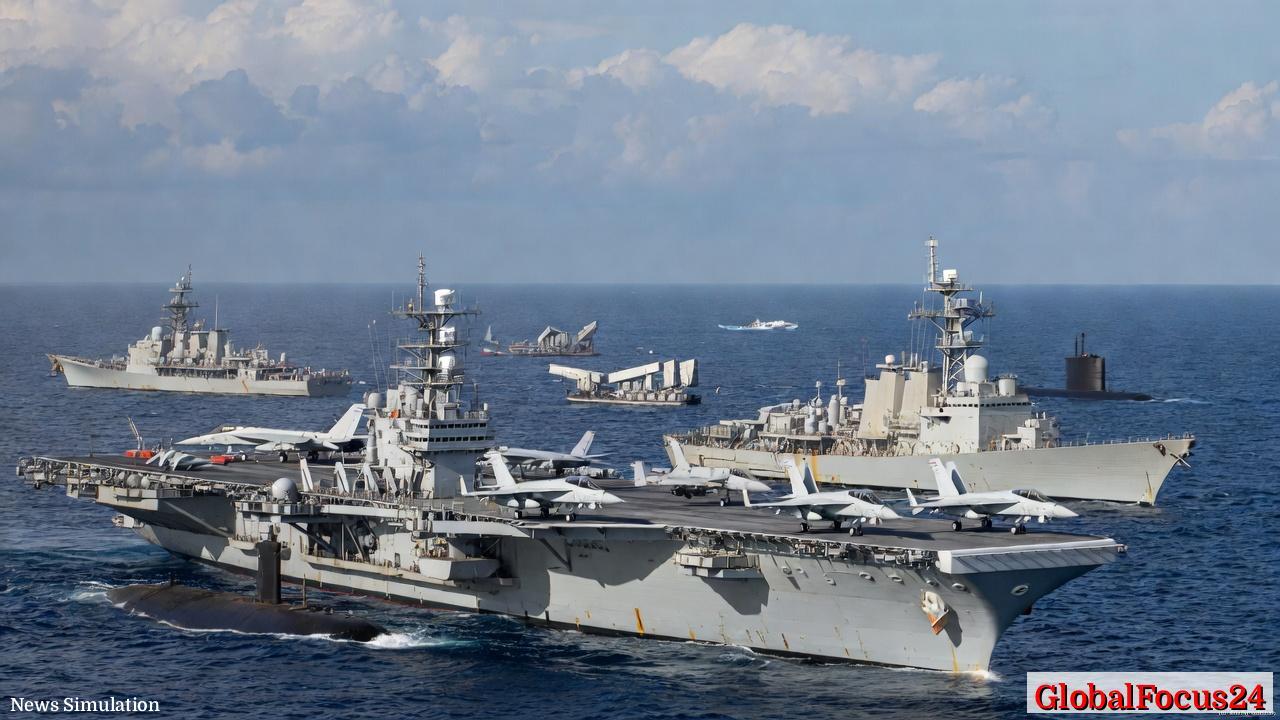
A rapid and visible buildup of U.S. military assets is underway across the Middle East as the United States reinforces its defense posture amid growing regional instability and escalating threats to commercial and allied interests. Over the last several weeks, satellite imagery, defense briefings, and official statements have confirmed a significant surge in deployments, including aircraft carrier strike groups, advanced fighter jets, warships, submarines, and integrated air defense systems.
This expansion reflects evolving mission priorities, signaling a renewed commitment by Washington to deter aggression, protect shipping lanes, and reassure traditional partners. It also underscores the complexity of maintaining strategic balance in a region where multiple conflicts, proxy forces, and external powers increasingly overlap.
Aircraft Carrier Strike Groups Return to the Persian Gulf
At the center of the deployment stands a U.S. Navy aircraft carrier strike group positioned in the Arabian Sea, supported by guided missile destroyers and cruisers. The strike group functions as a mobile command hub—capable of projecting air power, providing intelligence, and launching precision operations if necessary.
The carrier itself carries dozens of aircraft including F/A-18 Super Hornets, EA-18G Growlers for electronic warfare, and E-2D Advanced Hawkeyes for airborne command and control. Complementing the carrier group’s firepower are Arleigh Burke-class guided missile destroyers, each outfitted with hundreds of vertical-launch missiles capable of intercepting both air and surface threats.
Washington has maintained a near-continuous naval presence in the Persian Gulf since the late 1980s, but the current composition of deployed forces represents one of the most formidable concentrations in recent memory. Analysts note that the pattern mirrors previous shows of force during periods of heightened tension, such as the 1990–91 Gulf War buildup and the 2014 campaign against the Islamic State.
Submarine and Surface Warfare Assets Reinforce Deterrence
Operating discreetly beneath the surface, U.S. Navy attack submarines—both Virginia- and Los Angeles-class—are believed to be patrolling key maritime chokepoints, including the Strait of Hormuz and the Bab el-Mandeb Strait. These vessels, armed with Tomahawk cruise missiles and advanced surveillance equipment, provide a critical second-strike capability and persistent situational awareness.
In addition, several cruisers equipped with Aegis Combat Systems have been redeployed from the Mediterranean and Red Seas to reinforce radar coverage and missile defense. These ships form a layered protection network linking U.S. naval operations with allied regional forces, including fleets from the United Kingdom, France, and Gulf partners.
Advanced Fighter Jets Bolster Air Superiority
In coordination with naval units, the U.S. Air Force has dispatched modern fighter aircraft to bases across the Arabian Peninsula. Deployments include F-15E Strike Eagles and F-35 Lightning II stealth fighters, integrated with KC-135 and KC-46 aerial refueling tankers to extend their operational range.
These assets are joined by reconnaissance aircraft and airborne early warning systems, enhancing visibility over contested airspace. U.S. Central Command (CENTCOM) has emphasized that these deployments support deterrence rather than escalation, though their tactical capabilities provide a readiness posture far exceeding standard rotational presence.
The F-35’s arrival marks a technological shift in the region’s aerial balance. Its advanced sensor fusion and radar-evading design allow for seamless integration with allied aircraft, such as Saudi and Emirati F-15s and Eurofighter Typhoons, forming a powerful joint deterrent network.
Layered Air Defense Systems Protect Key Installations
Beyond offensive capabilities, the U.S. has dramatically expanded its defensive architecture across critical bases and strategic chokepoints. Patriot missile batteries, Terminal High Altitude Area Defense (THAAD) systems, and portable counter-drone units have been repositioned to safeguard logistics hubs and population centers.
These systems are interconnected through a regional radar grid capable of detecting ballistic and cruise missile threats within seconds. The architecture builds upon decades of U.S.-Gulf defense cooperation, tracing back to the aftermath of the Gulf War when fears of missile attacks prompted the first large-scale deployment of Patriot systems to Saudi Arabia and Kuwait.
In recent years, the growing sophistication of drone swarms and precision-strike weapons has forced a reevaluation of defensive strategies. As a result, current U.S. deployments focus heavily on multi-layered interception and rapid-response coordination among air, naval, and land forces.
Historical Context of U.S. Military Engagement in the Middle East
The U.S. military footprint across the Middle East has evolved over more than seven decades, shaped by major conflicts, alliances, and shifting energy priorities. From the establishment of bases in Bahrain and Qatar during the Cold War to counter the Soviet Union’s southern influence, to the large-scale operations following Iraq’s invasion of Kuwait, American forces have maintained a continuous if adaptive presence.
During the early 2000s, large troop deployments in Iraq and Afghanistan drove the construction of sprawling logistical hubs such as Al Udeid Air Base in Qatar and Camp Arifjan in Kuwait. As combat operations wound down, Washington shifted toward a leaner, technology-driven posture emphasizing quick mobility, intelligence coordination, and strike readiness.
Today’s buildup recalls earlier patterns of deterrence but operates with far more precision and flexibility. Rather than occupying territory, modern U.S. strategy relies on dynamic deployment—moving high-value assets in and out of the region depending on intelligence and threat levels.
Strategic Drivers Behind the Current Build-Up
Several interlinked developments are driving the renewed surge in U.S. deployments. Renewed maritime tensions in the Red Sea and Gulf of Aden, frequent missile launches near critical shipping lanes, and proxy escalations across Lebanon, Syria, and Iraq have all contributed to Washington’s decision to reinforce its posture.
Commercial vessels and energy infrastructure remain particularly vulnerable. With nearly one-third of the world’s seaborne oil trade passing through Middle Eastern straits, even short-term disruptions can trigger global economic ripples. The U.S. move aims not only to secure military advantage but also to stabilize these essential trade arteries.
Intelligence sources have also cited the increasing frequency of unmanned aerial and naval drone activity targeting merchant ships, raising alarms about the potential spread of precision-guided weaponry beyond traditional state actors. Enhanced air and naval defenses are therefore viewed as preventive measures rather than preludes to escalation.
Economic and Energy Implications
The concentration of U.S. military power carries both stabilizing and uncertain economic consequences. On one hand, visible deterrence can calm markets by signaling Western commitment to keeping oil routes open. On the other, it underscores the fragility of global supply chains dependent on Middle Eastern security.
Energy analysts note that spikes in insurance premiums for tanker ships often follow missile or drone incidents, increasing transportation costs for crude oil and liquefied natural gas exports. The presence of U.S. warships tends to mitigate these price surges, though long-term reassurance depends on sustained maritime security cooperation among allied nations.
Regionally, host countries benefit from increased logistical contracts and infrastructure development linked to the deployments. However, they also face domestic pressures related to balancing foreign basing arrangements with local political sensitivities.
Regional Comparisons and Strategic Balance
Compared to other global commands, the U.S. maintains one of its most active operational networks under CENTCOM, responsible for forces in the Middle East and parts of Central Asia. Similar to forward-operating patterns in the Indo-Pacific, the Middle East structure relies on rotational deployments and joint exercises to maintain readiness.
Neighboring powers have likewise adjusted their military postures in response. Russia continues to sustain facilities along the Syrian coast, while Western European navies, including those of France and the United Kingdom, have expanded participation in multinational patrols. The result is an increasingly crowded and technologically competitive military environment from the Eastern Mediterranean to the Arabian Gulf.
Public and International Reaction
Early public reactions across the Middle East have reflected a mixture of relief and apprehension. U.S. allies in the Gulf view the buildup as essential reassurance amid regional volatility, while some civil groups express concern that extended deployments could inflame existing tensions. International diplomats have called for de-escalation and dialogue to prevent miscalculations that could spiral into wider confrontation.
Markets have so far responded cautiously. Brent crude prices have fluctuated within a narrow band, reflecting both the perceived protective effect of U.S. presence and persistent underlying uncertainty.
Looking Ahead: Deterrence or Precursor to Crisis?
For Washington, the coming months will test the effectiveness of deterrence without direct confrontation. Military planners emphasize that the build-up’s purpose lies in preserving freedom of navigation, protecting personnel, and reassuring allies—not in preparing for imminent conflict.
However, the concentration of powerful forces in close proximity to volatile flashpoints inherently carries risk. Any incident—an intercepted drone, a missile misfire, or an accidental engagement—could trigger rapid escalation before diplomatic channels can respond.
As tensions simmer, the U.S. reinforcement in the Middle East stands as both a warning and a promise: a demonstration of resolve intended to preserve balance in a region where stability remains as vital as it is precarious.