Air Travel Disrupted Across Middle East as Strikes Trigger Widespread Airspace Closures
Sharp Decline in Flights Signals Unprecedented Disruption
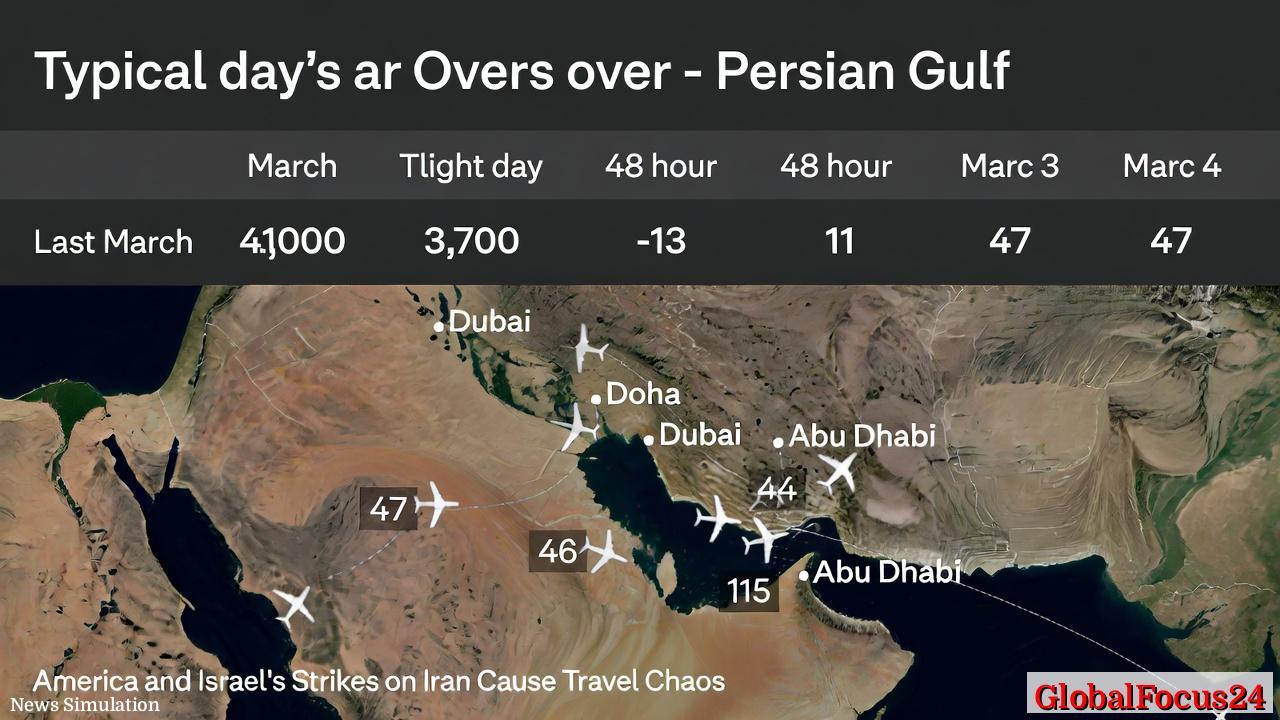
International air travel across the Middle East has been severely disrupted following coordinated strikes by the United States and Israel on Iran, and subsequent retaliatory actions by Iran targeting neighboring countries. Flight-tracking data reveals a dramatic collapse in air traffic over one of the world’s busiest aviation corridors.
In a typical 48-hour period during March of last year, more than 3,700 aircraft traversed the Persian Gulf’s tightly managed airspace. By contrast, on March 3 and 4 this year, only 47 flights were recorded in the same region. The scale of the decline underscores the intensity of the disruption and highlights how quickly geopolitical tensions can reshape global transportation networks.
The Persian Gulf serves as a critical artery for long-haul flights connecting Europe, Asia, Africa, and Oceania. The sudden near-closure of this corridor has forced airlines to rapidly adjust operations, often with limited notice and rising safety concerns.
Airspace Closures Ripple Across Key Aviation Hubs
Several countries in the region have imposed partial or complete airspace closures, citing security risks amid escalating military activity. These restrictions have directly impacted major global aviation hubs, including:
- Dubai International Airport, one of the busiest airports in the world for international passengers
- Hamad International Airport in Doha, a central hub for transcontinental travel
- Abu Dhabi International Airport, a key gateway linking Europe and Asia
With these hubs constrained, airlines have been forced to cancel thousands of flights or reroute them along longer, less efficient paths. Aircraft that would typically cross the Persian Gulf are now being diverted north over Central Asia or south via the Arabian Sea, adding several hours to flight times.
Passengers have faced widespread delays, missed connections, and extended layovers. In many cases, airlines have struggled to rebook travelers quickly due to limited alternative capacity and already congested routes.
Airlines Face Operational and Financial Strain
The disruption has placed significant operational and financial pressure on airlines worldwide. Longer routes increase fuel consumption, crew costs, and maintenance demands, while cancellations result in lost revenue and compensation obligations.
Airlines based in the Gulf region have been particularly affected. Carriers such as Emirates, Qatar Airways, and Etihad Airways rely heavily on their geographic positioning to facilitate efficient global connections. The current situation undermines that advantage by restricting access to their primary airspace.
International carriers are also feeling the strain. European and Asian airlines that depend on Middle Eastern transit corridors are being forced to adjust schedules, reduce frequencies, or temporarily suspend certain routes.
Industry analysts note that prolonged disruptions could lead to higher ticket prices as airlines attempt to offset increased operating costs. Cargo operations have also been impacted, potentially affecting global supply chains for time-sensitive goods such as electronics, pharmaceuticals, and perishable items.
Historical Context of Airspace Disruptions
Airspace closures due to conflict are not unprecedented, but the scale and speed of the current disruption stand out. Previous events, such as the Gulf War in 1991 and the Iraq War in 2003, also led to significant rerouting of global flights. However, the modern aviation network is far more interconnected and operates at much higher volumes.
More recently, conflicts in Eastern Europe led to extended closures of Ukrainian and Russian airspace, forcing airlines to adopt longer routes between Europe and Asia. The current Middle East situation compounds these challenges, further limiting available corridors and increasing congestion in alternative airspaces.
The aviation industry has developed contingency planning systems over decades, but simultaneous disruptions in multiple regions test even the most robust frameworks. Airlines must coordinate closely with international aviation authorities to ensure safety while maintaining operational continuity.
Impact on Global Travel Patterns
The disruption has begun to reshape global travel patterns, particularly for long-haul journeys. Routes between Europe and Asia, which often pass through or near the Middle East, are among the most affected.
Travelers are experiencing:
- Extended flight durations, sometimes adding two to four hours to journeys
- Increased layover times as airlines adjust schedules
- Limited availability on alternative routes, leading to higher fares
- Greater uncertainty due to rapidly changing flight plans
Tourism-dependent economies in the region may also feel the impact. Cities like Dubai and Doha, which have built reputations as global transit and tourism hubs, are seeing reduced passenger flows. This decline could affect hospitality, retail, and related sectors if disruptions persist.
Safety Concerns Drive Rapid Policy Changes
Safety remains the primary driver behind airspace closures and flight cancellations. Aviation authorities and airlines are closely monitoring the situation, relying on intelligence assessments and real-time data to guide decisions.
Modern commercial aviation operates under strict safety protocols, and even the perception of risk can lead to immediate operational changes. Airlines are required to avoid conflict zones where there is any potential threat to aircraft, including missile activity or electronic interference.
In this context, rerouting flights—even at significant cost—is considered essential. Aviation regulators in multiple countries have issued advisories warning carriers to avoid affected areas until further notice.
Regional Comparisons Highlight Strategic Importance
The Middle East’s role in global aviation is unique due to its geographic position. Unlike other regions, it functions as a central crossroads for intercontinental travel.
By comparison:
- European airspace disruptions tend to have more localized effects due to multiple alternative routes
- East Asian disruptions can often be mitigated through Pacific or polar routes
- Middle Eastern disruptions, however, affect a narrower set of high-capacity corridors, making rerouting more complex and less efficient
This concentration of traffic amplifies the global impact when the region’s airspace becomes restricted. The current situation demonstrates how dependent international aviation remains on a relatively small number of strategic pathways.
Economic Implications Extend Beyond Aviation
The effects of the disruption extend beyond airlines and passengers. Global trade, tourism, and business travel are all interconnected with aviation networks.
Key economic implications include:
- Increased shipping costs due to delayed or rerouted air cargo
- Reduced business travel efficiency, potentially affecting international commerce
- Financial losses for airports, service providers, and tourism industries
- Rising operational costs that may be passed on to consumers
Energy markets may also be indirectly affected, as the Persian Gulf region plays a central role in global oil and gas production. While maritime routes remain operational, any broader instability could influence logistics and pricing.
Passenger Experience Marked by Uncertainty
For travelers, the disruption has introduced a new level of uncertainty. Airports in affected regions have reported crowded terminals, with passengers waiting for updates or alternative arrangements.
Airlines are attempting to manage the situation by:
- Offering flexible rebooking options
- Increasing customer support resources
- Providing accommodation for stranded passengers where possible
However, the sheer scale of the disruption has made it difficult to maintain normal service levels. Travelers are being advised to check flight status frequently and allow extra time for journeys.
Outlook Remains Uncertain
The duration of the disruption remains unclear, as it depends on evolving geopolitical developments and security assessments. Aviation authorities and airlines continue to adapt in real time, balancing safety considerations with the need to maintain global connectivity.
If tensions ease, airspace could reopen تدريجيًا, allowing traffic to return to normal levels. However, prolonged instability could lead to sustained changes in flight routes and airline strategies.
The current situation highlights the vulnerability of global aviation to geopolitical events and underscores the importance of flexibility and coordination within the industry. As airlines, regulators, and passengers navigate these challenges, the full impact on international travel and the global economy is still unfolding.