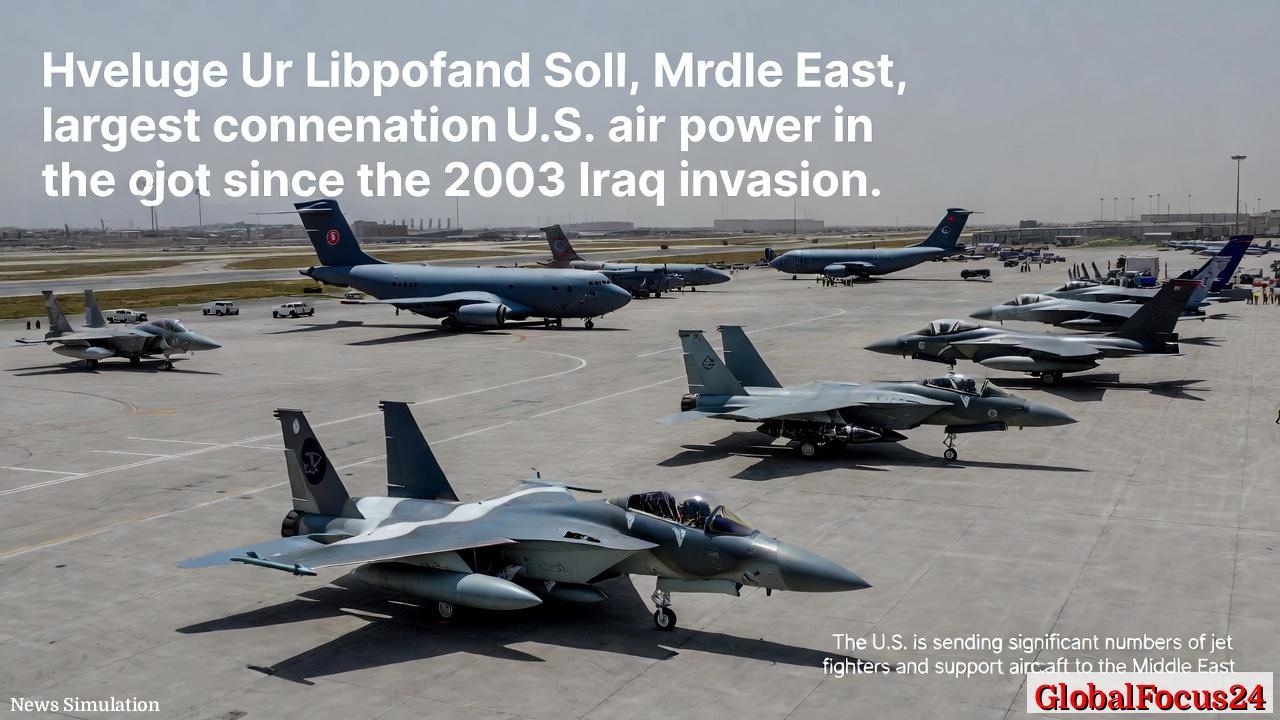
U.S. Military Buildup in the Middle East: Air Power at a Historic Scale
The United States is deploying a substantial number of jet fighters and support aircraft to the Middle East, marking the largest concentration of air power in the region since the early years of the 2000s. The movement signals a strategic emphasis on rapid response, deterrence, and crisis management in a landscape shaped by evolving regional threats, shifting alliance dynamics, and humanitarian considerations. As air assets stream into key bases and forward operating locations, analysts and regional observers are weighing implications for security, economy, and local communities.
Historical context: from the Gulf War to a new posture To understand the current deployment, it helps to look back at the arc of air power in the region. The Gulf War of 1991 demonstrated the transformative impact of integrated air campaigns, precision-guided munitions, and real-time command-and-control. In the years that followed, air力量 operations in the region became a core instrument of military planning, with coalition partners coordinating long-range strikes, air superiority missions, and intelligence, surveillance, and reconnaissance (ISR) campaigns. The 2003 invasion of Iraq amplified the role of air power as a decisive force multiplier, enabling ground operations and shaping postwar security challenges. Since then, regional airpower posture has continually evolved in response to emerging threats, including non-state actors, ballistic missile programs, and asymmetric warfare tactics. The current buildup draws on lessons from that era while leveraging modern stealth capabilities, networked sensors, and longer-range aircraft to project power from air bases and carrier operations alike.
Strategic objectives driving the buildup
- Deterrence and signaling: visible reinforcement serves to deter potential aggressors by demonstrating ready capability, speed, and reach. The aim is to deter destabilizing moves and reassure regional allies of U.S. commitments.
- Rapid crisis response: enhanced air power improves the ability to detect and respond to developing crises, including threats to aviation safety, critical infrastructure, or humanitarian corridors.
- Operational reach and flexibility: modern fighter jets, supported by aerial refueling, electronic warfare, and ISR, extend the United States’ reach into areas of strategic importance while maintaining a safer standoff for allied forces on the ground.
- Coalition interoperability: the deployment reinforces broader alliance frameworks, encouraging partner nations to coordinate defense planning, intelligence sharing, and joint air operations.
Economic impact: costs, contracts, and regional commerce Deploying a large air component involves substantial direct and indirect economic effects. The immediate costs include fuel, maintenance, wear on aircraft, and personnel readiness. However, these expenditures interface with a broader economic web:
- Defense contracting and supply chains: the movement sustains demand for spare parts, aircraft components, and maintenance services. Regional hubs can experience shifts in logistics activity as bases ramp up operations.
- Aviation and aerospace sectors: manufacturers and suppliers benefit from orders related to aircraft readiness, upgrades, and sustainment programs. Over time, continued investments can spur research and development in adjacent technologies such as stealth, sensors, and cybersecurity for air operations.
- Local economies near bases: host communities may observe changes in employment, housing markets, and service demand linked to rotating crews, civilian contractors, and support personnel.
- Global energy considerations: while not the sole driver, regional security dynamics influence energy markets—oil supply expectations, shipping routes, and pricing can reflect perceived risk in a geopolitically sensitive corridor.
Regional comparisons: how the current buildup stacks up
- Size and scale relative to past deployments: the present concentration of fighters and support aircraft represents one of the largest peacetime air power build-ups in the region since the early 2000s. By comparison, earlier phases of the post-9/11 era featured intensive campaigns with substantial carrier and airbase deployment. The current force posture emphasizes sustained presence, industrial capacity, and rapid mobility rather than a single, decisive campaign.
- Persisting threats and deterrence dynamics: today’s environment includes a broader set of challenges, from ballistic missile developments to unmanned systems and hybrid warfare tactics. Airpower strategies thus blend traditional air superiority with counter-ISR, counter-UAS, and cyber-physical risk management, reflecting a diversified threat matrix.
- Alliances and supply networks: regional cooperation with partner nations has intensified in recent years, expanding joint training, intelligence sharing, and interoperability exercises. This networked approach enhances operational resilience and helps distribute training and maintenance responsibilities across allied bases and facilities.
- Economic and political considerations: unlike some past episodes driven primarily by direct military objectives, the current buildup intersects with broader regional diplomacy, economic diversification efforts, and infrastructure resilience initiatives. The presence of air power is now part of a larger toolkit that includes humanitarian access, stabilization programs, and disaster response planning.
Operational implications for air crews and bases
- Readiness cycles and rotation: with a steady state of high alert, air crews undergo rigorous training cycles, mission planning, and fatigue management to maintain peak performance. Rotations are designed to preserve quartering, rest, and recovery time, while ensuring continuity of operations.
- Logistics and resupply: forward operating locations rely on a robust logistics chain for fuel, munitions, spares, and maintenance personnel. The efficiency of these replenishment pipelines directly affects sortie rates and mission availability.
- Intelligence and cyber dimensions: modern air power relies on fused intelligence, layered sensors, and robust cyber defense. Protecting command-and-control networks against interference and cyber threats is a critical element of mission success.
- Civilian safety and infrastructure: military air operations in populated or sensitive airspaces require careful coordination with civilian authorities, adherence to international norms, and robust risk assessments to minimize accidental engagements.
Regional humanitarian and societal considerations The presence of a sizable air power deployment has nuanced implications for civilian communities. On one hand, it can enhance medical evacuations, disaster response capabilities, and the rapid delivery of relief supplies in the event of a regional emergency. On the other hand, increased military activity may raise concerns about safety, civilian air traffic disruption, and the potential for escalation. Public communication efforts often accompany such deployments to provide accurate, timely information about expected activities, flight corridors, and safety protocols.
Technology and innovation: what the buildup signals for the future The current acceleration in air power deployments underscores advances in several technology domains:
- Stealth and survivability: next-generation fighters emphasize reduced radar cross-section, sensor fusion, and enhanced cockpit interfaces to improve decision speed in contested airspace.
- Range and endurance: aerial refueling, efficient engines, and lightweight materials extend mission duration and reach, enabling longer campaigns without frequent basing.
- ISR integration: real-time data links, satellite connectivity, and cloud-based command-and-control architectures enable faster, more coordinated responses across theaters.
- Electronic warfare and countermeasures: sophisticated jamming, deception, and cyber-resilience capabilities are integral to preserving freedom of maneuver in contested environments.
Public reactions and perception Public sentiment in host nations and allied capitals typically reflects a mix of support for security assurances and concerns about regional stability. Leaders emphasize that the buildup aims to deter aggression, protect civilians, and uphold international norms. Local media coverage often focuses on the practical impacts of air operations, including the safety of flights, the presence of foreign troops, and the educational and economic opportunities that can accompany sustained military engagement. Community programs, veterans’ services, and cultural exchange initiatives frequently accompany longer-term military footprints, helping to foster mutual understanding and collaboration.
Looking ahead: scenarios and strategic considerations Analysts anticipate several possible trajectories for the coming months and years:
- Stabilization via deterrence: sustained airpower facilitates a stable security environment, reducing the likelihood of rapid escalations while preserving diplomatic channels.
- Escalation risk and crisis management: as with any major deployment, there remains the possibility of rapid changes in regional dynamics requiring swift adaptation to evolving threats.
- Partnership deepening: enhanced interoperability may yield longer-term defense collaboration, joint exercises, and shared procurement advantages that benefit allied nations beyond the immediate theater.
- Economic ripple effects: premium on maintenance, training, and logistics could influence defense budgets and regional industrial activity, potentially driving investment in local suppliers and workforce development.
Conclusion: a pivotal moment for regional security architecture The current deployment of fighter jets and support aircraft to the Middle East signals a pivotal moment for regional security architecture. It reflects a strategic, multi-faceted approach that blends deterrence, rapid response, and alliance integration with a focus on resilience and humanitarian considerations. As the air power footprint grows, stakeholders—from policymakers and military planners to local communities and economic partners—will watch closely how this presence translates into steady stability, coordinated diplomacy, and sustainable economic activity. The true measure will be the degree to which the force projection enhances security, reduces uncertainty, and preserves the safety and prosperity of people living in a volatile but strategically critical region.