U.S. Expands Naval and Air Deployments Across CENTCOM, EUCOM, and INDOPACOM Regions Amid Rising Global Tensions
Expanding American Military Posture Across Three Theaters
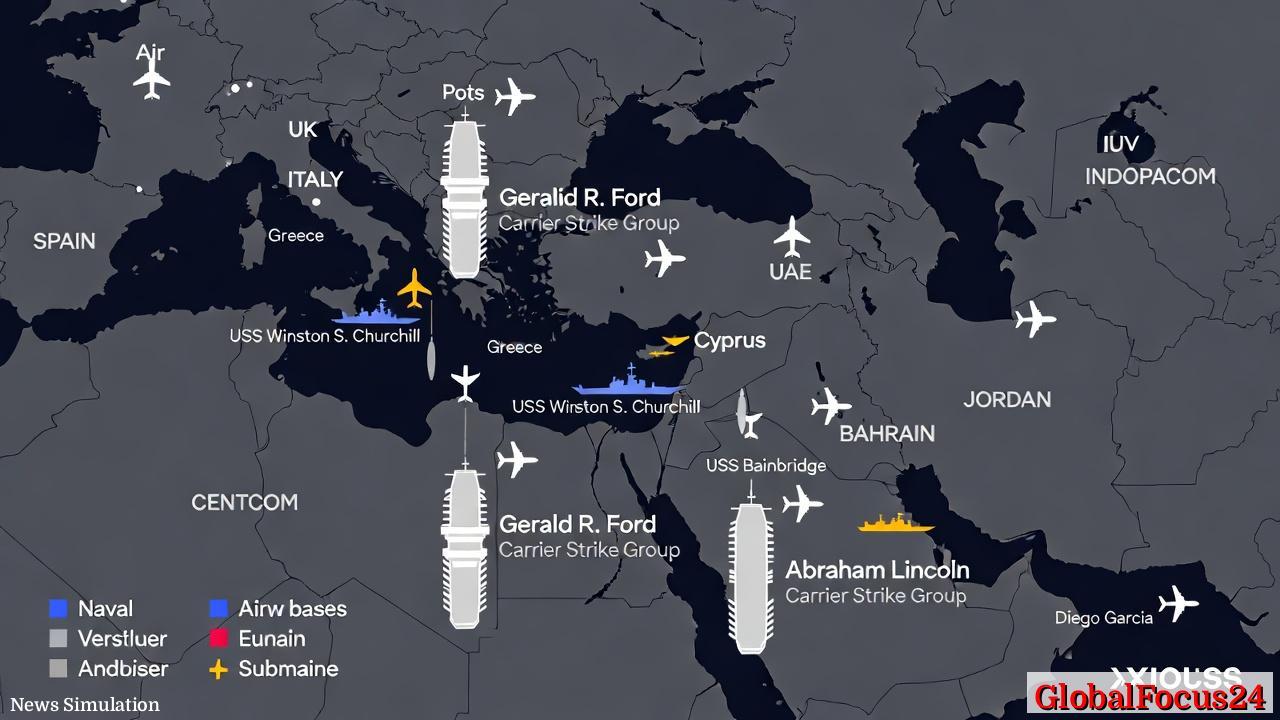
A detailed new map released in mid-February 2026 reveals an expanded and coordinated presence of U.S. naval and air forces across the Middle East, Europe, and the Indo-Pacific. The deployments reflect an increasingly complex global security environment, as the United States repositions major strike groups, aircraft squadrons, and support elements within the areas of responsibility of U.S. Central Command (CENTCOM), European Command (EUCOM), and Indo-Pacific Command (INDOPACOM).
At the heart of this strategic footprint are the Gerald R. Ford Carrier Strike Group (GRFCSG) and the Abraham Lincoln Carrier Strike Group (ABECSG)—two of the Navy’s most formidable carrier battle groups. Their current routes, locations, and compositions illustrate a posture designed to maintain deterrence, flexibility, and responsiveness amid regional uncertainties spanning from the Mediterranean to the Arabian Sea and beyond.
Gerald R. Ford Carrier Strike Group: Forward Presence and Transit
Centered on USS Gerald R. Ford (CVN-78), the GRFCSG serves as a key component of U.S. maritime deterrence and power projection. Accompanied by Carrier Air Wing Eight (CVW-8)—which includes squadrons such as the Tomcatters (VFA-31), Blacklions (VFA-213), and Gray Wolves (VFA-104)—the strike group maintains advanced multi-role capability, combining air superiority, strike, and electronic warfare assets.
Supporting the Ford are several Arleigh Burke-class destroyers, including USS Winston S. Churchill (DDG-81), USS Oscar Austin (DDG-79), USS Paul Ignatius (DDG-117), and USS Bainbridge (DDG-96), all equipped with Tomahawk Land Attack Missiles (TLAMs). These destroyers enhance the fleet’s strike reach and defense against both air and missile threats.
Illustrative transit routes on the current map show the Ford strike group moving from Atlantic positions through the Mediterranean Sea and toward the Middle East. This trajectory suggests flexibility for rapid reinforcement of either the Eastern Mediterranean or Red Sea operational zones—key corridors for U.S. and allied military logistics.
Abraham Lincoln Strike Group Anchors U.S. Posture in the Arabian Sea
The Abraham Lincoln Carrier Strike Group (ABECSG), led by USS Abraham Lincoln (CVN-72) and its embarked Carrier Air Wing Nine (CVW-9), is positioned in the Arabian Sea, a highly strategic location adjacent to the Gulf of Oman and Iranian maritime approaches. The wing’s squadrons—among them the Black Knights (VFA-154), Vigilantes (VFA-151), and Wizards (VAQ-133)—provide both offensive and defensive capabilities across air-to-air and air-to-surface spectrums.
The deployment of the ABECSG parallels earlier patterns observed during heightened regional tensions in previous decades, notably during operations in 1998 and 2020, when carrier groups were similarly stationed in the Arabian Sea to reinforce freedom of navigation and sustain strike readiness across CENTCOM missions. The return of a major strike group to this area underscores the enduring U.S. commitment to maritime security in one of the world’s most contested waterways.
Forward-Deployed Air Assets in Europe and the Middle East
Beyond naval movements, U.S. airpower remains pivotal to maintaining theater-level balance. In EUCOM, F-35 Lightning II squadrons, along with fourth-generation fighters, operate from key bases in the United Kingdom and Germany, forming a cornerstone of NATO’s integrated deterrence strategy. These assets enable rapid reinforcement of allied nations along NATO’s eastern flank and flexibility in air policing, reconnaissance, and strike missions.
Within CENTCOM, airfields across Jordan, the United Arab Emirates, and Bahrain host a mix of strike fighters, aerial refueling tankers, intelligence and surveillance aircraft, and heavy airlift platforms. Their presence gives U.S. commanders layered capability—ranging from precision targeting and reconnaissance to humanitarian response and partner training operations.
The concentration of air assets in Jordan, according to the new map, represents a continued shift toward regional basing diversification. This approach, developed over the past decade, is designed to reduce vulnerability to single-point attacks and to improve responsiveness across multiple hotspots, from the Levant to the Arabian Peninsula.
Naval Concentrations: Carriers, Destroyers, and Submarines
The map details a broad network of U.S. warships and support vessels extending across the Atlantic Ocean, Mediterranean Sea, Red Sea, Arabian Sea, and Indian Ocean. Each area features layered combinations of carrier strike groups, destroyers, submarines, and ships from the Military Sealift Command and U.S. Coast Guard.
Highlighted in the visualization are color-coded indicators: blue for aircraft carriers, red for destroyers, orange for submarines, and green for command elements. This clear representation shows not only the distribution but also the concentration of Tomahawk-capable destroyers in CENTCOM waters. Such a grouping suggests a readiness posture able to deliver long-range precision strikes within hours of command authorization.
The enduring presence of submarines, often unpublicized for operational security reasons, enhances undersea deterrence and intelligence gathering—critical components in modern naval warfare where stealth and data collection often shape the strategic advantage long before any conflict erupts.
Strategic Infrastructure: Air Bases and Ports
Across both Europe and the Middle East, American and allied air bases and naval ports provide critical anchors for sustained operations. The map marks locations including the United Kingdom, Italy, Spain, Greece, Cyprus, United Arab Emirates, Bahrain, Jordan, and Diego Garcia. Together these installations form a vast logistical architecture connecting three theaters.
From Souda Bay in Crete—known for its deep-water naval facilities—to Naval Support Activity Bahrain, the U.S. has maintained decades-long access agreements enabling repair, resupply, and surge deployments. Historically, this network evolved as early as the Cold War era and was further solidified during U.S. operations in the Persian Gulf, Kosovo, and Afghanistan.
In practical terms, such infrastructure ensures that carrier strike groups and air assets can operate for prolonged periods without degradation of tempo, projecting what the Pentagon describes as “persistent presence with rotational depth.”
Historical Context: Continuity Through Modernization
The layout and movement patterns visible in the February 2026 map echo strategic themes that have shaped U.S. force planning since the Second World War: forward presence, mobility, and layered deterrence. During the 1980s, the Navy’s “Maritime Strategy” emphasized a similar global reach across three major commands, using carrier battle groups to secure sea lanes and counter near-peer competitors.
Following the Gulf War and the post-9/11 campaigns, the United States transitioned toward a more flexible, rotational force posture. Carriers such as the Nimitz, Roosevelt, and Reagan routinely moved between EUCOM and CENTCOM waters, maintaining near-constant presence. The Ford-class carrier—the Navy’s latest—represents the modernization of that concept with improved radar systems, electromagnetic aircraft launch technology, and sustainability improvements enabling longer deployments with reduced crew strain.
In this sense, the February 2026 deployment is not a dramatic shift but rather an evolution in capability—an affirmation that global maritime dominance remains rooted in reliable logistics, airpower integration, and continuous technological advancement.
Economic and Regional Impact of Sustained Deployments
The economic implications of these operations extend far beyond defense budgets. Annual carrier strike group deployments contribute directly to allied economies through port visits, supply contracts, and regional maintenance partnerships. Ports in Spain, Italy, and Greece have benefited from decades of recurring fleet activity, supporting local shipyards and service industries.
In the Gulf region, U.S. military presences—particularly in Bahrain and the UAE—continue to underwrite maritime trade security for shipping lanes vital to global energy markets. The Strait of Hormuz and Bab el-Mandeb, two of the planet’s most critical chokepoints, rely on stabilization through consistent multinational patrols. Any disruption in these areas can ripple through international oil prices, shipping insurance costs, and regional investor confidence.
European nations, meanwhile, perceive U.S. naval visibility in the Mediterranean and North Atlantic as an assurance amid renewed concerns over territorial security. Increased exercises and rotations help sustain allied shipbuilding and maintenance industries, reinforcing transatlantic industrial and defense ties.
Broader Strategic Outlook
As of early 2026, the United States faces a world characterized by simultaneous challenges: maritime disputes in the Indo-Pacific, renewed strategic competition in Europe, and fragile ceasefires across the Middle East. The integrated patterns shown on the map depict a deliberate balancing act—maintaining readiness across multiple fronts without overextending any single command.
By linking deployments across CENTCOM, EUCOM, and INDOPACOM, U.S. planners preserve operational continuity, enabling assets to flow between theaters as conditions demand. In practice, such modular force flexibility allows Washington to deter aggression while keeping diplomatic and economic channels open.
While the map does not indicate any imminent conflict, it underscores the growing recognition that deterrence today depends not just on weapons but on logistics, coordination, and visible presence. The detailed representation of command elements and ship types serves as both a status snapshot and a reminder of global U.S. commitments at the midpoint of the decade.
Sustaining Global Deterrence Through 2026 and Beyond
The updated deployment map illustrates more than just the disposition of ships and aircraft—it captures the essence of modern maritime strategy: sustained readiness in an unpredictable world. With two carrier strike groups active across CENTCOM and EUCOM waters, robust airpower forward-deployed in Europe and the Middle East, and a network of ports spanning three continents, the United States continues to demonstrate its capacity to project stability and deterrence across multiple theaters.
As the year unfolds, these movements will likely influence ongoing diplomatic and security calculations worldwide. From partners seeking reassurance to competitors measuring resolve, the balance of power at sea and in the skies remains a decisive factor shaping the security landscape of 2026.