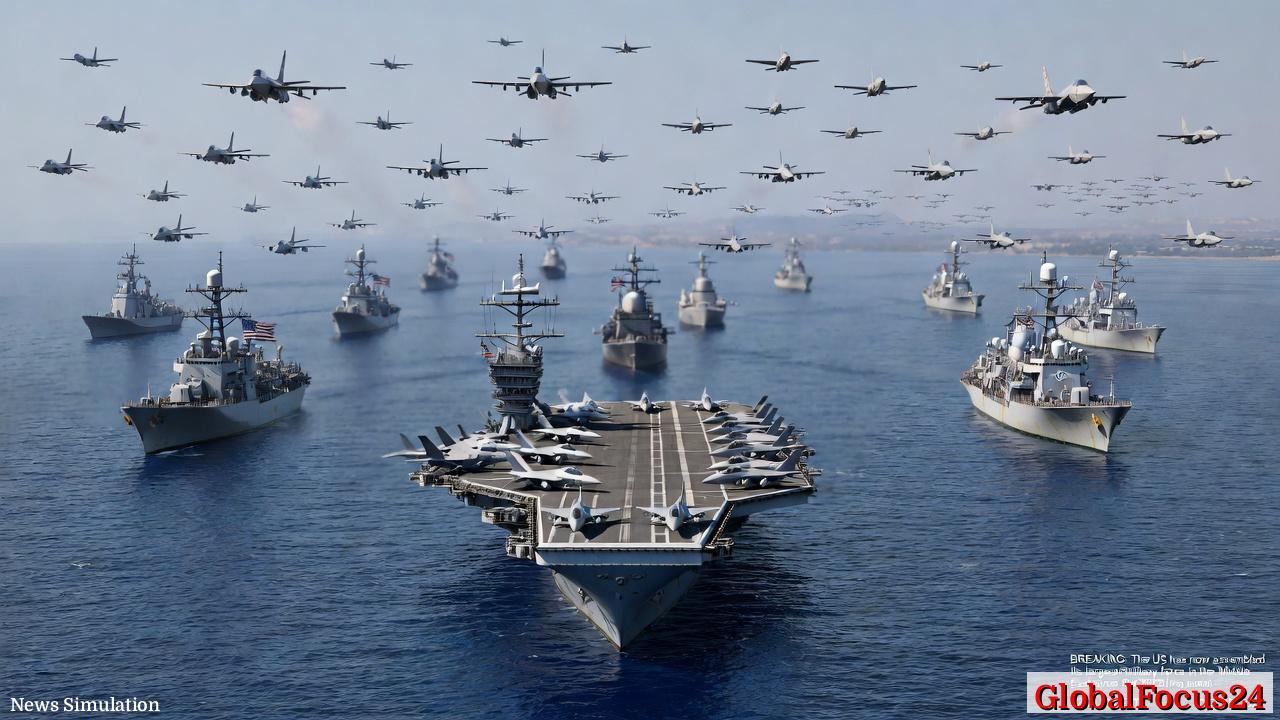
U.S. Mobilizes Largest Middle East Force Since 2003 as Regional Tensions Escalate
A Major Show of Force
In a move described by defense analysts as the most significant U.S. military buildup in the Middle East in over two decades, the United States has deployed a vast array of naval, air, and logistical assets to the region. The deployment includes two aircraft carrier strike groups, 12 supporting warships, and hundreds of aircraft — among them advanced F-35, F-22, and F-16 fighter jets. Over 150 cargo flights have ferried essential equipment and personnel, with an additional 50 fighter jets expected to arrive within 48 hours.
Officials familiar with the buildup indicate the sharp increase in force projection aims to deter potential escalations and reassure allies amid rapidly intensifying regional tensions. The mobilization has already influenced global markets, sending oil prices to new six-month highs and sparking renewed debate over the prospects for stability across the Gulf.
Echoes of the 2003 Iraq Invasion
The scale of the current deployment has drawn immediate comparisons to the 2003 Iraq invasion, when U.S. military strength in the region peaked with hundreds of thousands of troops and a massive air-naval presence staged in the Persian Gulf. Although the present operation has not yet been designated for active combat, its scope represents the largest U.S. force concentration in the Middle East since that era — a clear signal of Washington’s strategic intent.
In contrast to 2003, when the buildup preceded a full-scale invasion, the current posture reflects an effort to signal deterrence rather than prepare for conventional war. Military officials describe it as a preemptive stabilizing move, designed to ensure freedom of navigation in critical shipping routes, protect regional partners, and maintain rapid-response capability should tensions spill into open conflict.
Global Oil Markets Respond
Energy markets reacted almost immediately to news of the deployment. Brent crude rose sharply, surpassing its previous yearly high, while U.S. benchmark West Texas Intermediate (WTI) followed suit. Analysts attribute the spike to heightened concerns over potential supply disruptions in key maritime corridors, especially the Strait of Hormuz — a narrow passageway through which roughly one-fifth of the world’s oil supply transits daily.
Historically, any sign of instability in the Gulf triggers sensitive price fluctuations. During the late 1970s oil crises and the Gulf War of 1990–91, similar fears of shipping bottlenecks drove global markets upward. The present situation has reintroduced a familiar calculus: geopolitical uncertainty inflates premium pricing. Refiners and traders are already recalibrating supply chains and insurance rates for tankers passing through contested waters.
Military Composition and Strategic Reach
While the Pentagon has not disclosed the specific locations of the newly deployed forces, defense analysts suggest that assets are positioned strategically around the Arabian Peninsula, the Red Sea, and the Eastern Mediterranean. The presence of two U.S. aircraft carriers dramatically expands operational reach, allowing simultaneous air operations across multiple regional theaters.
The accompanying 12 warships provide layered defense against aerial, surface, and missile threats, supported by advanced Aegis-equipped destroyers capable of intercepting ballistic and cruise missiles. Air defense systems, including Patriot and THAAD batteries, have reportedly been deployed to safeguard bases and allied territories. The overall configuration reflects an integrated deterrence model — projecting power while allowing rapid redeployment depending on emergent threats.
Historical Patterns of Regional Buildups
This latest mobilization fits a long pattern of U.S. force surges to deter regional instability. Notable precedents include the 1990 Gulf War buildup following Iraq’s invasion of Kuwait, the 2014 anti-ISIS coalition campaign, and earlier responses to attacks on shipping or U.S. facilities. Each event underscored Washington’s enduring security commitments to its allies in the Gulf Cooperation Council and the broader Middle East.
Even after substantial troop drawdowns from Iraq and Afghanistan, U.S. strategic doctrine has consistently emphasized flexibility — the ability to “surge” forces into the region when circumstances demand. The current deployment appears to be another iteration of that philosophy, balancing deterrence with adaptability.
Economic Ripples Beyond Energy
The ripple effects of heightened military presence are being felt far beyond the oil sector. Equity markets saw modest declines following the announcement, with defense and aerospace stocks outperforming amid expectations of prolonged engagement or increased procurement. Shipping insurers began reconsidering risk premiums for routes through the Persian Gulf and Red Sea, citing potential hazards to commercial traffic.
Regional economies that depend heavily on maritime trade, particularly the United Arab Emirates and Saudi Arabia, are moving quickly to reassure investors of continued stability. Analysts note that while energy exporters may benefit in the short term from elevated oil prices, sustained tension could undercut tourism, infrastructure investment, and supply chain operations vital to Gulf diversification agendas.
For import-dependent economies in Asia and Europe, rising fuel costs come at an already fragile economic moment. Many have only recently recovered from inflationary pressures linked to earlier supply chain disruptions. A protracted standoff could revive inflationary headwinds globally, tightening fiscal space for central banks working to stabilize consumer prices.
Regional Comparisons and Reactions
In regional comparison, this deployment dwarfs recent Western military movements. European Union contributors have maintained smaller naval missions in the Red Sea and Arabian Gulf, primarily focused on anti-piracy and security patrols. Russia and China have also increased their naval presence in the Indian Ocean, though neither approaches the scale of the current U.S. mobilization.
Regional governments have offered measured responses. Gulf capitals reportedly welcome the deterrence message, viewing the display as essential to maintaining stability along key shipping and energy corridors. Meanwhile, other regional actors have warned of the risks of large-scale deployments further escalating tensions by miscalculation or misunderstanding.
Observers recall that previous U.S. carrier strike group deployments have sometimes served as effective signaling tools — reducing hostilities without direct confrontation. The challenge now lies in sustaining that balance amid a volatile environment where even small provocations can produce disproportionate consequences.
The Logistics Behind the Mobilization
Behind the scenes, the logistics of moving such a vast concentration of assets are extraordinary. The 150-plus U.S. Air Force cargo flights have transported precision munitions, vehicles, communications gear, and critical infrastructure to forward bases. Satellite imagery confirms expanded activity at several regional airfields, including visible stockpiling of supplies and maintenance equipment.
Carrier strike groups represent floating cities, each with thousands of sailors and dozens of aircraft. Coordinating their movements requires synchronization across air, sea, and cyberspace. Support ships carry fuel, ammunition, and medical facilities to sustain long-duration operations, demonstrating a high state of readiness that few nations can match.
The rapid tempo of deployment highlights advances in logistical coordination capabilities since the early 2000s. Improved modular shipping containers, digital tracking systems, and autonomous maintenance tools allow faster, more efficient mobilization than during previous build-ups.
Implications for U.S. Foreign Policy
While the Pentagon frames the deployment as routine deterrence, the timing suggests broader strategic implications. The U.S. continues to maintain alliances and base agreements throughout the Gulf, and the presence of advanced aircraft like the F-35 and F-22 underscores an intent to maintain air superiority across potential flashpoints. These aircraft also serve as a visible reassurance to partners who depend on U.S. defense commitments.
Experts caution that prolonged military concentration can strain resources elsewhere, particularly in regions like the Indo-Pacific or Eastern Europe where U.S. commitments are also intense. Balancing simultaneous theaters of operation demands acute strategic prioritization — a challenge the Department of Defense has faced repeatedly since the end of the Cold War.
Public and Market Sentiment
Public reaction in the U.S. reflects a mixture of concern and cautious support. Polls show Americans prefer to avoid new ground conflicts, yet they favor strong responses to perceived threats to allies or shipping lanes. Economically, consumers are likely to feel any sustained increase in fuel prices quickly, renewing domestic debates over energy security and reliance on foreign oil flows.
Markets are watching closely. Analysts note that while oil rallying can benefit energy producers, prolonged price volatility could harm broader market confidence. Traders remain alert for any sign of direct confrontation that would elevate risk levels across commodities and equities alike.
What Comes Next
For now, the deployment underscores a broader message of deterrence through strength. U.S. officials have not disclosed the expected duration of the operation, though historically such mobilizations have lasted weeks to months depending on evolving conditions. The central aim remains maintaining open sea lanes, protecting regional allies, and preventing small-scale confrontations from escalating into wider conflict.
The coming days will be critical as additional fighter jets arrive and posture adjustments continue across the region. How other powers and non-state actors interpret this display of force will determine whether it stabilizes or inflames an already uneasy landscape.
The world watches closely, aware that in this part of the globe, the line between deterrence and escalation has always been perilously fine — and history has shown how swiftly events in the Middle East can reshape global security and economic stability.