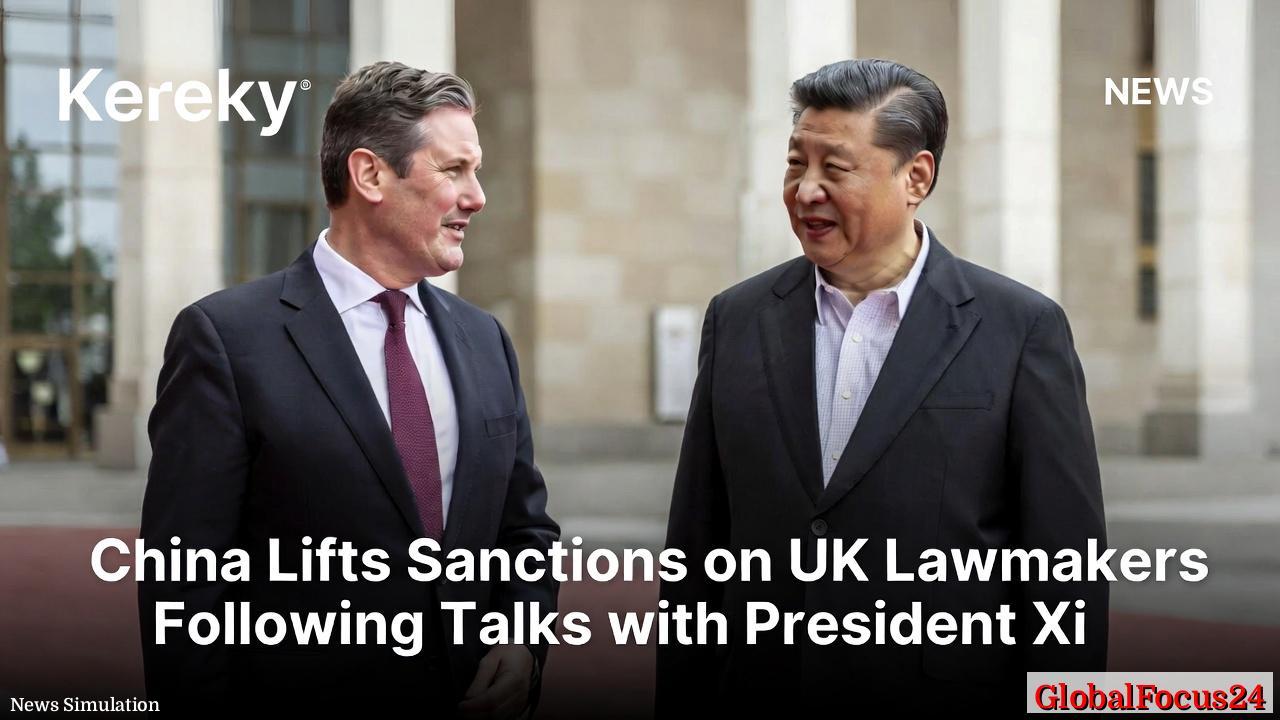
China Lifts Sanctions on UK Lawmakers in Major Step to Reset UK-China Ties
In a strategic move signaling a potential recalibration of post-pandemic relations, Beijing. has announced the removal of sanctions and travel bans on six serving UK parliamentarians, including four Conservative MPs and two Lords, following a high-level meeting between Prime Minister Keir Starmer and President Xi Jinping in Beijing. The decision marks a notable shift from a period of punitive measures and diplomatic frictions that stretched back to 2021, when the United Kingdom imposed sanctions over alleged human rights concerns in Xinjiang. The Chinese government’s statement confirmed that the restrictions no longer apply and extended a welcome to all UK parliamentarians considering future visits to China.
Historical context: a decade of growing friction and diplomacy
The last decade has seen a rolling series of disputes between the two nations that began to intensify in the mid-2010s and culminated in a bilateral chill during the early 2020s. UK concerns over human rights, trade practices, technology security, and geopolitical alignments with Western partners in Europe and North America fostered a widening gap. London responded with sanctions aimed at specific Chinese officials, manufacturing a consequential ripple in diplomatic channels. In response, China imposed counter-sanctions on a subset of UK lawmakers and entities, creating a landscape where parley and practical cooperation seemed increasingly difficult.
Amid the tension, both sides pursued a broader objective: maintaining open lines of communication while avoiding a full-blown decoupling in strategically sensitive sectors. The removal of sanctions on UK legislators signals an intent to reframe the relationship from punitive tit-for-tat measures to a more functional, issue-driven dialogue. For Beijing, restoring parliamentary goodwill complements broader trade and investment goals and underscores Xi’s willingness to engage foreign partners on terms that emphasize mutual interests. For London, the move may reduce the political heat around parliamentary travel and encourage new channels for discussion on global challenges ranging from climate to finance.
Economic impact: potential cascade effects across trade, investment, and finance
From an economic standpoint, sanctions and counter-sanctions create costs that ripple through markets, supply chains, and investment decisions. The lifting of restrictions on UK lawmakers could ease a layer of friction that has, at times, complicated high-level business negotiations and joint projects. The timing aligns with ongoing British efforts to diversify its trade relationships post-Brexit and to explore avenues for collaboration in technology, green energy, and financial services. While the immediate near-term financial effects of this specific policy change may be modest, the policy signal matters: it increases the likelihood of smoother, more predictable diplomatic engagements, which in turn can support confidence among business leaders, investors, and multinational firms with exposure to both markets.
Investors typically watch for any resurgence of predictable policy environments. In the conventions of international economics, improved political risk perception tends to lower the risk premium on cross-border investments and can support currency stability, bilateral contracts, and joint ventures. For sectors that rely on long planning horizons—such as infrastructure, energy, and manufacturing—regulatory clarity and stable diplomatic channels reduce the risk of sudden disruptions. The lifting of sanctions also interacts with incentive structures for technology transfers, research collaborations, and academic exchanges—areas where both nations have previously demonstrated appetite for cooperation despite broader strategic tensions.
Regional comparisons: how this move fits into broader Asia-Pacific and Europe geopolitics
Comparative regional patterns show that countries pursuing strategic engagement with major powers often pursue a mix of sanctions relief, dialogue, and economic collaboration to balance competing interests. In Europe, several nations have sought to maintain pragmatic ties with China while upholding values and standards on issues such as human rights and trade practices. The United States, meanwhile, has generally remained wary of rapid concessions that could compromise core security or technological leadership, instead favoring a calibrated mix of sanctions, export controls, and alliance-driven diplomacy.
Within Asia, China’s outreach to Western partners has included high-profile diplomacy coupled with targeted economic initiatives. The sanctions relief for UK lawmakers may be viewed as part of a broader strategy to de-risk bilateral relations with long-standing partners while continuing to assert Beijing’s stance on core sovereignty and governance. For the UK, this move comes as part of a broader effort to re-engage China on global issues such as climate cooperation, supply-chain resilience, and financial services connectivity, while navigating domestic debates about human rights, national security, and post-Brexit economic strategy.
Public reaction: a mix of cautious optimism and scrutiny
Public sentiment around the sanctions relief is likely to be mixed. Supporters may describe it as a practical step toward stabilizing a key international relationship that can benefit business, science, and cultural exchange. Critics may emphasize the need for continued accountability on human rights and rule-of-law concerns, underscoring that diplomatic gestures should be matched by sustained commitments to transparency and human rights safeguards. In parliamentary chambers and think-tank discussions, analysts will likely examine how this development affects the balance of power in bilateral negotiations, the tempo of upcoming trade talks, and the potential for joint policy initiatives in climate, finance, and technology.
Implications for UK-China dialogue going forward
The sanctions relief sets a precedent for a more expansive UK-China dialogue framework. Observers will be watching for concrete outcomes, such as scheduled high-level discussions on trade arrangements, investment guarantees, and regulatory alignment in areas like data governance and environmental standards. The move could accelerate a roadmap for collaboration, particularly in sectors where both countries see strategic value, including renewable energy, electric vehicles, and advanced manufacturing. It also raises questions about the pace and scope of political commitments that accompany business-friendly arrangements, such as reciprocal buyer-seller assurances, market access improvements, and collaborative research programs.
Security considerations and regulatory oversight
While economic and diplomatic benefits are plausible, security concerns remain a critical part of the equation. Policymakers in both capitals are likely to review export controls, supply chain integrity, and critical technology stewardship to prevent dual-use technologies from shifting into unintended hands. The sanctions relief on lawmakers does not automatically erase lingering concerns about governance, cyber security, or foreign interference risks. Instead, it may prompt a more formalized approach to risk assessment, with clearer channels for monitoring and transparency in future engagements. Businesses should stay attuned to potential regulatory shifts and ensure compliance across cross-border operations, especially when dealing with sensitive technologies or strategic sectors.
Historical context enriches understanding of this turning point
To understand the significance of this development, it helps to recall past milestones in UK-China relations. The 2010s established a pattern of growing economic interdependence tempered by political and human rights debates. The early 2020s introduced a sharper divergence as the geopolitical landscape intensified, with allied countries coordinating responses to shared concerns about governance and security. In this frame, the current sanctions relief can be seen as a recalibration moment—an attempt to recouple diplomatic engagement with pragmatic economic and scientific collaboration, while acknowledging that the underlying disagreements remain or will require ongoing dialogue.
What this means for regional partners and global markets
For regional partners in Europe and Asia, the incident is a reminder that bilateral relations in a multipolar world can shift with high-level diplomacy. Multinational corporations with diversified footprints in both the UK and China may adjust project timelines and investment appetites in response to new expectations for cooperation. Trade partners across the Asia-Pacific region, as well as European allies, will be watching to see if similar steps follow in other capitals or if this remains a selective, case-by-case policy adjustment. In global markets, the signal is that major economies are gradually normalizing certain channels of engagement after periods of strain, which could contribute to greater predictability in international trade and investment climates.
Operational challenges and opportunities for UK policymakers
UK policymakers now face the task of translating this diplomatic overture into tangible policy outcomes. Key opportunities include:
- Expanding dialogue on clean energy cooperation, including wind, solar, and grid modernization initiatives.
- Strengthening financial services collaboration, such as cross-border investment platforms and regulatory harmonization where feasible.
- Advancing educational and cultural exchanges that cultivate long-term goodwill and expertise in both countries.
- Aligning standards and certifications to facilitate smoother trade in strategic goods and consumer products.
- Coordinating with international partners to ensure that any engagement remains consistent with global human rights norms and international law.
At the same time, policymakers must remain vigilant about potential risks:
- The possibility of backsliding if core human rights concerns re-emerge in future negotiations.
- The specter of strategic competition intensifying in other domains, including technology and military affairs.
- The need to preserve the integrity of supply chains in critical sectors while pursuing openness and collaboration.
Conclusion: a pragmatic pivot with long-term implications
The lifting of sanctions on six UK lawmakers marks a pragmatic pivot in UK-China relations, signaling an intent to re-open channels for dialogue, economic cooperation, and mutual risk management. While it does not resolve deeper disagreements, it creates a more navigable environment for discussions on trade, climate, finance, and technology. For the UK, it aligns with a broader strategy to diversify partnerships and to pursue multilateral solutions in a shifting global order. For China, it reinforces a message that selective diplomacy and controlled engagement can unlock opportunities in one of the world’s most consequential bilateral relationships.
As the two countries chart the next phase, observers will look for substantive outcomes that translate diplomacy into measurable benefits—lower barriers to commerce, clearer regulatory pathways, and sustained commitments to governance principles that support a stable, prosperous, and interconnected global economy. The world will watch closely as Parliament, business leaders, and civil society assess how this development reshapes the cadence of UK-China cooperation in the coming months and years.