Tucker Carlson Accuses Trump of Betraying ‘America First’ with Iran War
Rising Conservative Rift Over Trump’s Foreign Policy Shift
Former Fox News host Tucker Carlson has publicly accused President Donald Trump of abandoning the “America First” principle that defined his political rise, following the administration’s military engagement in Iran. Carlson’s sharp criticism marks one of the most visible fractures within the conservative movement since Trump’s return to power—an ideological clash that signals broader uncertainty over the future of the nationalist agenda that reshaped U.S. politics over the past decade.
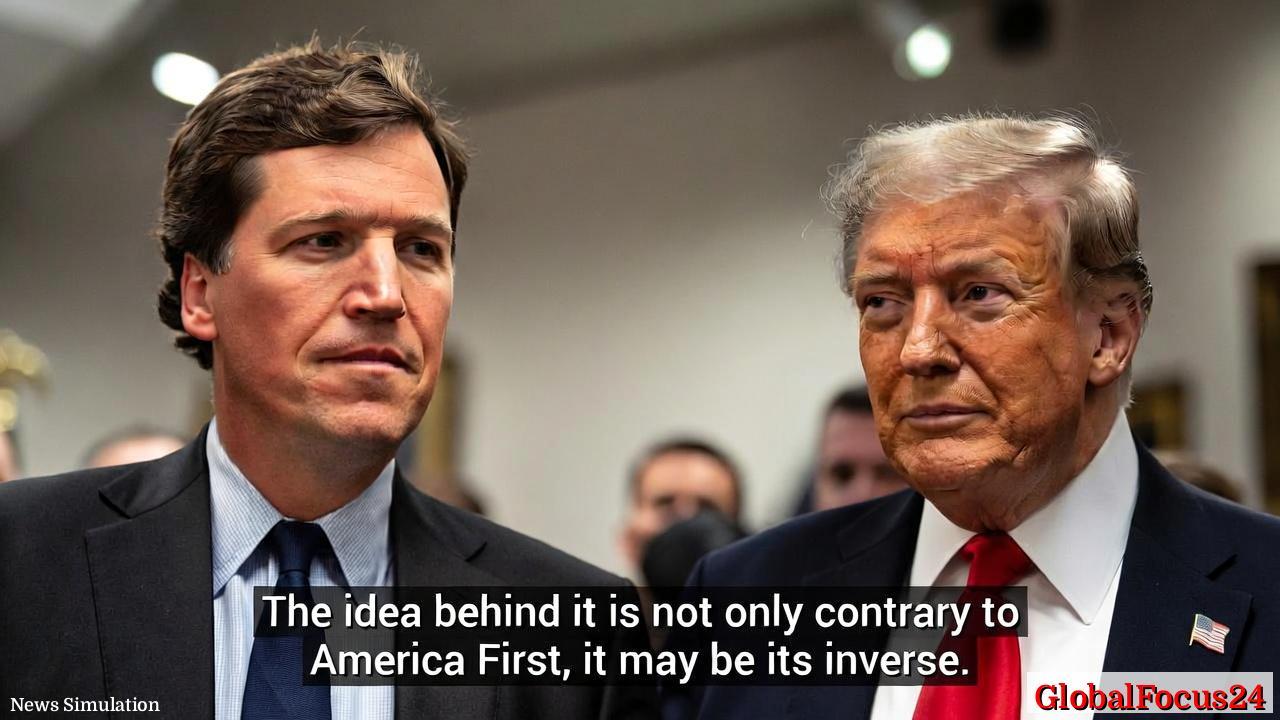
“This war is something that he promised he wouldn’t do, not once but countless times,” Carlson said in a recent broadcast. “The idea behind it is not only contrary to America First, it may be its inverse.” He described the decision to strike Iran as “absolutely disgusting and evil,” claiming the operation was carried out “on Israel’s timetable rather than America’s interests.”
Trump dismissed the rebuke as a personal betrayal, saying Carlson has “lost his way” and is “no longer part of the MAGA movement.” The exchange—once unthinkable between two of the movement’s closest allies—has laid bare a philosophical divide over how America should wield its global power.
From Allies to Adversaries
For years, Tucker Carlson stood as one of Trump’s most influential media allies. During the 2024 campaign, he not only endorsed Trump but reportedly played a role in shaping the administration’s nationalist message and even the selection of his running mate. Carlson’s presence at Trump victory events, including the election-night gathering at Mar-a-Lago, symbolized their shared populist crusade.
Now, that alliance has shattered. Carlson’s condemnation of the Iran war reveals deep ideological tension between populist isolationists, who see global conflicts as a drain on American resources, and interventionists within the Trump administration who frame the strikes as necessary for deterrence and security.
His outrage is reminiscent of his past critiques of U.S. foreign entanglements under both Republican and Democratic leadership. Long before his break with Trump, Carlson emerged as one of television’s most outspoken critics of the Iraq War and the post-9/11 interventionist consensus. His latest statements revive those themes and have ignited fresh debate among conservatives over whether the United States can claim to be “America First” while waging another Middle Eastern campaign.
Historical Context: A Movement Built on Non-Intervention
The “America First” philosophy that propelled Trump to power in 2016 drew deeply from early 20th-century American isolationism—a popular sentiment before the U.S. entered World War II. It called for prioritizing domestic prosperity and avoiding foreign entanglements, arguing that overseas wars often failed to serve American working families.
When Trump used the phrase during his first campaign, it resonated with voters disillusioned by decades of global military commitments. His administration’s 2016–2020 record featured few new wars, and in 2021, Trump repeatedly criticized the “endless wars” in the Middle East. By contrast, his current engagement in Iran marks a dramatic turn from that doctrine, reigniting questions about whether any president can fully disengage America from its long-standing global military obligations.
Political historians note that similar pivots have occurred throughout U.S. history. Presidents from Woodrow Wilson to Ronald Reagan campaigned on restraint but later found themselves confronting crises that reshaped their foreign policies. Trump’s Iran operation, some analysts argue, fits that historical pattern—a point of tension between ideological promises and geopolitical realities.
The Strategic and Economic Costs
Beyond the political drama, the conflict with Iran has already sparked measurable economic consequences. Markets reacted sharply to news of American air and naval operations, with oil prices surging above $100 per barrel—their highest level since 2022. Increased fuel costs threaten to ripple through transportation, manufacturing, and agriculture sectors, potentially stalling the modest post-pandemic recovery and complicating the Federal Reserve’s delicate inflation management.
Defense spending has also spiked, as Congress moves to fund additional deployments across the Persian Gulf and Eastern Mediterranean. Economists warn that renewed overseas military operations often carry hidden fiscal burdens. The wars in Afghanistan and Iraq, for instance, cost U.S. taxpayers more than $2 trillion, according to estimates by Brown University’s Costs of War project.
Energy analysts caution that prolonged instability in the Strait of Hormuz could further strain global supply chains. Approximately 20 percent of the world’s petroleum passes through the narrow waterway, and any disruption risks steep price increases globally. The resulting inflationary pressure could test consumer confidence and reshape electoral politics heading into the 2026 midterms.
A Movement Divided
Carlson’s critique has found receptive audiences among parts of the conservative base that remain skeptical of U.S. intervention abroad. Figures aligned with the populist right, libertarian circles, and some veterans’ groups have echoed his language, calling the Iran escalation a “betrayal” of the core promise that vaulted Trump to power: prioritizing domestic renewal over foreign conflict.
Conversely, many in Trump’s orbit defend the strikes as an act of strength and deterrence following Iranian aggression against American allies. They argue that Trump’s decision demonstrates both resolve and prudence, preventing wider regional escalation by taking decisive action early.
The resulting divide reflects broader ideological realignment inside the Republican coalition. Traditional hawks—once dominant under George W. Bush—now contend with nationalist populists skeptical of global intervention. Carlson’s denunciation underscores that these tensions have not dissipated, but rather deepened, as fresh crises test the coherence of the “America First” worldview.
Regional Comparisons: The Iranian Front vs. Past Conflicts
The unfolding campaign in Iran differs sharply from prior U.S. engagements in Iraq, Afghanistan, or Syria. Early assessments describe a limited but intensifying conflict, driven primarily by targeted airstrikes rather than large-scale troop deployments. Defense analysts compare the approach to early 2020s shadow operations designed to project power without committing to long-term occupation.
However, critics warn that such “limited wars” often expand over time. In Iraq, what began as precision missions in 2003 evolved into a protracted occupation lasting nearly a decade. Even smaller campaigns, like the anti-ISIS mission in Syria, revealed how regional complexities can entangle the United States far longer than anticipated.
Other regional powers, including Saudi Arabia and Turkey, have reacted cautiously but supportively toward the U.S. operation, viewing Iran’s destabilizing role as a shared threat. European leaders, meanwhile, express concern that renewed conflict could derail fragile nuclear diplomacy and spark a fresh refugee crisis. The contrast between U.S. assertiveness and European restraint highlights competing transatlantic views on security and strategy—a familiar tension dating back to NATO divisions during the Iraq War.
Domestic Reaction and Political Implications
Public opinion in the United States remains divided. Early polling indicates that while many Americans back strong responses to Iranian provocations, a significant segment opposes new military commitments overseas. This ambivalence reflects persistent fatigue from two decades of Middle Eastern conflict and the lingering social costs on veterans and their families.
Carlson’s comments have amplified that debate, driving online discussions and reshaping conservative media narratives. On his podcast, which now attracts millions of listeners weekly, Carlson argues that the real danger lies not only in war’s cost but in what it reveals about the limits of political promises. “Voters were told no more foreign wars,” he said. “And yet here we are again.”
For Trump, the political calculus is complex. The president has framed the Iran offensive as a limited defensive measure, emphasizing national security while insisting it will not become another endless engagement. Yet politically, even a short-term conflict could test support among swing voters who once rallied behind his anti-war pledges.
The Future of “America First”
The dispute between Trump and Carlson is more than a personal falling-out—it represents a crossroads for the broader nationalist movement that helped redefine U.S. conservatism. Whether the phrase “America First” endures as a viable organizing principle may depend on how deeply this Iran conflict drags the country into another open-ended struggle abroad.
If the war expands, it could accelerate a return to the pre-2016 status quo: a Republican Party divided between global interventionists and isolationists, with neither side fully dominant. But if the conflict remains contained, Trump might yet preserve his populist appeal while reshaping what “America First” means in practice—an evolution from non-intervention to selective assertion of power.
For now, Carlson’s blast has forced an uncomfortable reckoning among conservatives: whether loyalty to movement leaders outweighs loyalty to the principles that built the movement itself. As the situation in Iran unfolds, the question persists—can a nation promise to put itself first while stepping once again into the moral and strategic quicksand of war?