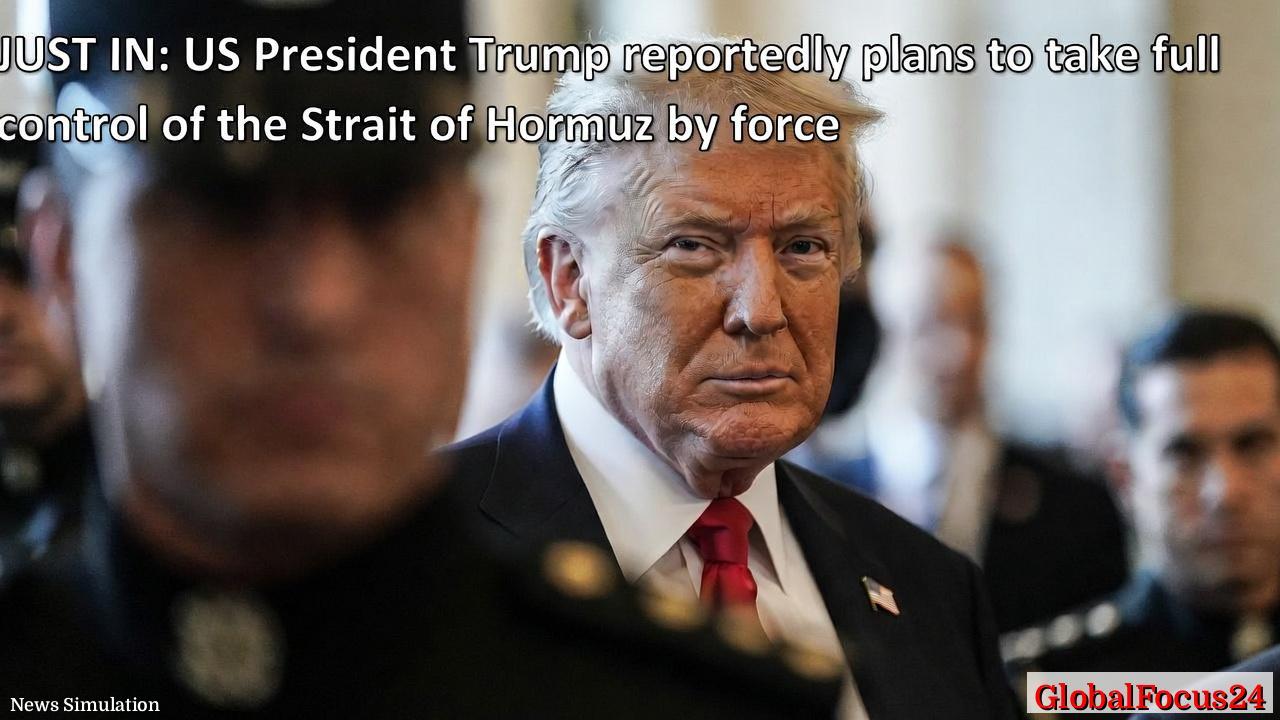
Trump Reportedly Plans to Assert U.S. Control Over Strait of Hormuz Amid Rising Global Tensions
A Strategic Flashpoint in Global Trade
The Strait of Hormuz, a narrow waterway linking the Persian Gulf with the Gulf of Oman, has long been one of the world’s most geopolitically sensitive choke points. Roughly one-fifth of the planet’s crude oil and petroleum products pass through its confines every day, making it an indispensable artery for global energy supply and a barometer for the health of international trade routes.
Now, reports indicating that U.S. President Donald Trump plans to take full control of the strait “by force” have sent waves of concern across global markets and diplomatic channels. While details of the plan remain unclear, the mere suggestion has reignited debate over U.S. military presence in the Middle East and the fragile balance of power in one of the most volatile maritime regions on Earth.
The Stakes: Control Over Global Oil Flow
The 21-mile-wide passage is the maritime lifeline for oil-rich nations such as Saudi Arabia, Kuwait, the United Arab Emirates, and Iraq. Every tanker sailing through its waters carries cargo that fuels industries from Tokyo to London. Even minor disruptions — a grounded ship, a skirmish, or heightened tension — can move markets by billions of dollars.
Should the United States attempt to assert unilateral control, experts warn that the move would upend existing norms governing international waters. It could also provoke fierce resistance from Iran, which borders the northern shoreline of the strait and claims a historic role in regulating passage. Tehran has frequently used the waterway to project influence, occasionally seizing or harassing foreign tankers during periods of confrontation.
Oil analysts note that even the perception of potential military conflict near the Hormuz corridor drives prices upward. In 2020, for example, a U.S.-Iran clash briefly pushed crude futures up by over 3%. Today, with energy markets already unsettled by shifting demand and supply realignments, renewed military escalation would risk a shock reminiscent of the oil crises that defined much of the twentieth century.
A Historical Cycle of Confrontation
The Strait of Hormuz has been at the heart of U.S.-Iranian tensions for decades. During the 1980s Iran-Iraq War, the “Tanker Wars” saw repeated attacks on commercial vessels, leading the U.S. Navy to launch Operation Earnest Will — a campaign to escort reflagged Kuwaiti tankers under the American flag. That mission established a precedent for U.S. military involvement in Gulf shipping lanes that persists to this day.
In more recent years, the strait has become a testing ground for power projection between the United States and Iran. Following Washington’s withdrawal from the Iran nuclear agreement in 2018, Tehran began harassing oil tankers and conducting naval drills along its coast. The Trump administration at that time responded with sanctions and expanded naval patrols in the region, vowing to ensure freedom of navigation.
Veterans of U.S. foreign policy note that the new reports echo those earlier doctrines of control, but the explicit suggestion of “taking full control by force” marks a sharp rhetorical escalation. The scenario raises questions about whether Washington seeks a temporary show of dominance or a long-term reconfiguration of security governance in the Gulf.
Global Economic Ripples
The Strait of Hormuz’s significance extends far beyond regional politics. About 85% of the crude that passes through the strait is destined for Asian markets, notably China, India, Japan, and South Korea. A U.S. takeover attempt could force these economies to reassess supply lines and increase reliance on alternative routes such as pipelines across Saudi Arabia or the UAE. However, those alternatives can handle only a fraction of the strait’s daily load.
Financial markets have already responded with heightened volatility. Brent crude futures spiked more than 4% in early trading following the reports, while energy-sector stocks experienced similar surges amid investor speculation of forthcoming disruptions. Shipping insurers, meanwhile, are closely monitoring the situation, as higher risk premiums could make the transport of oil in the region prohibitively expensive for smaller operators.
Economic analysts warn that sustained tension could push inflation upward globally. Higher energy costs often cascade into price hikes for goods, materials, and transport, imposing widespread effects far beyond the oil industry. With several major economies still contending with post-pandemic fiscal pressures, such inflationary shocks could derail fragile recovery efforts.
Legal and Diplomatic Implications
Under international law, specifically the United Nations Convention on the Law of the Sea (UNCLOS), the Strait of Hormuz is considered an international strait, meaning civilian and commercial ships from all nations retain the right of transit passage. While the United States has not formally ratified UNCLOS, it has traditionally recognized these principles to uphold freedom of navigation across global waters.
An overt U.S. attempt to control the strait militarily would heighten diplomatic friction not only with Iran, but also with allies that depend on maritime trade through the region. European powers, already balancing their own security partnerships with economic interests, may find themselves opposing Washington if such an action is perceived as overreach. Similarly, China and India — both reliant on Gulf oil — could push for a multilateral maritime security framework as an alternative to unilateral intervention.
Former defense officials caution that a new military build-up in the Persian Gulf could strain U.S. resources and alliances alike. Many recall the financial and logistical toll of protracted deployments during the Iraq and Afghanistan wars, emphasizing that control of a narrow strait could become an expensive, indefinite commitment.
Comparisons to Other Global Chokepoints
The Strait of Hormuz shares its strategic importance with other global maritime arteries, including the Suez Canal, Bab el-Mandeb Strait, and the Strait of Malacca. Each of these has witnessed disruptions — from natural blockages to political unrest — that reshaped trade patterns and exposed vulnerabilities in global logistics.
For instance, the six-day Suez Canal blockage in 2021 halted nearly $10 billion in trade daily. A military conflict in the Strait of Hormuz would have far greater consequences, potentially obstructing over 20% of the world’s oil supply for an extended period. Unlike the Suez, there is no viable detour; the only major alternate routes involve lengthy overland pipelines or routes around southern Africa, both economically impractical for most shipping operators.
Oil-importing nations across Europe and Asia have been investing in strategic petroleum reserves precisely to buffer against such emergencies. Yet even with stockpiles, the potential for weeks or months of limited traffic through Hormuz would almost certainly destabilize markets and heighten political pressure on consumer governments.
Regional Reaction and Possible Scenarios
Reactions across the Middle East have been mixed. Gulf Arab states, long dependent on U.S. security assurances, may quietly welcome a more assertive protection of trade routes but fear becoming direct targets should Iran retaliate. Tehran, for its part, has consistently declared that any attempt by foreign powers to “dominate” the strait would be met with proportionate response. Iranian naval units have reportedly increased patrol activity along the northern coast in recent weeks, further raising tension in already crowded waters.
Defense analysts have outlined several potential outcomes:
- A temporary surge of U.S. naval forces to assert deterrence without direct confrontation.
- A unilateral blockade or partial control operation aimed at preventing Iranian interference.
- A full-scale military engagement, which most observers view as the least likely but most consequential scenario.
Each carries distinct risks. Even absent open conflict, a sustained military buildup could trigger accidental skirmishes, putting international shipping — and by extension, global trade — in dangerous proximity to escalation.
The Broader Geopolitical Context
The reported shift in U.S. posture comes amid a wider reexamination of American strategic priorities. Recent years have seen Washington pivot toward great-power competition with China and Russia, reducing emphasis on counterinsurgency operations in the Middle East. However, maintaining freedom of navigation has remained a consistent pillar of U.S. military doctrine worldwide.
The potential decision to assert direct control over the Strait of Hormuz may reflect an attempt to reassert dominance in regions crucial to global energy supply. Yet with military commitments stretched thin and domestic opinion wary of prolonged foreign entanglements, experts question whether such a move would be sustainable politically or economically.
Conclusion: A Test for Global Stability
The Strait of Hormuz has always symbolized the intersection of commerce, conflict, and control. Any U.S. effort to dominate it by force would not only risk a direct confrontation with Iran but also reverberate through every economy dependent on steady energy flows.
As of now, international partners are calling for restraint and dialogue to prevent escalation. Whether such appeals will be heeded remains uncertain, but one fact is clear: the Strait of Hormuz’s narrow waters continue to carry the weight of global stability, and decisions made there in the coming weeks may ripple across the world for years to come.