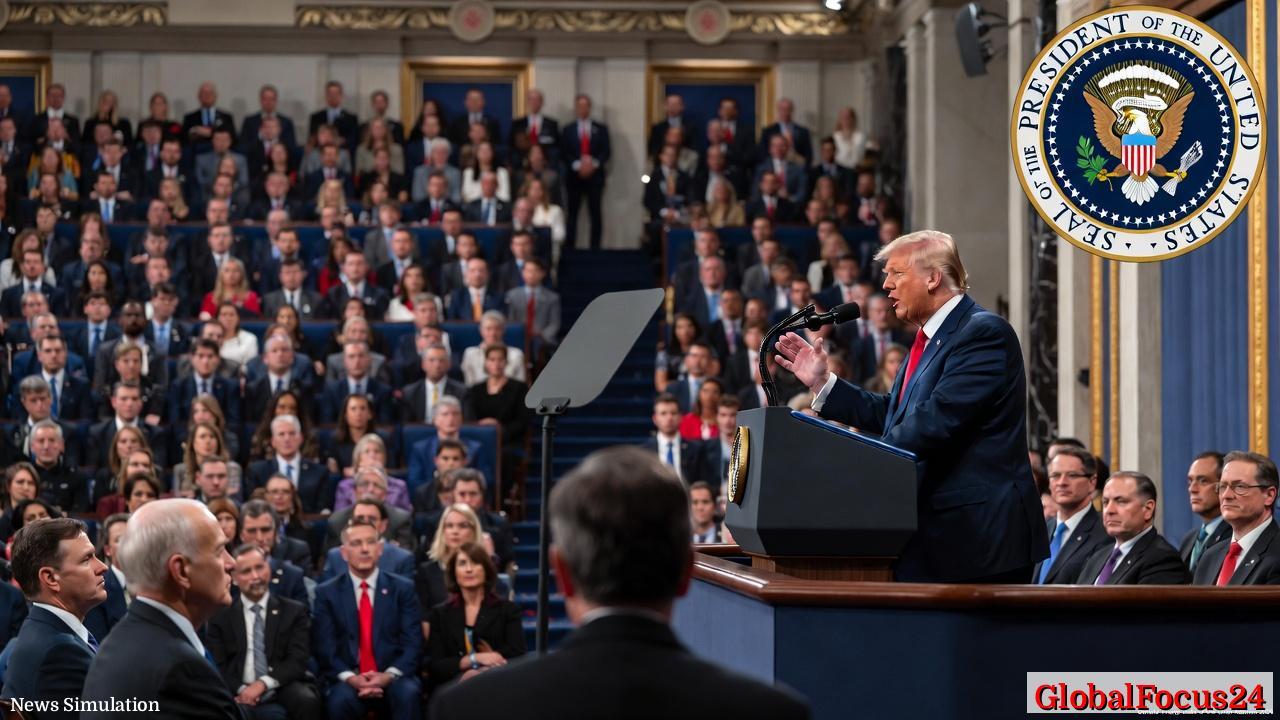
President Trump Declares “Golden Age” for America in 2026 State of the Union Address
A sweeping and defiant address marks a pivotal moment in Trump’s second presidential term
WASHINGTON — In a fiery and lengthy State of the Union address on February 24, 2026, President Donald Trump proclaimed that the United States is entering “a new Golden Age,” heralding what he described as record-breaking achievements in border security, economic growth, and foreign relations. Speaking for one hour and forty-eight minutes—the longest State of the Union in modern history—Trump delivered a sweeping message of triumph and transformation, emphasizing his administration’s vision of an America rejuvenated by strength, prosperity, and self-reliance.
The president’s address blended celebration, challenge, and ambition, positioning his administration’s policies as the culmination of a historic shift following years of division and global uncertainty. Against a backdrop of strong economic signals and contentious policy debates, Trump cast his government as the architect of a nation “roaring like never before.”
Economic revival claims dominate the address
The heart of Trump’s 2026 address revolved around the economy, which he portrayed as emblematic of a national turnaround. “Inflation is plummeting, jobs are soaring, and American wealth is rising faster than anywhere else on Earth,” he declared to a mixture of applause and silent skepticism in Congress.
Central to his remarks was the “One Big Beautiful Bill” Act, a sweeping tax package that promises to eliminate federal taxes on tips, overtime pay, and Social Security income. According to the administration, the bill is designed to boost disposable income for working- and middle-class Americans while stimulating consumer spending and small business growth.
Economists and analysts are divided, however, on whether such tax eliminations will sustain long-term fiscal stability. Some argue that reduced federal revenues could strain public programs, while others say the approach could strengthen domestic consumption—a primary driver of the U.S. economy. Historically, large-scale tax cuts have created short-term economic boosts but have also led to widening fiscal deficits, a dynamic seen during previous administrations of both parties.
The president also announced expansions to domestic manufacturing incentives, touting new plant openings in the Midwest and South as proof of an industrial resurgence. Trump credited his administration’s deregulation agenda—cuts to what he described as “job-killing red tape”—for reviving American production and attracting foreign investment.
Border security takes center stage
Trump’s second major theme was border control, a consistent focal point of his political brand. He claimed that the U.S. southern border is now “fully secure,” crediting aggressive enforcement measures, barriers, and expanded deportation programs for what he called “the end of the border crisis.”
Since his return to office in 2025, Trump has prioritized immigration control through a series of executive actions and legislative proposals aimed at curbing unlawful entry. His administration reports a dramatic decrease in border crossings since mid-2025, though independent analyses show variations by month and region.
The border issues have deep historical roots. Previous presidents grappled with similar crises—from George W. Bush’s comprehensive reform attempts to Barack Obama’s Deferred Action policies and Joe Biden’s efforts to balance humanitarian protection with enforcement. Trump’s reassertion of “border sovereignty,” as he termed it, represents the most comprehensive reinstatement of restrictionist policy in decades.
To his supporters, these actions symbolize restored national strength and order. Critics, however, warn of human rights concerns and economic repercussions in industries reliant on immigrant labor, particularly in agriculture and construction.
Foreign policy: from “ending wars” to reshaping alliances
Turning to international affairs, President Trump claimed success in “ending eight wars,” framing his foreign policy as one of peace through power. He highlighted U.S.-brokered progress in a Russia-Ukraine ceasefire negotiation and asserted that America is now “respected again” on the global stage. The administration has reportedly reduced troop deployments abroad while increasing strategic investments in advanced defense systems.
This reduction in military entanglements marks a continuation of the “America First” doctrine, emphasizing defense modernization and trade protectionism over prolonged intervention. While Trump touted the peace initiatives as proof of diplomatic success, foreign policy scholars note that the geopolitical landscape remains volatile. Rising tensions in East Asia and the Middle East, coupled with shifting European alliances, continue to test America’s global leadership role.
Regional comparisons suggest that the United States remains economically dominant yet faces mounting competition. China’s manufacturing recovery, the European Union’s tightening energy strategy, and India’s expanding digital economy all present parallel narratives of national renewal. Trump’s “Golden Age” declaration thus positions the U.S. as an economic juggernaut striving to reassert its edge amid an increasingly multipolar world.
Domestic reforms and social policy pledges
Trump’s address also detailed ambitious changes to health care, energy, and social welfare. He pledged to replace the Affordable Care Act—an enduring political flashpoint—with what he called “a freedom-based healthcare system,” designed to lower premiums and drug prices through competition.
On energy policy, Trump reaffirmed his commitment to domestic production, including expanded oil and gas exploration and streamlined permitting for refineries and pipelines. He criticized what he described as the “failed green experiment” of prior years, asserting that reducing energy costs will relieve inflationary pressures and strengthen industrial competitiveness.
His proposed “SAVE America Act” is aimed at lowering housing costs, cutting government spending, and promoting infrastructure modernization through private-sector partnerships. Critics question the feasibility and funding of such large-scale proposals, yet they align with Trump’s broader economic narrative of deregulation and privatization.
Socially, the president reiterated his intention to end federal support for Diversity, Equity, and Inclusion (DEI) programs, labeling them “divisive and wasteful.” He also called for new restrictions on gender-affirming medical care, while renewing his administration’s emphasis on “religious freedom” initiatives. These announcements drew both staunch applause from his conservative base and sharp opposition from civil rights and healthcare organizations.
Tackling corruption and government waste
One of the more striking announcements from the address was Trump’s declaration of a nationwide “War on Fraud,” to be led by Vice President JD Vance. The initiative targets government inefficiency and alleged corruption in state-administered aid programs. Trump cited a controversial case in Minnesota involving alleged misuse of federal funds, promising accountability and recovery of taxpayer dollars.
Fraud prevention has long been a bipartisan objective, but Trump’s framing—linking it to national renewal and accountability—frames the campaign as a moral crusade. The administration plans to deploy enhanced auditing systems and artificial intelligence tools to track misappropriated funds in federal programs.
If successfully implemented, the effort could represent one of the largest anti-fraud operations in modern U.S. history, echoing mid-20th-century reforms like Harry Truman’s postwar fraud investigations and the Reagan-era oversight expansions during robust privatization initiatives.
Historical echoes and public reaction
In both tone and substance, the 2026 address evoked echoes of earlier moments of American self-promotion, such as John F. Kennedy’s “New Frontier” vision and Ronald Reagan’s optimistic portrayal of a “morning in America.” Yet Trump’s rhetoric diverged by intertwining triumphalism with grievance, celebrating victory while warning of enemies within and abroad.
Public reaction was predictably polarized. Supporters praised the speech as a confident affirmation of national pride and accomplishment, pointing to falling inflation rates, a stronger dollar, and resurgent manufacturing. Detractors highlighted factual discrepancies in claims about border security, employment, and foreign policy outcomes—points later analyzed in post-speech fact-checks.
Polling in the days following the address showed a modest bump in presidential approval, particularly among independents who cited economic optimism. However, division remains sharp along partisan lines, a reflection of the broader social and cultural cleavages defining American politics in the 2020s.
Regional and economic context
From a regional standpoint, economic growth patterns in the United States remain uneven despite the upbeat national indicators. States across the Sun Belt—Texas, Arizona, and Florida—have enjoyed strong job creation and industrial investment tied to energy, logistics, and technology manufacturing. The Rust Belt states, including Ohio and Michigan, have begun to see incremental rebounds due to renewed infrastructure spending and auto industry revitalization.
By contrast, coastal states such as California and New York continue to face affordability challenges and uneven post-pandemic recovery in commercial real estate. The administration’s energy and tax policies could amplify these divides, rewarding high-growth conservative regions while imposing new fiscal strains on states with larger social infrastructure commitments.
Historically, cyclical economic expansions driven by deregulation have boosted GDP but also risk overheating markets if unchecked by monetary policy. The Federal Reserve, maintaining cautious watch over inflation trends, continues to calibrate interest rates amid political pressure from the White House.
A confident close to a contentious moment
As Trump concluded his record-length address, he reaffirmed his message of confidence and revival: “The state of our union is strong—stronger than ever before. America is winning again.”
Even as fact-checkers challenge several of the administration’s claims, the address captured the essence of Trump’s enduring political method: fusing economic populism, nationalist rhetoric, and executive assertiveness into a vision of renewal.
Whether this proclaimed “Golden Age” endures will depend not only on the immediate outcomes of Trump’s policies but also on the nation’s capacity to reconcile prosperity with its enduring divisions. For now, the 2026 State of the Union has reset the narrative—one of ambition, confidence, and a presidency determined to cement its legacy in the annals of American political history.