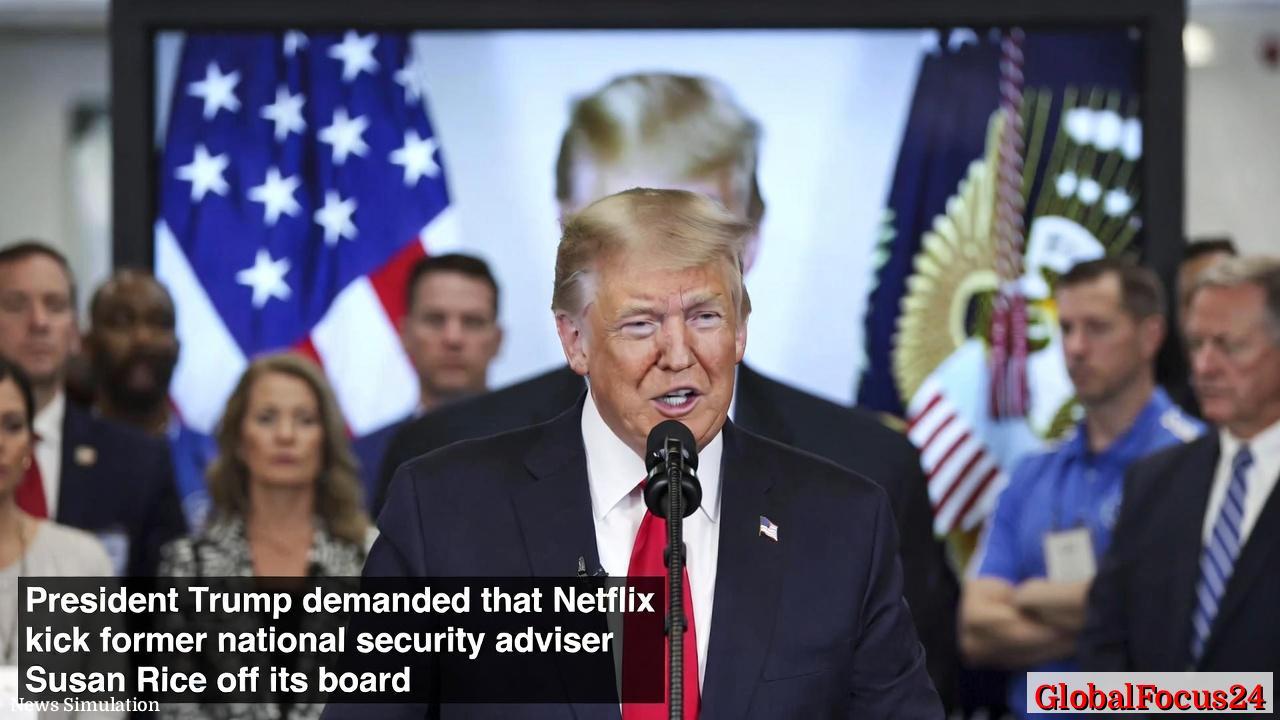
Trump Calls for Netflix to Remove Former National Security Adviser Susan Rice From Its Board
Tensions Renew Over Corporate Ties and Political Influence
Former President Donald Trump has publicly demanded that Netflix remove Susan Rice, former National Security Adviser under President Barack Obama, from its board of directors, rekindling debates over the intersection of corporate governance, public service, and political influence. The call, made during a recent speech and amplified on social media, drew attention across political and corporate circles, where questions about the role of major streaming platforms in American culture and politics continue to intensify.
Rice, who joined Netflix’s board in 2018 before later serving in the Biden administration as Director of the Domestic Policy Council, has long been a figure of both praise and controversy. Her dual career in national security and corporate leadership has often made her a symbolic figure for discussions about Washington’s revolving door between public office and the private sector. Trump’s remarks now reignite scrutiny not only of Rice herself, but also of Netflix’s evolving position as both an entertainment company and a global cultural power.
Netflix’s Board Under the Spotlight
Netflix’s board of directors has frequently included prominent names from diverse sectors—ranging from technology and entertainment to academia and public policy. Rice’s appointment in 2018 was hailed at the time as a strategic move to bring international expertise and political insight to a company expanding aggressively into global markets. Her experience at the United Nations and the White House was seen as valuable in navigating the complex cultural and regulatory landscapes that Netflix faces in dozens of countries.
However, Trump’s statements have now placed the company in an uncomfortable position, forcing it to address political pressures that tech and media corporations have increasingly found themselves facing. While there is no indication that Netflix plans any changes to its board based on the former president’s remarks, the episode underscores how entertainment companies can quickly be drawn into the political arena.
A Familiar Clash Between Trump and Obama-Era Figures
Susan Rice has been a frequent target of criticism from Trump and his allies since the early days of his presidency. Their disputes date back to the controversy surrounding the 2012 Benghazi attack, when Rice, serving as U.S. ambassador to the United Nations, appeared on television defending administration positions about the assault on U.S. diplomatic facilities in Libya. Though later investigations produced mixed conclusions about the intelligence presented at the time, Rice remained a lightning rod for conservative criticism.
Trump’s attacks on Rice continued throughout his time in office, particularly after she publicly criticized elements of his foreign policy and pandemic response. His renewed focus on her board role at Netflix now blends older political rivalries with newer cultural and economic battlegrounds—the growing connection between corporate America, media, and the political class.
Corporate Governance Meets Public Pressure
Corporate boards typically wield significant influence over company strategy but rarely become the focus of public debate. The presence of high-profile political figures like Rice often brings both prestige and controversy, as stakeholders weigh the value of their experience against potential reputational risks.
For Netflix, which continues to dominate the global streaming market with more than 260 million subscribers worldwide, board representation aligns with its strategy of global expansion. Rice’s diplomatic background, particularly her experience managing international negotiations and multilateral relationships, complements the company’s increasing focus on localized content production in markets from India to South Korea.
Trump’s demand, by contrast, highlights a tension familiar across corporate America—the challenge of balancing nonpartisan business operations with the political identities of executives, directors, and creative partners. As political polarization deepens, companies find themselves navigating consumer activism and shareholder concerns alongside broader questions about their social and cultural influence.
Historical Context: Politics and Corporate Boards
The intersection of business and politics in American boardrooms is nothing new. In past decades, government officials and military leaders have regularly transitioned into private-sector leadership roles after public service. Figures such as Henry Kissinger, Colin Powell, and Robert Gates all joined corporate boards, reflecting a longstanding pattern of leveraging government experience to inform global business strategies.
However, what distinguishes the current era is the increased scrutiny that comes with digital transparency and the speed of public reaction. Social media amplifies controversies that might once have gone unnoticed outside the business press. Companies like Netflix also represent a new kind of corporate influence—one that shapes public opinion not only through business decisions but through the global dissemination of culture and storytelling.
The involvement of political figures thus raises broader concerns about impartiality and messaging, even when their actual board roles are limited to governance rather than creative direction. In the case of Susan Rice, some critics have suggested that her presence symbolizes ideological leanings at odds with some American viewers; others argue that such assertions misunderstand the largely apolitical nature of corporate board responsibilities.
The Economic Stakes for Netflix
While Trump’s remarks are unlikely to affect Netflix’s stock performance directly, they arrive at a delicate moment for the streaming industry. After years of rapid subscriber growth, major streaming services are under pressure to sustain profitability amid rising competition, content costs, and shifting audience habits. Netflix has recently refocused its strategy toward ad-supported plans, licensing deals, and curbing password sharing—initiatives aimed at stabilizing revenue and retaining market leadership.
Public controversies, particularly those involving political figures, can still pose reputational risks that influence consumer perceptions. Analysts note that brand image plays a vital role in Netflix’s relationship with subscribers, who view the platform not only as a source of entertainment but as a cultural lens. Any public dispute touching on political or ideological divisions could potentially spark boycotts or trending backlash campaigns, as seen in similar cases involving other global brands.
However, investors have historically shown resilience to-driven controversies when the underlying business fundamentals remain strong. Netflix’s continued success in content development and international growth may insulate it from lasting impact unless the dispute escalates further or triggers broader calls for corporate reform.
Comparing Global Corporate Practices
Other major streaming and media companies have also attracted politically connected figures to their boards, though often with less visible backlash. Amazon, Apple, and Disney, among others, employ or consult with former government officials and policy experts to navigate complex regulatory environments. Internationally, it is even more common for corporations to recruit diplomats and former ministers, particularly in Europe and Asia, where public-private collaboration is more formalized.
By comparison, the American political climate has made such appointments more contentious. As streaming platforms wield greater cultural power globally, companies like Netflix must balance their need for expertise with heightened sensitivity to domestic politics. The controversy surrounding Rice illustrates how even routine corporate governance decisions can become flashpoints in broader ideological battles.
Public Reaction and Broader Implications
Public responses to Trump’s remarks have been predictably split along partisan lines. Supporters of the former president view the demand as a challenge to what they see as a convergence of corporate power and liberal politics, while critics argue that such interventions amount to political overreach into private enterprise. The broader American public appears less directly engaged with boardroom issues, but social media discourse has reflected a familiar pattern of viral commentary and polarization.
For Netflix, the question may be less about political allegiance and more about maintaining independence. The company has historically sought to avoid overt political engagement, focusing instead on its role as a platform for diverse storytelling. Yet as cultural influence becomes increasingly synonymous with political relevance, companies like Netflix face a shrinking buffer between entertainment and public policy debates.
Looking Ahead: Corporate Roles in a Polarized Era
Whether or not Netflix responds to Trump’s demand, the incident underscores a deeper trend: corporate boards are no longer insulated from political rhetoric or public scrutiny. The global visibility of major companies ensures that decisions about leadership, content, and partnerships can carry political significance far beyond the boardroom.
For Susan Rice, the renewed attention adds another chapter to a career spent at the convergence of policy, diplomacy, and now business. For Netflix, it is a reminder that in an age where streaming platforms shape global culture, even seemingly internal decisions can become moments of political theater.
As media, technology, and politics continue to intertwine, the question facing not just Netflix but all large corporations remains pressing: how can a company remain apolitical in a world that increasingly demands it take a side?