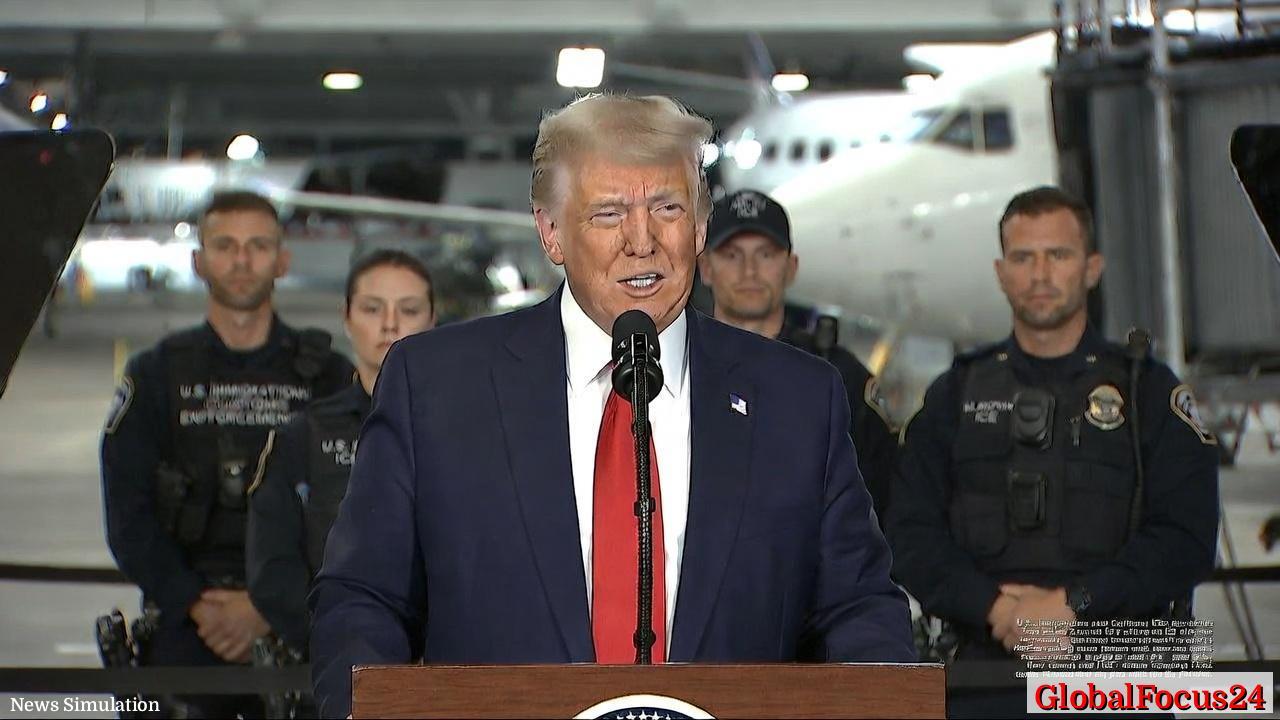
Trump Threatens to Deploy ICE Agents to Airports Amid Homeland Security Funding Lapse
Funding Impasse Triggers Bold Presidential Threat
Former President Donald Trump vowed Saturday to deploy U.S. Immigration and Customs Enforcement (ICE) agents to American airports if Congress fails to resolve a funding lapse at the Department of Homeland Security (DHS). The announcement came amid tense budget negotiations that have stalled crucial funding for multiple federal agencies, including the Transportation Security Administration (TSA).
Trump’s statement, delivered through a series of remarks late Saturday, argued that the impasse has jeopardized airport safety and border control. He warned of immediate executive action if lawmakers do not act to restore funding, proposing that ICE agents temporarily assume security duties typically handled by TSA officers.
“If the Radical Left Democrats don’t immediately sign an agreement to let our Country, in particular, our Airports, be FREE and SAFE again, I will move our brilliant and patriotic ICE Agents to the Airports where they will do Security like no one has ever seen before,” Trump said, referring to the ongoing standoff.
The comments represent one of the most aggressive public threats to reassign federal law enforcement capabilities in recent history, raising questions about operational feasibility, legality, and broader implications for domestic security infrastructure.
Homeland Security Funding Lapse Deepens Concerns
The Department of Homeland Security, one of the largest federal employers, entered its third day of a partial funding lapse this week after budget negotiations broke down along party lines. The failure to pass a continuing resolution disrupted operations across multiple agencies, including TSA, the Federal Emergency Management Agency (FEMA), and the U.S. Coast Guard.
Historically, government shutdowns or partial lapses have led to unpaid furloughs for thousands of federal employees. In past crises, TSA workers have often been required to continue working without pay, leading to high absentee rates and operational slowdowns at major airports such as Atlanta, Los Angeles, and Chicago.
If ICE were to take over TSA responsibilities even temporarily, it would mark an unprecedented realignment of federal authority within the national security structure. ICE’s focus is immigration enforcement, not aviation security — a core function of TSA since its creation in the aftermath of the September 11, 2001, terrorist attacks.
Legal and Operational Hurdles to ICE Deployment
Experts note that Trump’s proposed move, while politically striking, would face major logistical and legal obstacles. Federal law delineates the specific responsibilities of ICE and TSA, both of which operate under the Department of Homeland Security but with distinct mandates.
ICE’s purview is primarily investigative and enforcement-oriented, addressing immigration violations, transnational crime, and deportation proceedings. TSA, meanwhile, is trained for aviation screening procedures, risk analysis, and passenger vetting using specialized security technology.
Reassigning ICE personnel to perform these duties would require emergency authorizations, retraining, and potentially new inter-agency agreements. Security policy analysts warn such shifts could compromise efficiency and introduce confusion during one of the busiest travel periods of the year.
“The agency’s officers are well-trained, but their operational mission is not designed for airport screening,” said a former TSA official who served under both Republican and Democratic administrations. “Even temporary reassignment could reduce ICE’s capacity to fulfill its core enforcement duties while not necessarily improving airport security.”
Reaction from States and Airport Authorities
Trump’s comments prompted swift reactions from state officials and airport authorities across the country. Several major airport operators, including those in New York, Illinois, and California, expressed uncertainty over how such an order could be implemented in practice.
The Port Authority of New York and New Jersey, which manages airports including JFK and Newark Liberty, said in a brief statement that any deployment of non-TSA personnel would require federal approval and coordination to maintain safety standards set by the Federal Aviation Administration (FAA).
Airport security unions voiced concern that transferring responsibilities to ICE could disrupt established screening procedures. “Security work at airports depends on training, technology, and consistency. Sudden changes could undermine traveler confidence,” said a representative of the American Federation of Government Employees, which represents many TSA staffers.
Ripple Effects Across the Aviation Industry
The aviation industry remains highly sensitive to disruptions in TSA operations. Previous shutdowns have slowed passenger screening significantly, resulting in longer wait times and, in some cases, missed flights and cancellations.
Airlines have also warned that prolonged funding disputes could affect Customs and Border Protection (CBP) staffing at international terminals, leading to cascading delays in customs clearance and cargo inspection.
If ICE were to assume TSA roles, air travel experts predict a temporary slowdown in processing times as agencies adapt to new operational chains of command. Moreover, the airlines’ coordinated security partnerships with TSA — built over two decades — would likely face recalibration to align with ICE’s enforcement-oriented framework.
Historical Context: ICE and TSA’s Distinct Origins
Both ICE and TSA arose in the early 2000s but for distinctly different reasons. TSA was established in November 2001 in direct response to the 9/11 attacks, under the Aviation and Transportation Security Act. Its mission was to secure the nation’s transportation systems to ensure freedom of movement for people and commerce.
ICE, by contrast, emerged in 2003 under the newly formed Department of Homeland Security following a restructuring of immigration and customs enforcement units. Its focus lies in investigating criminal organizations, immigration violations, and national security threats.
While both agencies share a homeland security mandate, their organizational cultures, training regimens, and operational priorities diverge significantly. Experts note that substituting one for the other would represent a major policy shift rather than a temporary measure.
Regional Reactions and Political Landscape
Trump’s comments also took aim at Minnesota, linking immigration from Somalia to crime and governance issues in the state. The remarks drew immediate condemnation from community leaders and local officials, who described the statements as inaccurate and inflammatory. They emphasized Minnesota’s decades-long history of Somali immigration and integration, pointing to the community’s central role in business growth and civic life across the Twin Cities.
Regional observers note that Trump’s criticism reflects longstanding tensions between his administration’s immigration policies and states with large immigrant populations. Minnesota’s economy, boosted by healthcare, manufacturing, and technology sectors, continues to rely on both native and immigrant labor — trends mirrored in states such as California and Texas.
While security policy is largely federal, local governments often bear the social and economic consequences of abrupt enforcement changes. Analysts warn that positioning ICE within airport operations could reinforce fears among immigrant communities, particularly those already wary of heightened enforcement actions.
Economic Implications of the DHS Stalemate
Beyond the immediate security concerns, the DHS funding lapse could reverberate through multiple sectors. Airport slowdowns have ripple effects across the travel industry, tourism, and business logistics. Prolonged uncertainty can cut into airline revenues, delay cargo deliveries, and discourage both domestic and international travel.
During the 2019 government shutdown, which lasted 35 days, economists estimated the U.S. economy lost more than $11 billion in output, according to the Congressional Budget Office. A similar interruption today could affect an even larger share of GDP given the post-pandemic expansion of air travel and shipping dependence on air freight.
Financial analysts have already flagged potential turbulence in the aviation sector, with airlines facing increased insurance premiums and investors bracing for a short-term dip in consumer demand if airport delays persist.
Broader National Security Considerations
National security experts caution against conflating immigration enforcement with aviation safety. While both are components of homeland protection, they serve fundamentally different purposes. Airport screening is designed to prevent terror-related or safety threats, whereas ICE focuses on immigration law and criminal investigations.
Merging those functions without clear structure or guidance could lead to gaps in oversight. Additionally, ICE’s law enforcement posture may not align with the customer-facing and safety-driven context of airport screening, raising questions about civil liberties and federal oversight.
Some security analysts have proposed contingency frameworks — such as activating National Guard units or contracting private security providers — as more viable short-term measures compared to ICE reassignment.
Looking Ahead: Uncertainty and Urgency
As the funding impasse continues, the White House faces mounting pressure to resolve the DHS stalemate before it begins affecting key travel hubs. Without resolution, airports could experience significant staffing shortages, prompting longer security lines and increased traveler frustration during the upcoming spring travel surge.
While Trump’s threat signals his intent to project strength on security issues, its practical implications remain uncertain. Implementing such a move would require coordination with DHS leadership, Congress, and potentially the courts to clarify jurisdictional limits.
For now, DHS agencies continue to operate in limited capacity, awaiting a congressional breakthrough. Whether Trump’s ultimatum becomes a turning point in the standoff or remains a rhetorical show of force will depend on the next round of negotiations in Washington — and how the broader public, weary of government shutdowns, responds to yet another showdown over homeland security.