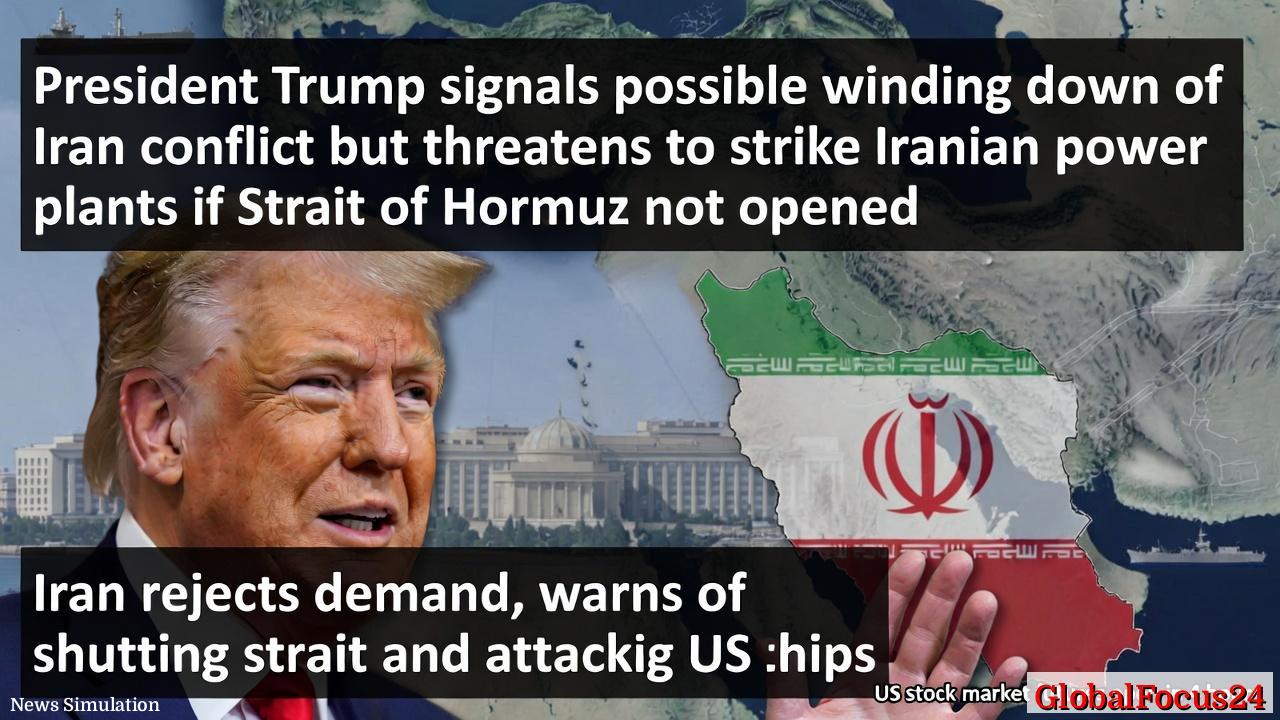
Trump Threatens Iran’s Energy Infrastructure as Strait of Hormuz Deadline Nears
Rising Tensions in the Fourth Week of the U.S.–Iran Conflict
The conflict between the United States and Iran entered its fourth week this weekend, with President Donald Trump signaling both de-escalation and renewed threats within a span of hours. After initially indicating that Washington was exploring ways to wind down hostilities, Trump warned that the U.S. would target Iran’s critical power infrastructure unless Tehran reopened the Strait of Hormuz within 30 hours. The ultimatum marks one of the sharpest inflection points in the standoff, with both sides signaling readiness for broader confrontation across the Middle East.
Iran has rejected the demand, dismissing it as coercive diplomacy. In a televised speech broadcast in Tehran, senior Iranian military officials warned that any attack on the nation’s energy grid would trigger “a complete and indefinite closure” of the Strait of Hormuz — the world’s most vital maritime chokepoint for oil shipments. Iranian leaders also threatened retaliatory strikes on U.S. and Israeli assets across the region, including bases in Bahrain, the United Arab Emirates, and Iraq.
The Strait of Hormuz: A Global Energy Lifeline at Risk
Roughly one-fifth of the world’s oil supply passes through the Strait of Hormuz each day, according to estimates from the U.S. Energy Information Administration. Any disruption to this narrow, 21-mile-wide channel — located between Iran and Oman — has immediate ripple effects across global energy markets. Since the conflict began last month, oil prices have surged nearly 30 percent, climbing above $130 per barrel at their peak. Futures trading on Sunday night indicated further volatility ahead if Iran follows through on its latest threats.
The Strait’s closure would impact not only exporters like Saudi Arabia, Kuwait, and Iraq but also major importing economies such as China, Japan, and the European Union. Past blockages and confrontations in the waterway, including during the Iran-Iraq War of the 1980s and the tanker crises of 2019, have underscored how quickly tensions in the Gulf can reshape global supply chains and transportation routes. However, analysts note that this current confrontation carries far greater stakes because it involves simultaneous cyber and military dimensions.
The Escalating Battle Over Energy Infrastructure
U.S. intelligence agencies reported increased cyber activity targeting Middle Eastern energy grids in recent days, raising fears that both sides may resort to asymmetric tactics. American officials have previously accused Iran’s Revolutionary Guard Corps of launching cyberattacks on Gulf oil facilities, while Tehran claims U.S. sanctions amount to “digital warfare.”
Trump’s threat to strike Iran’s power plants is unprecedented in scale, given the central role these facilities play in sustaining the nation’s economy and civilian life. Iran’s energy grid supplies not only its domestic population but also key industrial sectors tied to oil refining and petrochemical exports. A successful attack could cripple the country’s production capacity for months, prompting cascading humanitarian and economic crises.
Experts warn that such strikes could also have unintended consequences. “Targeting energy infrastructure would blur the line between military and civilian targets,” said Dr. Razia Mokhtari, an energy security analyst at King’s College London. “This could push the conflict into a total-war scenario that neither side can easily control.”
Diplomatic Channels Falter as Allies Reassess
Despite mounting global concern, diplomatic channels remain largely frozen. European officials have urged restraint and called for emergency talks under the auspices of the United Nations, but neither Washington nor Tehran has agreed to new mediation efforts. Russia and China have both condemned the potential strikes, framing them as destabilizing actions that could ignite a regional war.
Regional governments are meanwhile bracing for potential spillover. Saudi Arabia and the United Arab Emirates have placed their air defenses on high alert, while Iraq has reported renewed militia activity near U.S. diplomatic compounds. Israel — identified by Iranian officials as a potential retaliation target — has mobilized several Iron Dome batteries in the north and south of the country, citing “high-probability threats” of drone or missile attacks.
The Pentagon has confirmed additional troop rotations into Qatar and Bahrain, though military officials insist these moves are “defensive in nature.” U.S. Central Command has also repositioned naval assets, including an aircraft carrier strike group, closer to the Gulf to ensure rapid response capability should the deadline lapse without Iranian compliance.
A Volatile Blend of De-escalation and Deterrence
Observers are struggling to interpret the dual messaging from Washington, which has alternated between overtures for negotiation and sharp escalation. Some analysts suggest the mixed signaling may be a deliberate strategy to pressure Iran without committing to all-out war. Others view it as evidence of internal division within the U.S. administration regarding how far the conflict should go.
So far, Trump’s statements have mirrored earlier patterns of calibrated brinkmanship that characterized his first term’s dealings with adversarial states. The combination of threats and offers to negotiate was a tactic aimed at forcing adversaries to the table. However, the chances of a breakthrough appear slim this time, particularly after a month of airstrikes, naval confrontations, and cyber skirmishes that have hardened political positions on both sides.
Iran, for its part, has framed its defiance as an assertion of sovereignty against what it calls “economic and military coercion.” The country’s leadership is emphasizing national unity amid the crisis, highlighting its capacity to withstand sanctions and combat operations. The government’s official stance suggests it is preparing for escalation rather than compromise, leveraging its control over regional proxy militias as deterrence.
Economic Ripples Beyond the Persian Gulf
The global economy is already feeling the strain from the four-week-long conflict. Stock markets in Asia and Europe opened lower Monday, with investors fleeing to safe-haven assets such as gold and the U.S. dollar. Energy-intensive industries — including transportation, shipping, and manufacturing — face rising input costs as oil markets remain unstable.
For countries dependent on Middle Eastern crude, the crisis threatens to derail fragile recoveries following last year’s global economic slowdown. Analysts at several think tanks warn that a prolonged closure of the Strait could shave up to 0.5 percent off global GDP this quarter, with developing economies suffering disproportionately.
The United States, though less vulnerable to direct supply interruptions due to its domestic oil production, is still exposed to higher energy prices and inflationary pressure. Economists note that even modest spikes in oil costs historically amplify consumer prices and weaken purchasing power. Within the U.S., trucking and airline sectors are facing renewed cost surges, echoing patterns seen during the Gulf War and the 2011 Libyan crisis.
A Historical Echo in a Modern Conflict
The current standoff evokes several historical parallels, most notably the 1988 “Operation Praying Mantis,” when the U.S. Navy destroyed Iranian naval targets after a mine damaged an American warship. That confrontation, the largest U.S. naval engagement since World War II, effectively ended Iran’s bid to disrupt shipping lanes during the Iran–Iraq War. Yet technology and geopolitical dynamics have transformed since then, introducing new layers of complexity — from drone warfare to cyber offense capabilities — that make escalation today more unpredictable and potentially uncontrollable.
While previous conflicts centered on maritime dominance, the ongoing confrontation spans multiple domains. Iran’s capacity to conduct cyberattacks, deploy proxy groups, and weaponize oil exports gives it tools for asymmetric retaliation. The United States, meanwhile, possesses overwhelming conventional superiority but faces mounting diplomatic isolation should it launch strikes that trigger civilian suffering or long-term environmental damage.
Countdown to the Deadline
As the 30-hour deadline approaches, both sides appear to be maneuvering for position rather than retreating. U.S. reconnaissance flights have intensified over southern Iran, and satellite imagery shows activity at several Iranian power sites, possibly indicating preparations for protective measures. Meanwhile, tanker traffic exiting the Gulf has slowed sharply, with insurance premiums for vessels soaring over 400 percent since the start of the crisis.
The world is now watching whether the ultimatum will yield negotiation or detonation. Markets, energy analysts, and ordinary citizens across multiple continents await clarity amid growing uncertainty. A single miscalculation — a drone strike, a radar misreading, or a cyber-triggered blackout — could convert an already volatile standoff into a full-blown regional war.
What happens over the next 30 hours could shape the balance of power, energy, and diplomacy in the Middle East for years to come — and redefine the global perception of American deterrence in an era where even threats alone can move markets and test alliances.