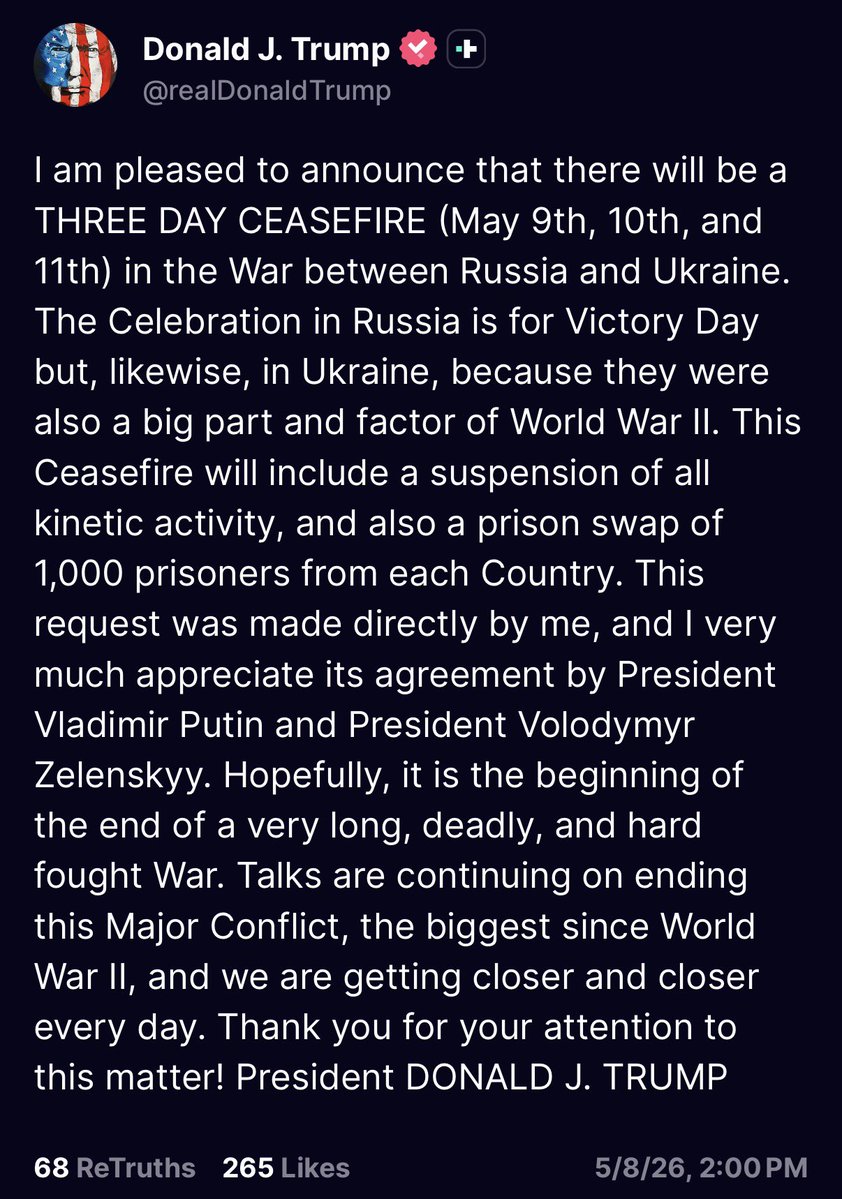
Trump Announces Three-Day Ceasefire in Russia-Ukraine War
A high-stakes pause in fighting between Russia and Ukraine has been announced for a three-day window, running from May 9 to May 11. The agreement, described by officials as a humanitarian pause, centers on a full suspension of kinetic military activity and a simultaneous prisoner exchange, with up to 1,000 prisoners exchanged from each side. The plan was disclosed by President Donald Trump, who said he secured the arrangement through direct discussions with the leaders of the two warring nations. The ceasefire coincides with Russia’s Victory Day commemorations, a date historically tied to the end of World War II in Europe, and the timing has added a layer of significance to the effort.
Historical context and precedent
The idea of short, supervised pauses in war has a long arc in modern conflict management. Previous truces and humanitarian pauses in the Russia-Ukraine conflict have often served multiple purposes: enabling wounded civilian evacuation, facilitating humanitarian aid deliveries, and creating a brief environment in which prisoner exchanges and information-sharing can take place. The current three-day pause follows a pattern of negotiated pauses that attempt to break cycles of escalation, even as broader political and military objectives remain unresolved.
The historical backdrop for a ceasefire during Victory Day adds symbolic resonance. Victory Day is a milestone that commemorates wartime alliances and sacrifices. In past eras, ceasefires or temporary truces around national holidays have been used as confidence-building measures, signaling a willingness to pause hostilities and test means of reducing harm to civilians. Analysts note that such pauses can provide a window for humanitarian access and verification of commitments, though they are rarely a permanent solution to deeply rooted strategic disputes.
Economic implications
Even brief pauses in conflict can ripple through regional economies in meaningful ways. During a three-day ceasefire, logistics networks—transportation corridors, energy routes, and cross-border trade flows—may experience temporary stabilization. Local markets in the border regions often face volatility stemming from disruption, but a pause can allow for critical repairs, supply deliveries, and the safe reallocation of resources. Financial markets tend to respond to news of de-escalation with short-term volatility, reflecting investor reassessment of risk and the potential for humanitarian relief to improve business confidence.
The broader economic impact of a sustained conflict has been substantial across the region. Ukraine’s infrastructure, energy infrastructure, and industrial sectors have borne heavy costs from years of fighting. Russia has faced sanctions, capital outflows, and supply-chain disruptions that have influenced production costs and export opportunities. A brief cessation creates a pause in direct military expenditures and can offer a momentary reprieve that supports local merchants, farmers, and small businesses reliant on stable operating conditions. However, without a durable political settlement, the economic gains from a short-term truce are likely to be temporary.
Regional comparisons
The response to a three-day pause in this conflict is not uniform across neighboring regions. In Europe, energy security and resilience have emerged as central concerns, given the intertwined energy relationships with Russia and alternative supply routes. Neighboring countries have been adapting by diversifying energy sources, increasing storage capacity, and strengthening cross-border cooperation to mitigate price volatility and supply shocks. In Eastern Europe, markets have become adept at absorbing rapid changes in confidence as political calculus shifts, with local manufacturing and logistics sectors closely watching any realignment of trade routes.
In contrast, countries with similar histories of prolonged conflict have observed that short-term truces can either pave the way for longer-term negotiation or, in some cases, lead to renewed escalation if foundational issues remain unresolved. Analysts emphasize that the effectiveness of a three-day ceasefire hinges on verification mechanisms, humanitarian access, and the ability to maintain momentum toward a broader peace process. Public sentiment often follows the trajectory of reported progress or setbacks, influencing political leadership and regional cooperation initiatives.
Humanitarian dimension
At the heart of a ceasefire announcement is the humanitarian imperative. A prisoner exchange of 1,000 individuals from each side represents a substantial gesture on both humanitarian and symbolic levels. The exchange can relieve some of the personal and familial toll the conflict has inflicted, providing a moment of relief for dozens of communities. Humanitarian agencies will be closely watching the ability to deliver aid, protect civilians, and ensure safe corridors for medical supplies, food, and shelter.
Civilian protection remains a central concern. Even short pauses can reduce the risk to noncombatants by halting bombardments, shelling, and other lethal activities in populated areas. Local populations in border and frontline communities often bear the brunt of conflict, facing displacements, infrastructure damage, and disrupted livelihoods. The success of the humanitarian component will depend on transparency, independent verification, and sustained access for international organizations to affected regions.
Geopolitical dynamics
The announcement of a three-day ceasefire has immediate geopolitical reverberations. If credible, the move could alter perceptions of regional stability and influence the calculations of major powers with strategic interests in the region. The involvement of U.S. leadership in brokering or supporting the pause may affect diplomatic alignments, sanctions policy, and regional security architectures. Allies and partners will be watching how the pause translates into credibility for broader negotiation efforts or a stepping-stone toward a longer-term ceasefire framework.
From a defense and security perspective, a temporary lull in active conflict offers an opportunity to reassess military postures, replenish supplies, and review readiness. It also raises questions about verification: how will both sides confirm that no offensive operations are underway, and what mechanisms will ensure compliance during the pause? International observers and non-governmental organizations are typically invited to monitor such arrangements, though the level of access can vary based on strategic considerations and on-the-ground realities.
Public reaction and media landscape
Public reaction to any ceasefire initiative is shaped by the information environment and local experiences of the conflict. In affected communities, individuals often balance cautious optimism with skepticism about long-term peace prospects. Social media, local networks, and traditional media channels contribute to a mosaic of views, ranging from hopeful narratives about near-term relief to concerns about possible violations or rapid shifts in the political landscape.
News coverage of ceasefire efforts tends to emphasize the human stories behind the numbers: families separated by the conflict, medical workers operating under duress, and farmers who rely on cross-border markets for essential income. The cadence of reporting—characterized by updates on negotiations, witness accounts, and official statements—plays a critical role in shaping public sentiment and international perception.
Operational and logistical considerations
Executing a three-day ceasefire requires careful logistical planning and on-the-ground coordination. Key operational elements include secure ceasefire lines, verified prisoner exchange centers, and agreed-upon humanitarian corridors. The uptime of communications between parties and the presence of neutral observers are also critical to preventing violations and maintaining the credibility of the pause. Local authorities, humanitarian agencies, and international partners often collaborate to establish temporary infrastructures, such as supply depots, medical triage points, and safe passage routes for civilians.
Additionally, border control and customs procedures may adapt during a ceasefire window to enable safe movement of people and goods. Trade agreements or temporary exemptions might be applied to facilitate humanitarian deliveries, repair work, and the resumption of essential services. The capacity of regional transportation networks to handle increased traffic, coupled with security measures to protect aid convoys, will influence the effectiveness of the pause.
Strategic outlook
While a three-day ceasefire is a notable development, experts emphasize that it is unlikely to resolve the underlying strategic impasse in a few days. Rather, it can be viewed as a confidence-building measure that creates a platform for dialogue, negotiation, and verification. The success or failure of this move could influence subsequent rounds of diplomacy and any broader framework for conflict resolution. Stakeholders will be evaluating not only the immediate outcomes but also the mechanisms that might support a longer-term peace process, including governance reforms, security guarantees, and economic reconstruction plans.
For regional stability, sustained de-escalation would offer the best chance for economic recovery and social resilience. Countries in proximity to the conflict have already diversified their economic strategies, investing in resilience programs, alternative energy sources, and cross-border collaborations designed to weather fluctuations in security conditions. The path forward will likely require a combination of humanitarian relief, political negotiation, and practical steps to rebuild trust and reduce the volatility that has characterized the region for years.
Conclusion
The announcement of a three-day ceasefire in the Russia-Ukraine conflict marks a significant moment in an already protracted crisis. While the pause is limited in duration, its potential value lies in the tangible relief it offers to civilians, the ability to facilitate prisoner exchanges, and the chance to test the willingness of the parties to engage in broader negotiations. As talks continue and observers monitor compliance, the international community will be closely watching for signs of durable progress or renewed tensions. The coming days will determine whether this momentary reprieve becomes a stepping stone toward a longer-lasting resolution or simply a temporary lull in a conflict that has already reshaped regional dynamics and global security considerations.