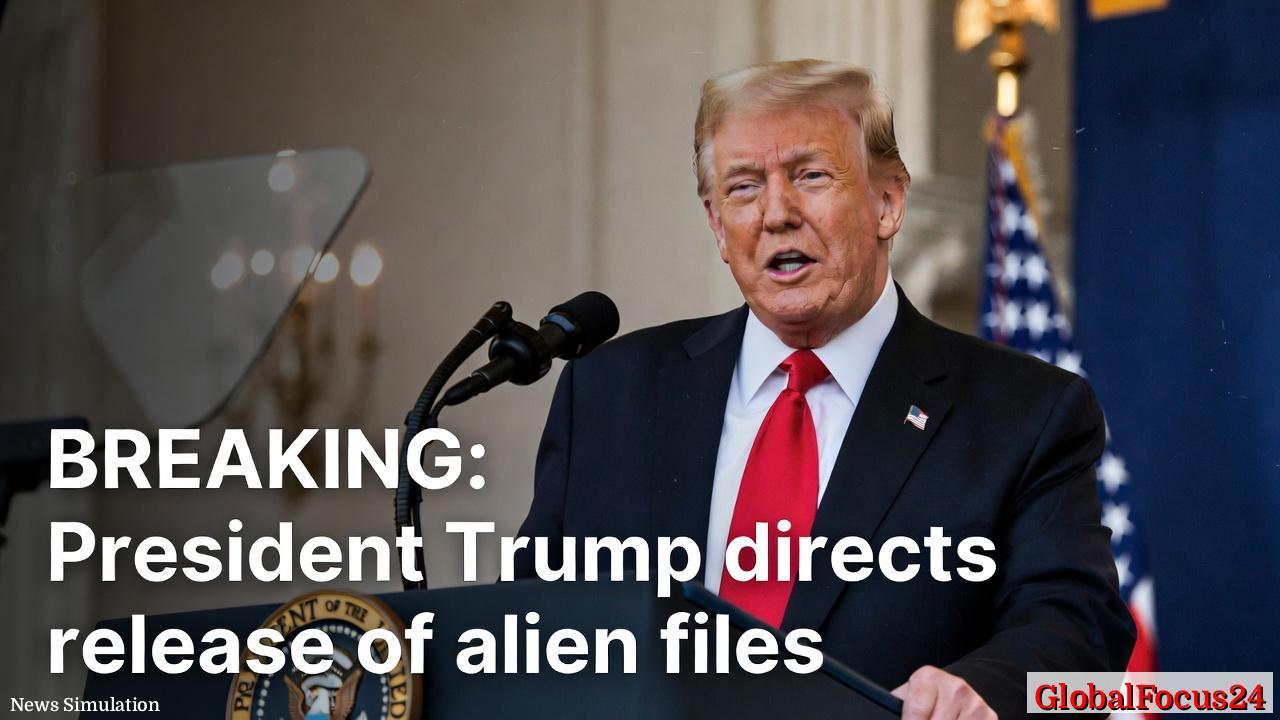
President Trump Orders Release of Government Files on Aliens, UFOs, and UAPs
In a striking directive that has immediately captured global attention, President Donald Trump announced that he will instruct the Secretary of War and other relevant federal departments to begin identifying and releasing classified government files related to extraterrestrial life, unidentified aerial phenomena (UAP), and unidentified flying objects (UFOs). The announcement marks one of the most significant federal transparency initiatives related to extraterrestrial research in U.S. history. The President concluded his statement with the emphatic words, “GOD BLESS AMERICA!”, underscoring the national symbolism attached to the decision.
A Defining Moment in the Disclosure Movement
The directive represents a potentially historic pivot in the U.S. government’s longstanding approach toward secrecy surrounding unidentified aerial phenomena. For decades, discussions about government-held information on alien life and UFOs have largely been relegated to speculation and fringe communities. Yet recent years have seen a notable shift toward mainstream legitimacy, driven by a surge in declassified videos, congressional hearings, and sustained public interest.
President Trump’s order formalizes what many disclosure advocates have sought for years: full or partial public access to official documentation that could illuminate decades of speculation surrounding unexplained aerial encounters. The move follows years of bipartisan congressional effort to push for greater transparency within the Department of Defense (DoD) and intelligence agencies.
Renewed Public Demand for Transparency
The timing of Trump’s directive aligns with unprecedented public curiosity about extraterrestrial phenomena. Over the past decade, polls have consistently shown that a sizable portion of Americans believe the government is concealing knowledge about alien life. Social media platforms have accelerated these discussions, fueling viral speculation each time a new video or document surfaces.
Over the past few years, even the Pentagon has confirmed the authenticity of multiple UAP videos captured by Navy pilots, describing objects moving in ways that defy known physics. These disclosures laid the groundwork for broader interest in what officials actually know—and what has been kept hidden.
Trump’s announcement effectively acknowledged that curiosity and transformed it into a formal governmental process. The directive tasks agencies to identify records, assessments, and inter-agency communications related to alien intelligence, UAP encounters, and programs that investigated such phenomena under classified designations.
Historical Precedents in UFO Disclosure
Today’s development comes within a long historical arc of secrecy and suspicion surrounding UFO phenomena. Since the mid-20th century, government engagement with unidentified aerial sightings has oscillated between investigation and concealment.
The U.S. Air Force’s Project Blue Book, established in 1952, remains the most famous official inquiry into UFO reports. Running until 1969, the project cataloged over 12,000 sightings—most later attributed to natural or human-made causes—but left 701 incidents officially unexplained. Subsequent government investigations often denied credible evidence of extraterrestrial origins, emphasizing instead potential national security implications.
However, the tone of official investigations began to shift in the 21st century. In 2017, reports revealed that the Pentagon had quietly operated the Advanced Aerospace Threat Identification Program (AATIP) from 2007 to 2012, a secretive effort to study unidentified aerial threats. It later evolved into the Unidentified Aerial Phenomena Task Force, which in turn led to the creation of the All-domain Anomaly Resolution Office (AARO)—an organization explicitly tasked with coordinating the U.S. government’s approach to unexplained aerial encounters.
Trump’s initiative, therefore, falls at the intersection of renewed government attention and public impatience for answers.
National Security and Strategic Implications
The forthcoming declassification effort raises profound national security questions. For military officials, one of the key challenges will be determining which files can be safely released without compromising ongoing intelligence operations or revealing classified technologies.
The Pentagon has historically treated unexplained aerial encounters as potential national security threats—whether or not extraterrestrial origins are considered. Many UAP sightings involve military aircraft, restricted airspace, or advanced sensor systems. Thus, releasing information too openly could unintentionally disclose defense capabilities or surveillance weaknesses.
Nonetheless, several defense analysts argue that transparency would enhance credibility. By systematically releasing data, the U.S. can differentiate between natural phenomena, foreign technologies, and truly unexplained events—thereby improving both public understanding and inter-agency cooperation.
Economic and Technological Ramifications
Economically, the directive could stimulate a broad spectrum of industries and academic institutions. Universities, aerospace firms, and private space exploration companies are expected to show heightened interest in newly accessible data. If the released materials include advanced technological findings—regardless of origin—the potential for innovation could be significant.
In past decades, government research on experimental aviation and atmospheric physics has indirectly fueled civilian advances in materials science, propulsion systems, and radar technology. A new wave of declassified research might similarly unlock unforeseen applications, encouraging investment not only from traditional defense contractors but also from emerging firms in the commercial space sector.
The disclosure also promises to influence the media, tourism, and education sectors. Regions historically connected to UFO legends—such as Roswell, New Mexico; Area 51 in Nevada; and California’s Mojave Desert—could experience surges in tourism and public interest. Meanwhile, academic institutions specializing in astrophysics and aeronautical engineering are likely to expand programs exploring anomalous data analysis and space-based intelligence.
Global Comparisons and International Reactions
Globally, Trump’s order places the United States at the forefront of governmental transparency concerning extraterrestrial investigations. Other nations, notably the United Kingdom, France, and Brazil, have already taken steps to release portions of their own UFO-related archives. France’s space agency, CNES, declassified its UFO reports as early as 2007 under the GEIPAN project, while the United Kingdom released large portions of its Ministry of Defence UFO files by 2013.
However, the scale of the U.S. archival collection—and its deep integration with military intelligence—means that any American disclosure effort may exceed all previous initiatives in scope and influence. Analysts suggest this could prompt allied nations to revisit and expand their own declassification programs, potentially reshaping global collaboration on aerial and space research.
Early international responses to Trump’s directive have been mixed. Some foreign officials privately expressed enthusiasm for a coordinated global approach to unexplained phenomena; others, particularly in defense-oriented ministries, voiced caution about revealing sensitive aerospace information that might overlap with multilateral defense programs.
Managing Expectations and Skepticism
While excitement runs high, experts caution that complete disclosure may not meet popular expectations. Many historical UFO incidents, once shrouded in mystery, later proved to involve experimental aircraft, atmospheric effects, or observational errors. The newly released materials could reveal much the same.
Yet even if much of the released data points to conventional explanations, the significance of transparency itself remains considerable. For decades, secrecy has eroded public trust in government institutions. A systematic, verifiable release of previously classified records could help rebuild that trust while distinguishing fact from speculation.
Skeptics warn that full transparency may be difficult to achieve given overlapping classification authorities and possible international implications. Nonetheless, under Trump’s directive, agencies are expected to adhere to clear timelines for review and release—marking a decisive change from the incremental disclosures of the past.
The Cultural and Psychological Impact
Beyond its defense and scientific implications, the directive touches on a deep-rooted aspect of American popular culture. From pulp magazines in the 1950s to blockbuster films and mainstream documentaries, the idea of alien contact has long served as both entertainment and existential inquiry.
Trump’s announcement instantly revitalized those cultural currents. Online forums and major media platforms erupted with speculation, anticipation, and renewed debate about humanity’s place in the cosmos. Within hours of the news, hashtags related to “alien disclosure,” “UAP files,” and “government release” trended across social media platforms, reflecting a blend of wonder and skepticism that has defined the American imagination since the first flying saucer sightings.
What Comes Next
Federal agencies are now preparing the first phase of the identification process, which could take months. The initial goal is to determine the volume, classification level, and storage locations of relevant files across military and civilian institutions. Officials say the eventual release will proceed in stages, with redactions applied only where necessary for national security.
Analysts say the outcome could shape public discourse far beyond UAP investigations. The precedent may encourage broader demands for transparency across other government sectors dealing with classified science and technology projects.
Whether the released material confirms extraordinary possibilities or simply expands understanding of human aviation and perception, the decision ensures that UFO and UAP phenomena will remain a defining issue in the intersection between government accountability, public curiosity, and scientific exploration.
As one senior defense official noted, “This is not just about aliens—it’s about how much truth a government owes its people.” With Trump’s directive now in motion, that question may soon find its most consequential test in decades.