Trump Says NATO Allies Decline to Join U.S. Military Operation Against Iran, Citing Lack of Support
Allies Refuse Participation as U.S. Leads Strike in the Middle East
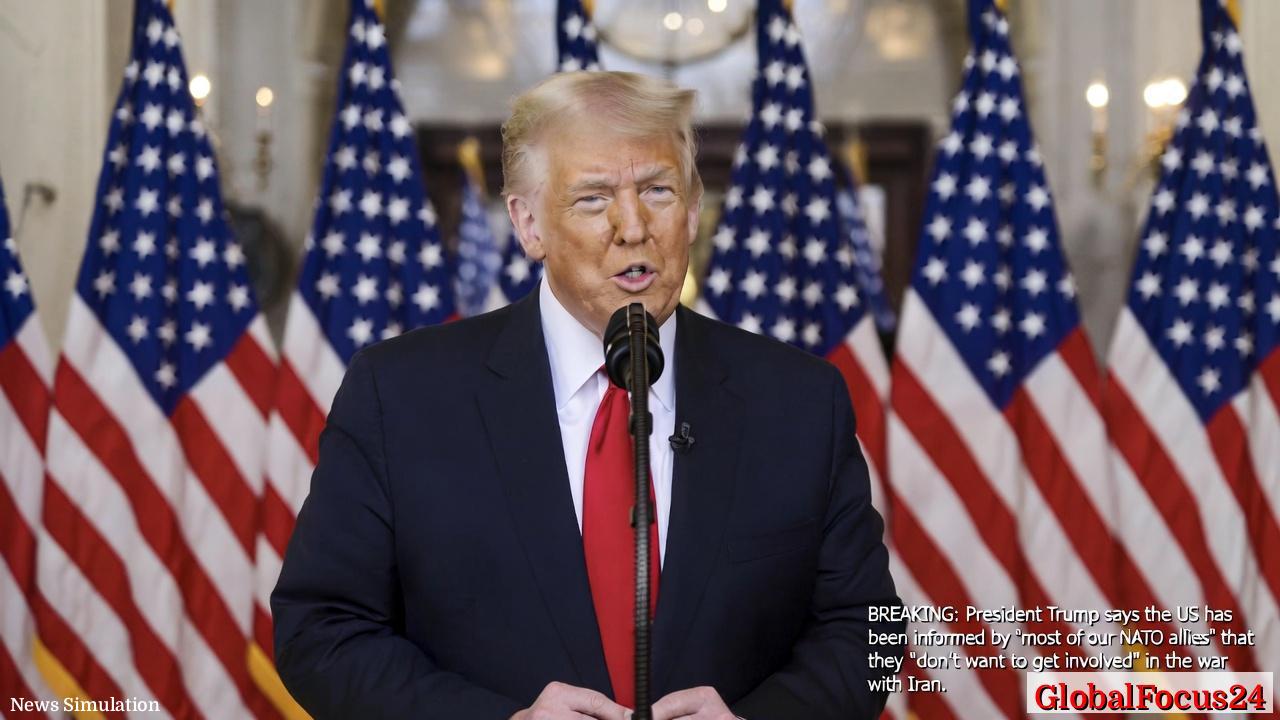
President Donald J. Trump announced Tuesday that most NATO allies have declined to participate in the U.S.-led military operation against what he described as the “terrorist regime of Iran.” The statement comes in the aftermath of a large-scale offensive that, according to the president, obliterated Iran’s naval, air, and radar defense systems, as well as key leadership positions.
Speaking from Washington, Trump underscored that while nearly every allied government agreed with the premise that Iran must not be allowed to obtain nuclear weapons, few were willing to take part in direct military intervention. “The United States spends hundreds of billions of dollars protecting these same countries,” he said. “But when it is time for them to do something in return, they do nothing.”
The remarks signal growing tension within NATO following the successful but controversial operation, and they mark another chapter in the long-debated question of alliance burden-sharing.
The Operation That Changed the Equation
U.S. military officials have yet to disclose detailed casualty figures or precise locations of the strikes, but early intelligence assessments suggest the campaign effectively neutralized Iran’s ability to project military power. According to administration sources, air raids targeted naval bases along the Persian Gulf, major airfields in central Iran, and several command and control centers near Tehran.
The president called the mission a “decisive success,” saying that “Iran’s navy is gone, its air force is gone, its anti-aircraft and radar capabilities are gone.” He further claimed that the regime’s leadership “at virtually every level is gone, never to threaten the United States, its Middle Eastern allies, or the world again.”
Military analysts note that such sweeping claims are difficult to verify independently. Nevertheless, satellite imagery and regional monitoring groups have reported widespread destruction of Iranian military infrastructure, with air defense networks and missile batteries showing extensive damage.
NATO’s Reluctant Response
The president’s comments highlight a stark divergence between U.S. military strategy and the caution exercised by its European allies. Several NATO members have long supported diplomatic containment of Iran rather than outright military confrontation, favoring sanctions and nuclear monitoring frameworks instituted under previous international agreements.
While there has been no official NATO statement rejecting participation, diplomatic sources in Brussels report that key allies—among them Germany, Italy, and France—expressed hesitation over operational involvement, citing concern over regional escalation. Scandinavian and Eastern European nations reportedly emphasized the defensive nature of NATO’s mission, noting that the alliance was not attacked directly.
Such restraint reflects internal strains that have surfaced before. The split echoes previous debates over interventions in Iraq and Libya, where coalition participation was uneven and often politically divisive at home.
A History of Uneven Burden-Sharing
Questions over NATO’s financial and strategic balance have persisted since the alliance’s inception in 1949. The United States currently contributes roughly 70 percent of NATO’s total defense spending, a disparity that has long been a point of contention in Washington.
Past presidents have urged allies to meet the alliance’s defense spending benchmark of 2 percent of GDP, but only a handful of member states consistently reach that level. Trump’s characterization of NATO as a “one-way street” recalls similar criticism he voiced during his first term in office, when he pressed European governments to “pay their fair share.”
Military historians note that while NATO serves as the backbone of Western collective defense, its operations outside Europe—particularly in the Middle East—have often tested member unity. The 2011 Libya campaign revealed significant gaps in European capabilities, with the U.S. providing the bulk of intelligence and logistical support. The current situation with Iran appears to have deepened that long-standing asymmetry.
Economic and Diplomatic Fallout
The aftermath of the strike is rippling across global markets and diplomatic channels. Oil prices surged in the immediate wake of the announcement, reaching their highest levels in nearly two years before stabilizing as reports confirmed widespread disruption to Iranian export infrastructure. Energy analysts warn that the elimination of Iran’s ability to produce and ship petroleum could strain supply lines already recovering from earlier global shocks.
European energy ministers reportedly convened emergency sessions to assess alternative import routes, particularly from Gulf countries and the Caucasus. Countries such as Greece and Italy, which rely heavily on Middle Eastern crude, are expected to feel the effects most severely.
Financial markets displayed mixed reactions. Defense stocks climbed, buoyed by expectations of increased military spending, while airlines and manufacturers dependent on stable fuel prices declined. Analysts cautioned that volatility could persist if retaliatory attacks or proxy conflicts emerge across the region.
Diplomatically, the operation leaves NATO at a crossroads. Several European capitals have called for renewed talks on alliance priorities, emphasizing that unilateral U.S. actions risk undermining multilateral consensus. However, Washington’s current posture suggests a turn toward selective partnerships beyond traditional NATO frameworks.
Regional Repercussions and Strategic Shifts
Across the Middle East, reactions were swift. Israel and Saudi Arabia voiced strong support for the U.S. operation, both governments having long viewed Iran as their primary adversary. Gulf oil producers quietly welcomed the removal of what they see as a destabilizing force, although officials publicly called for “restraint and long-term stability.”
Meanwhile, analysts in Ankara and Doha warned that the power vacuum in Iran could inflame existing regional rivalries. “Without a functioning central government, you could see new conflicts erupting—not only among Iranian factions but also between external powers vying for influence,” a Middle East policy expert at a leading think tank observed.
In Asia, responses were measured. Japan and South Korea—two key U.S. allies mentioned by Trump in his remarks—expressed understanding for the American position but avoided committing to any direct support, reflecting an ongoing preference for regional neutrality in Middle Eastern conflicts.
The U.S. Position on Self-Reliance
The president’s declaration that America “does not need the help of anyone” underscores a broader shift toward strategic self-reliance. The statement suggests a recalibration of U.S. defense doctrine—away from multilateral coalition-building and toward operations conducted independently or with ad hoc regional partners.
Defense policy experts note that this orientation mirrors earlier debates over the future of U.S. military alliances. While previous administrations stressed shared security responsibilities, the current stance appears to prioritize American capability over cooperative diplomacy. Some see this as pragmatic realism, while others warn it risks isolating allies and diminishing long-term deterrence.
Within the Pentagon, officials acknowledge that conducting high-intensity operations without allied support increases operational strain and logistical costs. But given the scale of the strike and its apparent success, proponents argue that the move demonstrates both U.S. readiness and global reach—sending a message to adversaries beyond Iran.
Lessons from Past Conflicts
Historically, unilateral or limited-coalition actions by the United States have produced mixed outcomes. The 1991 Gulf War, conducted under a broad international mandate, contrasted sharply with the 2003 invasion of Iraq, where limited allied participation contributed to prolonged reconstruction challenges. The Libya intervention in 2011, backed by NATO but lightly supported by the U.S., likewise revealed the alliance’s dependence on American air power and reconnaissance assets.
Analysts suggest that today’s Iran operation may mark the beginning of a new model: rapid, technology-driven deterrence, emphasizing overwhelming force and minimal occupation. Drone networks, hypersonic weapons, and cyber operations are believed to have played central roles, enabling precision strikes with limited personnel risk—a stark evolution from earlier wars.
Looking Ahead: NATO’s Next Test
As NATO convenes emergency consultations, the question of unity looms large. European leaders must balance domestic anti-war sentiment with concerns about alliance credibility. Meanwhile, Washington’s decisive action could embolden other powers to test the boundaries of Western responses.
For now, the operation has redefined both the U.S. relationship with NATO and the geopolitical balance of the Middle East. Whether this shift endures—or triggers deeper fractures within the transatlantic community—remains uncertain.
One thing appears clear: the American strike on Iran marks a turning point, not only in regional power dynamics but in the broader question of how alliances function in an era when the world’s most powerful nation asserts it can stand alone.