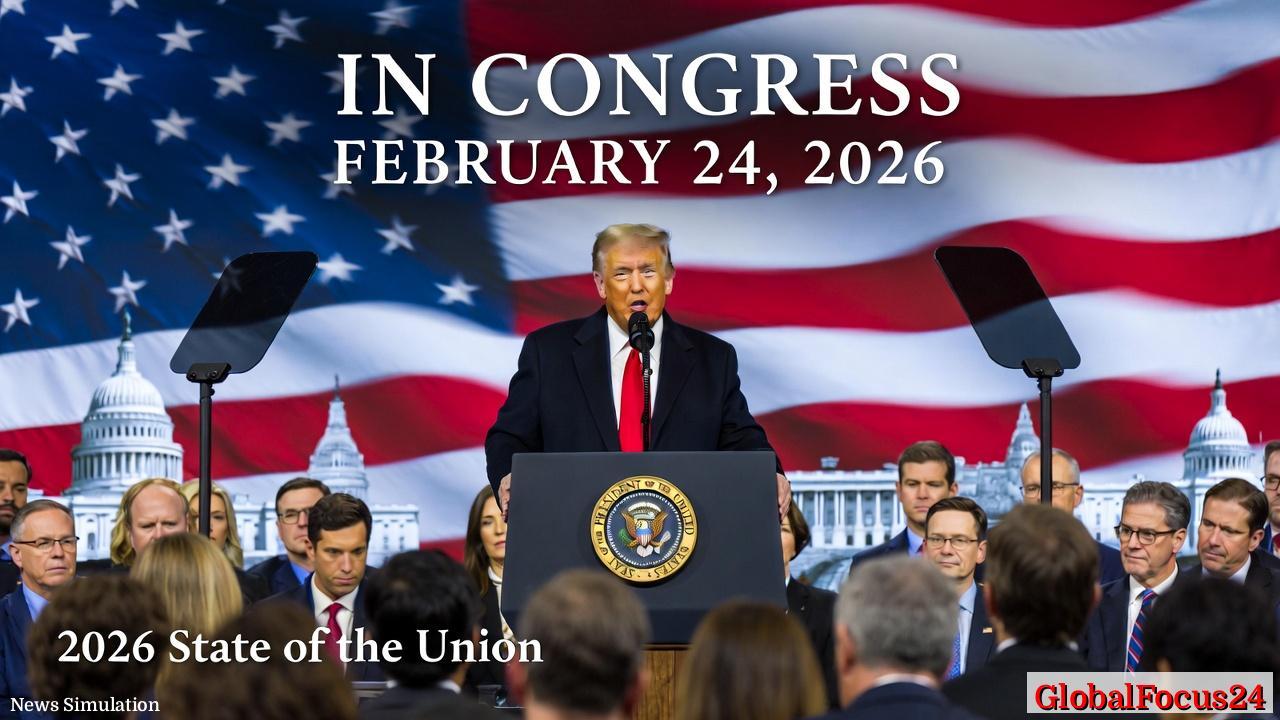
President Trump Delivers Longest State of the Union Address in American History, Declaring Nation “Stronger Than Ever”
A Record-Breaking Address Marks a Defining Moment
President Donald Trump delivered his 2026 State of the Union address to a joint session of Congress on February 24, speaking for nearly two hours in what is now the longest address in U.S. history. The speech, surpassing 10,000 words, blended celebration, defiance, and showmanship as Trump declared that “the nation is back—bigger, better, richer, and stronger than ever before.”
The record-setting address came as the United States approaches its 250th anniversary, a milestone that has shaped much of the administration’s rhetoric in recent months. For Trump, the moment was both symbolic and strategic—a platform to showcase the results of his second-term agenda and to project confidence in America’s economic and geopolitical standing.
Themes of Strength and Renewal
From the first moments of his address, the president presented an image of resurgence across every front. He credited his administration with what he described as “a turnaround for the ages,” emphasizing border security, economic expansion, and energy independence.
“The border has never been stronger,” Trump proclaimed, highlighting completion of additional barriers, new personnel deployments, and cooperation with Latin American governments. While official statistics from the Department of Homeland Security show declines in illegal crossings since 2024, analysts note that those numbers partly reflect shifts in migration routes and enforcement strategies rather than purely domestic policy.
Economically, the president cited strong consumer confidence, job creation, and falling inflation as proof of renewed prosperity. Inflation, which surged globally in the early 2020s, has stabilized in the U.S. since late 2025, aided by easing supply chains and steady Federal Reserve policy. Trump attributed that success to his administration’s energy policies and continued tax cuts, asserting that “American workers are winning again.”
Honoring Heroes and National Pride
As in his past addresses, Trump’s speech featured emotional moments of recognition for American citizens representing courage and achievement. Among those honored were members of the U.S. men’s hockey team, fresh from their Olympic gold medal victory, a 100-year-old Korean War veteran, and a Venezuelan political prisoner reunited with his family in the chamber after being freed through U.S. diplomatic efforts.
These high-profile recognitions—long a hallmark of State of the Union ceremonies—served to punctuate the night’s broader narrative of national pride and renewal. Each guest’s story was crafted to underscore key policy themes: defense, liberty, and perseverance.
Foreign Policy Outlook: Brief but Symbolic
Although domestic culture and economics dominated the address, Trump devoted moments to foreign policy. He referenced ongoing negotiations aimed at a new nuclear agreement with Iran and acknowledged recent U.S. military operations in Venezuela. Details remained vague, consistent with the administration’s practice of emphasizing results over process.
The brief foray into international issues seemed intended less to outline strategy and more to reinforce the theme of American strength abroad—a contrast to the deep dives characteristic of past presidents’ addresses.
Shifting Tone from 2017 to 2026
Observers quickly noted the contrast between Trump’s rhetoric in his first joint address to Congress in 2017 and the tone of this year’s speech. In 2017, as a newly elected president, Trump called for unity and renewed national purpose ahead of the semiquincentennial. By 2026, his message had evolved into one of partisan defiance and triumphalism.
Throughout the two-hour address, Trump leveled repeated criticisms at Democratic lawmakers, accusing them of “destroying the country” and refusing to applaud economic achievements. He drew sharp distinctions between what he described as his administration’s success and his opponents’ obstruction, again using the televised platform to reinforce divisions that have defined his political persona.
Political analysts describe the evolution in tone as reflecting both the realities of a polarized electorate and the president’s own instinct to frame his leadership in terms of confrontation and victory. The absence of a unifying appeal underscored a shift from the consensus-centered rhetoric of earlier presidencies to a more combative style that has marked much of Trump’s time in office.
Economic Landscape: A Complex Recovery
Trump’s emphasis on economic strength arrived amid measurable but uneven growth. According to data from the Bureau of Economic Analysis, the U.S. economy expanded steadily throughout 2025, supported by a rebound in manufacturing, modest wage gains, and continued job creation in energy, technology, and construction. Inflation hovered near 2.5 percent at the start of 2026—below its 2023 highs but above the pre-pandemic average.
Energy independence, a recurring goal of Trump’s agenda, has played a central role in stabilizing fuel prices and reducing imports. Increased domestic oil and natural gas production placed the U.S. in a stronger export position by late 2025, marking what industry observers call a return to “energy dominance.”
Yet, economists caution that major structural challenges persist: rising national debt, housing affordability, and subdued productivity growth. While Trump’s address described these as “temporary hurdles,” nonpartisan budget analysts warn that without fiscal restraint, the long-term sustainability of tax reductions may come into question.
Regional Comparisons Highlight Diverging Trends
Across the states, economic outcomes vary. Energy-rich regions such as Texas, North Dakota, and New Mexico have benefited from expanding oil and gas production, while parts of the Midwest and Northeast—especially manufacturing hubs in Ohio and Pennsylvania—have experienced slower recoveries.
California and Washington continue to lead in tech-driven growth, though housing costs remain a limiting factor for labor mobility. In the Southeast, low unemployment and rising infrastructure investment have encouraged migration and population gains. Trump used these disparities to support his call for reducing federal regulations that he argues suppress regional potential.
The Political Stage and Public Reaction
The gallery offered a snapshot of America’s divisions. Republican lawmakers punctuated Trump’s remarks with standing ovations, while many Democrats remained seated, some shaking their heads. The prime-time address drew tens of millions of viewers nationwide—figures that early ratings indicate rival his 2020 and 2024 appearances.
Public response, as reflected in overnight surveys, mirrored the polarization of the Capitol floor. Supporters praised the speech’s confidence and spectacle; critics described it as theatrical and divisive. Nonetheless, analysts agreed that the event reinforced Trump’s grip on his political base while underscoring the challenges of governing a fractured nation in a historic anniversary year.
Outside Washington, reactions unfolded in local gatherings, social media watch parties, and community events marking the prelude to America’s 250th birthday. For many Americans, the speech’s focus on national pride resonated beyond party lines, even as its tone sparked continued debate.
Historical Context: State of the Union as Political Performance
The State of the Union address has long served as both a constitutional requirement and a national stage. From Franklin D. Roosevelt’s broadcast addresses during the 1930s to John F. Kennedy’s television-era appearances and Barack Obama’s internet-savvy presentations, each generation has adapted the moment to its own media landscape.
Trump’s 2026 address extended that tradition into the social media age, leveraging live-streaming platforms and real-time commentary. Analysts noted that the speech’s length—twice that of many 20th-century predecessors—demonstrated not just oratory endurance but also an evolving approach to political communication: sustained engagement through spectacle and repetition.
Economic and Historical Significance Ahead of the Semiquincentennial
As the United States edges closer to its 250th year, the themes of Trump’s address—strength, independence, and resilience—echo through broader national conversations about identity and global role. Economically, the milestone coincides with a period of recalibration after years of disruptive shocks, from pandemics to inflationary surges.
Historians note that previous milestone years—1876 and 1976—also served as moments of reflection on the nation’s growth and challenges. In each era, political leaders sought to frame the commemoration as proof of endurance. Trump’s 2026 address fits squarely within that pattern, merging commemoration with campaign-style affirmation of continuity and strength.
Looking Ahead
The 2026 State of the Union, both record-setting and polarizing, may come to symbolize the broader dynamics of Trump’s second term: ambitious in scope, unyielding in tone, and defined by claims of national revival. As preparations for the country’s 250th anniversary accelerate, the administration’s next policies on trade, energy, and global diplomacy will test whether the optimism of Trump’s speech translates into measurable progress.
For now, the longest State of the Union in history stands as a defining snapshot of American politics in 2026—an era marked by confidence, contention, and the ongoing struggle over what “stronger than ever” truly means.