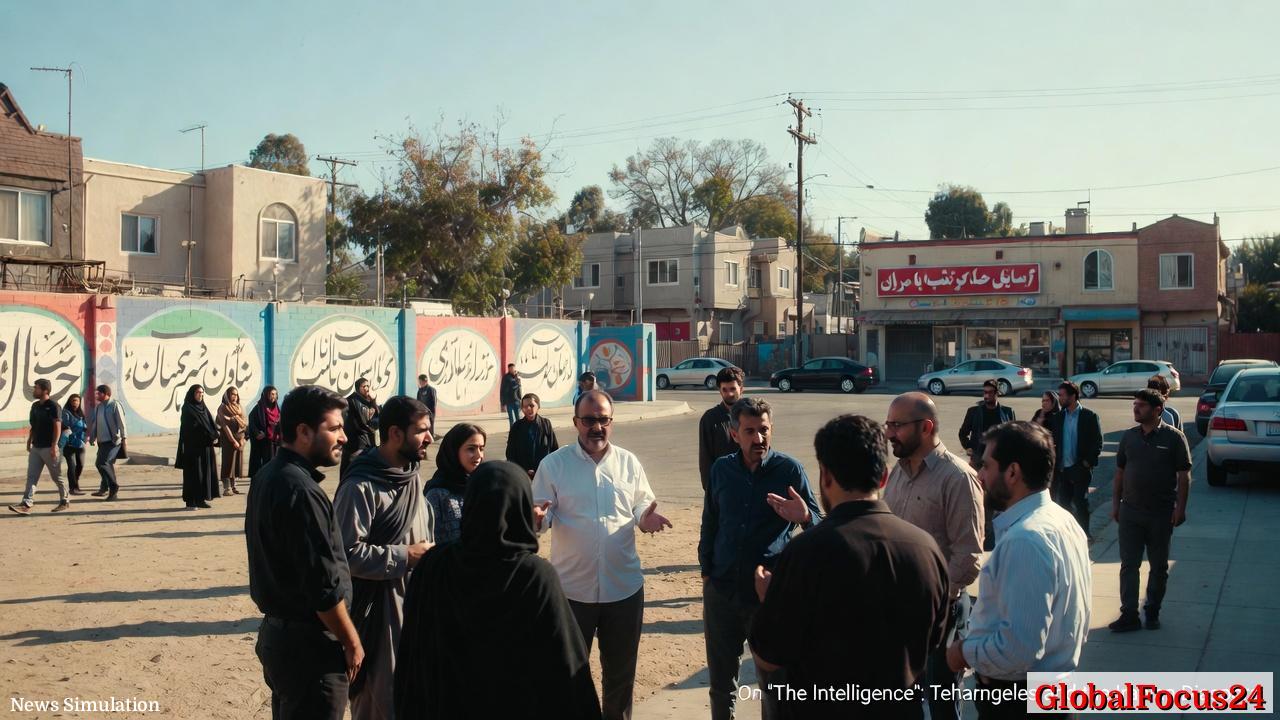
In Los Angeles’ “Tehrangeles,” Iran’s War Echoes Through a Divided Diaspora
A Neighborhood Bound by Memory and Distance
On a mild March evening in Los Angeles, the stretch of Westwood Boulevard known as “Tehrangeles” hums with the scent of saffron rice and the chatter of outdoor diners. Persian music drifts from café speakers, mingling with the hum of traffic and the aroma of fresh koobideh from nearby grills. Yet beneath the neighborhood’s comforting familiarity lies a growing unease.
As war deepens in Iran, thousands of miles away, the Iranian American community here finds itself caught between heartbreak, anxiety, and an uncertain hope for change. News reports flicker across television screens in pastry shops and travel agencies, as discussions swell in private homes, on social media, and in bustling eateries.
Many in Tehrangeles — the world’s largest Iranian diasporic enclave outside Iran — are watching events unfold with a mixture of fear and determination. For some, the conflict has reignited painful memories of revolution and exile. For others, it represents a desperate chance for transformation in a homeland they can no longer safely visit.
A Community with Deep Roots
Tehrangeles’ origins trace back to the late 1970s, when large numbers of Iranians fled to the United States following the Iranian Revolution. Los Angeles, then a city of opportunity and relative affordability, became their destination. The Westwood district quickly filled with Persian bookstores, grocery stores selling rosewater and lavashak, and family-run restaurants that recreated tastes of home.
Over time, the enclave became not just a cultural hub, but also a symbol of resilience. Many early immigrants were professionals — doctors, engineers, and academics — whose careers were disrupted by political upheaval. In California, they rebuilt their lives, opening small businesses and investing in education for their children.
Today, roughly half a million people of Iranian descent live in California, a significant portion concentrated in Los Angeles County. Tehrangeles stands as both a physical reminder of displacement and a thriving testament to renewal.
A War Reaches Across Oceans
The war in Iran has reopened old wounds that stretch across generations of Iranian Americans. The conflict, which began after months of rising tensions with neighboring states and internal unrest, has triggered fears of widespread instability in the region.
For many in Tehrangeles, the war is not an abstract geopolitical affair — it is deeply personal. Family WhatsApp groups have become lifelines for updates from relatives living under bombardment or dealing with shortages. In cafés, debates erupt over the legitimacy of various armed groups, the roles of Iran’s leadership, and the influence of foreign powers in the conflict.
Although physical distance offers safety, the emotional proximity is inescapable. “You can be 7,000 miles away, but when your cousin is running to a shelter, you feel every explosion,” said one shop owner, glancing up from a muted news broadcast showing smoke rising over Tehran.
Diaspora Divisions Resurface
The war has also exposed long-standing divides within the diaspora — ideological, generational, and political.
Older Iranian Americans who fled the 1979 revolution often express skepticism toward any new uprising, fearing that instability will only deepen suffering. Younger members of the community, many born in the United States, tend to show solidarity with protest movements and support more direct calls for regime change.
Community centers, cultural institutions, and local gatherings in Los Angeles have become microcosms of this divide. Some organizations host prayer vigils or charity drives for civilians affected by the war, while others focus on political advocacy and calls for international intervention.
At the heart of these disagreements lies a shared anguish over the fate of ordinary Iranians — students, workers, parents — who are trapped in violence beyond their control.
Historical Context: From Revolution to Exile
To understand the charged emotions unfolding in Tehrangeles today, it helps to look back at the path that led many of its residents here.
Following the 1979 revolution, Iran underwent dramatic political transformation that upended social classes and dislocated millions. Those who left carried with them not only the pain of exile but also conflicting narratives of what the revolution meant — liberation for some, loss for others.
In the decades that followed, Los Angeles became an epicenter of Iranian cultural production abroad. Satellite TV networks, Persian-language newspapers, and music studios kept the diaspora connected to their heritage. But these same media channels also shaped political identities, amplifying both reformist and monarchist voices. The current war has reignited those ideological battle lines, resurfacing questions about identity, justice, and belonging that have persisted for generations.
Economic Ripples and Regional Impact
The conflict’s economic effects are not confined to the Middle East. California’s Iranian-owned businesses — from import-export companies to tourism agencies — are already feeling the pressure. Supply chains reliant on goods from the Persian Gulf and regional tourism have slowed sharply. Jewelers and rug dealers report delays in shipments, while travel agencies serving dual citizens face waves of cancellations.
Remittances, which many diaspora families send to relatives in Iran, have also been disrupted. The value of Iran’s currency has plunged amid the instability, making international money transfers more complicated and expensive. For families straddling both economies, financial stress adds to emotional strain.
Economists warn that continued conflict could further affect global energy markets, influencing fuel prices in Southern California, which already ranks among the highest in the nation. The crisis has revived memories of the oil shocks of the late 1970s, when events in Iran helped send energy costs soaring worldwide.
Though Los Angeles is thousands of miles from Tehran, its economic and emotional ties to Iran make its residents acutely sensitive to such fluctuations.
Public Reaction and Cultural Expression
In Westwood and other parts of Los Angeles, public reactions to the war have taken many forms. Vigils line the steps of UCLA’s campus, where Iranian student organizations have placed photographs of victims and handwritten notes calling for peace. In nearby Beverly Hills, younger activists organize rallies demanding international solidarity, while in quiet suburban homes, elders gather to pray for their relatives’ safety.
Art, too, has become a vessel for processing collective trauma. Iranian musicians in Southern California are releasing instrumental pieces inspired by the war’s devastation. Visual artists at local galleries are showcasing works blending traditional Persian motifs with images of rubble and resistance.
The Persian-language radio shows broadcast from Los Angeles into Iran every day, carrying interviews, commentary, and personal testimonies that blur the line between journalism and confession. In this way, Tehrangeles functions not only as a sanctuary but also as a transmitter — a place where the diaspora’s pain and hope reverberate across continents.
Beyond Politics: Human Connections Endure
Despite differing political views, moments of solidarity still emerge. Charity networks within the community have mobilized to send humanitarian aid through international organizations. Small businesses host donation drives, and youth groups have launched online fundraisers to support displaced families.
In one Westwood bakery, customers drop dollar bills into a glass jar labeled simply “For Iran.” The shop owner, who left Tehran as a teenager in the 1980s, shrugs when asked about politics. “Everyone argues,” she says. “But everyone cares. That’s what matters.”
This sentiment — compassion above division — is echoed in many corners of Tehrangeles, even among those who fiercely disagree on solutions. The community’s shared longing for peace binds its members together more deeply than any ideological difference can pull them apart.
Looking Forward: Identity in Flux
For Iranian Americans in Los Angeles, the war has renewed an old question: what does it mean to belong to two places at once? Many young people who have never set foot in Iran describe a growing urgency to reconnect with their heritage. Others, weary of decades of unrest, prefer to focus on life in the United States, where their identities are shaped by both heritage and adaptation.
Immigration scholars note that such dual consciousness is common among long-established diasporas. Yet the intensity of Iran’s current conflict — amplified by digital connectivity and constant media coverage — is forcing even second-generation Iranians to reckon with the gravity of events taking place far from their daily lives.
In Tehrangeles, that reckoning plays out amid the aroma of cardamom tea and the glow of Persian neon signs. It is a reminder that, even half a world away, the lines between homeland and exile remain blurred.
The Ties That Endure
As the war in Iran continues, the population of Tehrangeles finds itself living in parallel realities — one steeped in the comfort and stability of California life, the other tethered to a distant nation in turmoil.
Between these worlds runs an unbreakable thread of connection: family, culture, and memory. For the Iranian diaspora, this conflict is not only a geopolitical tragedy but a deeply human one — a story of love and loss carried across oceans, retold every day in a small corner of Los Angeles that still calls itself home.