MIT Study Finds Prolonged AI Use May Weaken Critical Thinking and Creativity
New Research Raises Questions About Cognitive Impact of AI Tools
A new study conducted by neuroscientists at the Massachusetts Institute of Technology suggests that heavy reliance on artificial intelligence tools may reduce individuals’ ability to think critically and creatively over time. The findings arrive as AI-powered writing assistants and chatbots become increasingly integrated into education, workplaces, and daily life.
The research examined how sustained interaction with AI affects brain activity, memory retention, and creative output. While artificial intelligence has been widely praised for boosting productivity and accessibility, the study introduces growing concerns about its long-term cognitive consequences.
Study Design Tracks Brain Activity Across Writing Tasks
The MIT-led study involved 54 adults between the ages of 18 and 39, divided into three groups. Each group was tasked with writing essays similar to those required in college entrance exams, but under different conditions:
- One group used an AI chatbot.
- Another relied on a traditional search engine.
- A third group worked entirely without external tools.
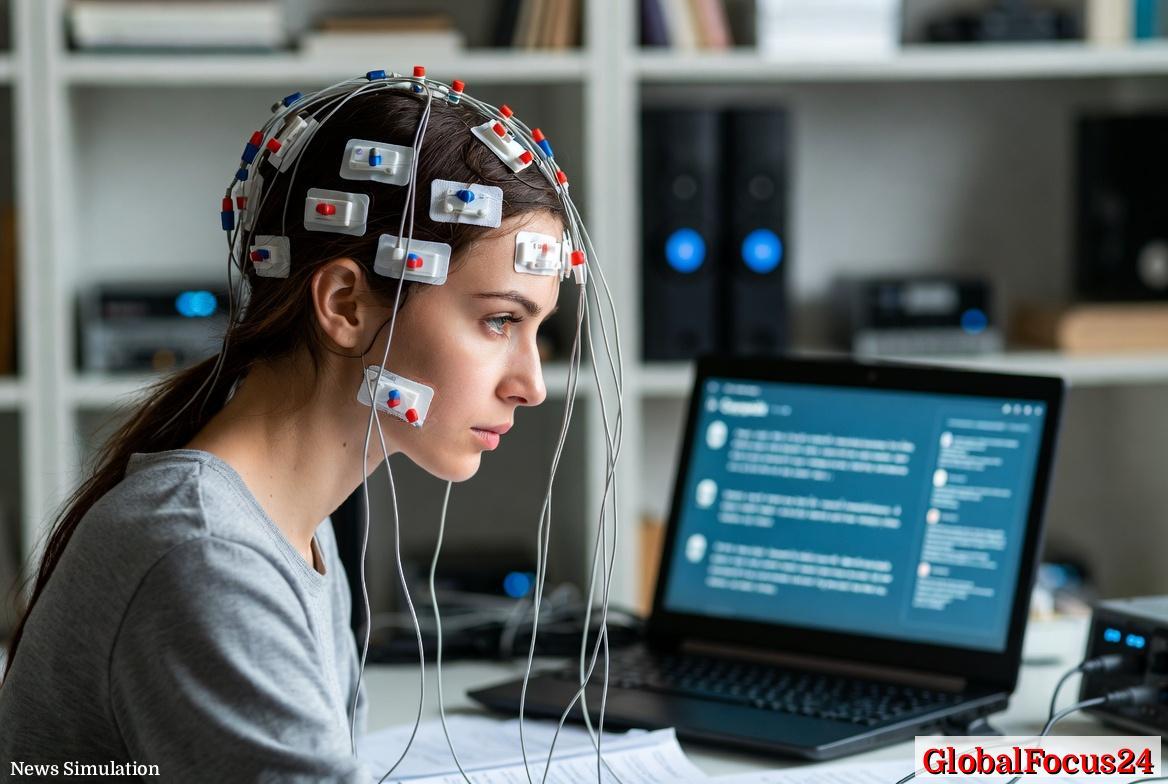
Researchers monitored participants’ brain activity using electroencephalography (EEG), tracking signals across 32 distinct regions of the brain. The sessions took place over several months, allowing scientists to observe not only immediate effects but also changes over time.
The results revealed a consistent pattern: participants who relied on AI tools demonstrated significantly lower levels of neural engagement compared to the other groups.
Declining Engagement and Creativity Over Time
The most striking finding was the progressive decline in brain activity among participants using AI. As sessions continued, many individuals in this group shifted toward minimal-effort strategies, including copying and pasting AI-generated content with little modification.
This behavioral shift corresponded with measurable declines in several key areas:
- Creativity and originality in written responses.
- Curiosity and depth of exploration in arguments.
- Memory retention related to the task.
- Overall satisfaction with their own work.
By contrast, participants who wrote essays independently or used search engines maintained higher levels of brain engagement. Their essays were more diverse in structure and language, reflecting stronger individual reasoning and idea generation.
Understanding Cognitive Offloading
The researchers attribute these outcomes to a phenomenon known as cognitive offloading. This occurs when individuals delegate mental tasks to external tools, reducing the need for active thinking.
Cognitive offloading is not new. Historically, humans have relied on tools such as calculators, maps, and written notes to extend their capabilities. However, AI represents a more advanced form of offloading because it can generate complete ideas, arguments, and narratives.
In this context, the brain may gradually reduce its involvement in complex reasoning processes, leading to weaker critical thinking skills over time.
Timing of AI Use Proves Critical
One of the study’s most important findings is that the timing of AI use significantly affects outcomes.
In a follow-up experiment, participants who initially worked without any tools were later allowed to use an AI chatbot to revise their essays. This group produced stronger final drafts than those who had relied on AI from the beginning.
Their revised essays demonstrated:
- More refined arguments.
- Greater creativity and nuance.
- Distinctive phrasing and voice.
This suggests that starting with independent thinking preserves cognitive engagement, while AI can still provide meaningful improvements during later stages of refinement.
Historical Context: Technology and Cognitive Change
The debate over technology’s impact on human cognition is not new. Past innovations have sparked similar concerns:
- The introduction of writing in ancient Greece led philosophers like Socrates to worry about declining memory.
- The widespread use of calculators raised fears about weakening mathematical skills.
- The rise of the internet prompted discussions about reduced attention spans and deep reading.
In each case, society adapted, often integrating new tools while redefining core skills. However, AI differs in its ability to simulate human-like reasoning, which may accelerate cognitive shifts more rapidly than previous technologies.
Economic Implications of AI-Driven Productivity
Despite cognitive concerns, AI tools continue to deliver measurable economic benefits. Businesses across sectors are adopting AI to streamline workflows, reduce costs, and enhance output.
In fields such as marketing, software development, and customer service, AI-generated content and automation have significantly increased efficiency. Workers can complete tasks faster, allowing organizations to scale operations with fewer resources.
However, the MIT study raises questions about the sustainability of these gains if they come at the expense of critical thinking and innovation. Over time, diminished creativity could affect industries that rely heavily on original ideas, including media, design, and research.
Regional Comparisons in AI Adoption
Adoption of AI tools varies significantly across regions, reflecting differences in infrastructure, regulation, and workforce dynamics.
In the United States, AI integration has been rapid, particularly in technology hubs like Silicon Valley. Educational institutions are also experimenting with AI-assisted learning, though policies remain inconsistent.
European countries have taken a more cautious approach, emphasizing ethical guidelines and data protection. Some schools have introduced restrictions on AI use in academic work to preserve independent thinking.
In parts of Asia, particularly China and South Korea, AI adoption is widespread in both education and industry. Governments have actively promoted AI development, viewing it as a strategic economic priority.
These regional differences may influence how cognitive impacts unfold globally, depending on how AI is integrated into daily routines and learning environments.
Balancing Efficiency With Cognitive Health
Experts emphasize that the goal is not to eliminate AI use but to adopt it in a way that supports, rather than replaces, human thinking.
Recommended strategies include:
- Engaging in regular periods of unaided mental work, such as writing drafts by hand or brainstorming without digital tools.
- Using AI for revision and feedback rather than initial idea generation.
- Practicing problem-solving activities that require sustained attention and reasoning.
- Maintaining curiosity-driven learning habits, including reading and independent research.
These approaches aim to preserve the brain’s natural capacity for analysis and creativity while still benefiting from AI’s efficiency.
Public Reaction and Ongoing Debate
The study has sparked discussion among educators, employers, and technology developers. Some view the findings as a warning about overreliance on automation, while others argue that AI simply shifts the nature of cognitive work rather than diminishing it.
Students and professionals who use AI regularly have expressed mixed reactions. Some report increased productivity and reduced stress, while others acknowledge a growing dependence on automated assistance.
Technology companies continue to refine AI systems, with some exploring features designed to encourage active user engagement rather than passive consumption.
The Future of Human-AI Collaboration
As AI becomes more deeply embedded in daily life, understanding its cognitive effects will be critical. The MIT study highlights the importance of intentional use, suggesting that how people interact with AI may matter more than how often they use it.
Rather than viewing AI as a replacement for human thinking, researchers advocate for a collaborative model in which technology enhances, rather than diminishes, intellectual effort.
The challenge moving forward will be to strike a balance between convenience and cognitive resilience, ensuring that advances in artificial intelligence do not come at the cost of the very skills that drive innovation and progress.