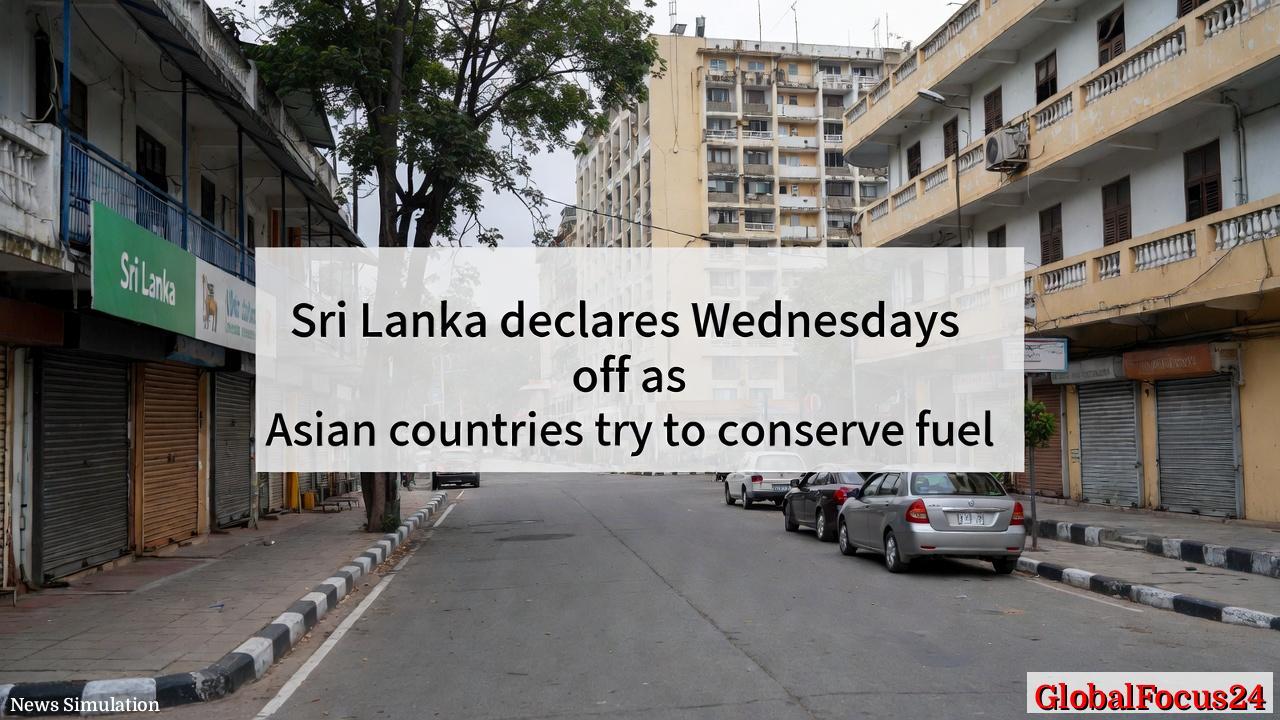
Sri Lanka Adopts Four-Day Week and Fuel Rationing as Regional Energy Turmoil Intensifies
Sri Lanka has unveiled a sweeping austerity package aimed at conserving fuel amid regional tensions and potential shortages sparked by a widening conflict in the Middle East. The plan, announced by President Anura Kumara Dissanayake at an emergency meeting, introduces a four-day workweek for government institutions, schools, and universities, effective immediately on Wednesdays. Essential services, including hospitals and immigration offices, will continue to operate fully, ensuring critical public functions remain uninterrupted. The policy also introduces a National Fuel Pass system to cap fuel purchases for private vehicles, a measure reminiscent of the country’s 2022 economic crisis, when shortages and rationing forced similar controls.
Historical context and why this matters Sri Lanka’s current measures echo a long arc of energy and economic vulnerability that has shadowed the island nation for years. The country has wrestled with a delicate balance between growth, debt sustainability, and energy security. The decision to designate Wednesday as a weekly holiday follows a pattern seen in past crises when governments use reduced public-sector activity to conserve scarce energy resources. The approach is not new in the region; it reflects broader Asia-wide responses to disruptions in global energy supply chains, particularly after the disruption of the Strait of Hormuz—one of the world’s most strategically important chokepoints for oil shipments.
Economic impact and the broader regional footprint The immediate economic rationale behind Sri Lanka’s four-day week is to reduce demand for fuel and electricity, easing pressure on a strained grid and on fuel imports priced in a volatile global market. With oil trading near the $100 per barrel mark following the recent surge in regional tensions, the policy aims to cushion the nation’s balance of payments and reserve levels while maintaining essential services. Analysts note that the short-term cost to productivity could be offset by greater energy stability and reduced wholesale energy costs if the measure successfully lowers consumption and stabilizes prices.
Beyond Sri Lanka, several regional neighbors have launched complementary conservation efforts, highlighting how interconnected energy security has become in South and Southeast Asia. In Thailand, for instance, public guidance encourages lighter clothing to reduce air-conditioning usage, while Vietnam promotes staying home, cycling, carpooling, and using public transport to curb emissions and energy demand. Myanmar and Bangladesh have pursued stricter vehicle usage policies and adjusted academic calendars and holidays to align with energy-saving goals. The Philippines has implemented a mix of telework, travel restrictions, and targeted cash support to key labor groups affected by the energy squeeze. These measures illustrate a regional consensus that energy resilience requires coordinated adjustments across public and private sectors.
Public reaction and social dimensions Public sentiment around Sri Lanka’s four-day workweek is mixed but largely pragmatic. Officials emphasize a careful calibration to avoid disruptions in essential services, while citizens and business groups monitor the ripple effects on daily life, supply chains, and economic activity. The decision to fix Wednesday as the public holiday, rather than creating three consecutive days off, is designed to minimize long closures and maintain continuity in government services. The National Fuel Pass introduces a practical, enforceable framework to curb nonessential consumption, but its success will hinge on implementation, public trust, and the capacity of the supply chain to adapt to fluctuating demand.
Regional comparisons illuminate similar trade-offs Sri Lanka’s approach aligns with broader regional strategies that prioritize energy conservation amid uncertainty. In Bangladesh and the Philippines, authorities have embedded targeted financial support and changes in work patterns to buffer vulnerable workers and sectors. Vietnam’s emphasis on encouraging public transport use and low-emission travel mirrors a longer-term push toward sustainable mobility, which can also reduce energy import bills and strengthen resilience to price shocks. These parallel measures reveal a shared understanding: reducing energy intensity during periods of geopolitical risk can slow the pace of inflation, stabilize households, and provide governments with a smoother path to fiscal consolidation.
Operational details and implementation Key elements of Sri Lanka’s plan include:
- A four-day workweek for government agencies, government-run institutions, and nonessential public offices, with essential services exempted to ensure continuity.
- Wednesday designated as the official public holiday to prevent three consecutive days of closures, preserving administrative consistency.
- A National Fuel Pass system that caps purchases for private cars at 15 litres and motorcycles at five litres per day, echoing rationing mechanisms during the 2022 economic crisis.
- A commitment to maintain vital services at immigration offices, hospitals, and police operations, ensuring public safety and mobility for residents.
- Acknowledgment that the policy is flexible and subject to review as regional energy dynamics evolve and supply conditions change.
Energy security implications and macroeconomic considerations From a macroeconomic perspective, the Sri Lankan policy aims to:
- Alleviate pressure on foreign exchange reserves by reducing import demand for fuel and electricity.
- Stabilize consumer prices by dampening energy-driven inflation and mitigating volatile power generation costs.
- Preserve social stability by balancing public sector reform with protection of essential services. The approach also signals a broader strategy to diversify energy consumption patterns, potentially accelerating demand for domestically produced electricity, renewable energy investments, and efficiency improvements. While the upfront productivity costs of reduced public-sector hours are a consideration, the longer-term gains in energy resilience and price stability could offset short-term losses if carefully managed.
Environmental and public health dimensions Lowering energy consumption can yield ancillary benefits, including reduced air pollution and lower greenhouse gas emissions, particularly if the energy mix includes cleaner sources. In regions facing air quality challenges, even modest reductions in traffic and electricity demand can have outsized health benefits, particularly for urban populations and vulnerable groups. The public health implication, however, depends on how households adjust—whether savings from reduced fuel use are reinvested in needed resources or diverted to other consumption that may offset environmental gains.
Operational risks and potential pitfalls As with any emergency policy, several risks exist:
- Compliance and enforcement: Ensuring adherence to the National Fuel Pass and preventing leakage into the black market or informal economies requires robust enforcement and transparent auditing.
- Economic disruption: Reduced public-sector hours could slow public service delivery and impact private sector operations that rely on government coordination, particularly in regulatory or licensing processes.
- Equity concerns: Lower-income households may benefit from subsidized energy costs, but unintended disparities could arise if rural or underserved communities face greater access challenges to fuel-economy resources.
- Supply chain resilience: The policy must be synchronized with electricity generation capacity, grid reliability, and fuel supply logistics to prevent bottlenecks during peak demand periods.
Historical precedents and lessons learned Sri Lanka’s previous experiences with energy shocks—especially the 2022 crisis—provide a reference point for both policy design and anticipated public responses. Past rationing and energy-saving measures demonstrated that clear rules, reliable public communication, and targeted support for affected groups help maintain social cohesion during periods of scarcity. The current plan builds on those lessons, while expanding the scale of public-sector participation and embedding a formal daily fuel cap as a structural element of energy management.
Implications for households and daily life For households, the immediate change translates into a more predictable rhythm of the week with one regular day off for public-sector activities. This can empower families to plan errands, healthcare appointments, and education-related tasks around a fixed midweek window. The fuel cap directly affects commuting decisions, potentially accelerating shifts toward carpooling, cycling, or the use of public transit when feasible. Retail and service sectors may experience shifts in consumer patterns, as people adjust to changed administrative hours and fuel availability.
Longer-term outlook and strategic considerations In the near term, Sri Lanka’s measures aim to stabilize energy markets and protect livelihoods in a volatile regional environment. Over the longer horizon, the policy could serve as a catalyst for structural reforms that improve energy efficiency, expand renewable capacity, and encourage behavioral change toward more sustainable mobility and consumption patterns. The regional context suggests that these efforts are not isolated; they reflect a wider recalibration of energy policy under geopolitical stress, with implications for trade, investment, and regional competitiveness.
Conclusion Sri Lanka’s decision to implement a four-day workweek for public institutions and to introduce a National Fuel Pass reflects a pragmatic response to a volatile energy landscape shaped by regional conflicts and the critical chokepoints that feed global energy markets. While the policy carries potential trade-offs in productivity and public service delivery, its alignment with broader regional strategies underscores a coordinated effort to reduce energy demand, protect vulnerable sectors, and maintain economic stability. In the weeks ahead, close monitoring of fuel usage patterns, service delivery metrics, and public sentiment will determine whether these measures can be refined to balance resilience with growth, as the region navigates an uncertain energy future.