)
Slovenia Introduces Europe’s First Fuel Rationing Amid Iran War Shortages
A Sudden Turn in Europe’s Energy Stability
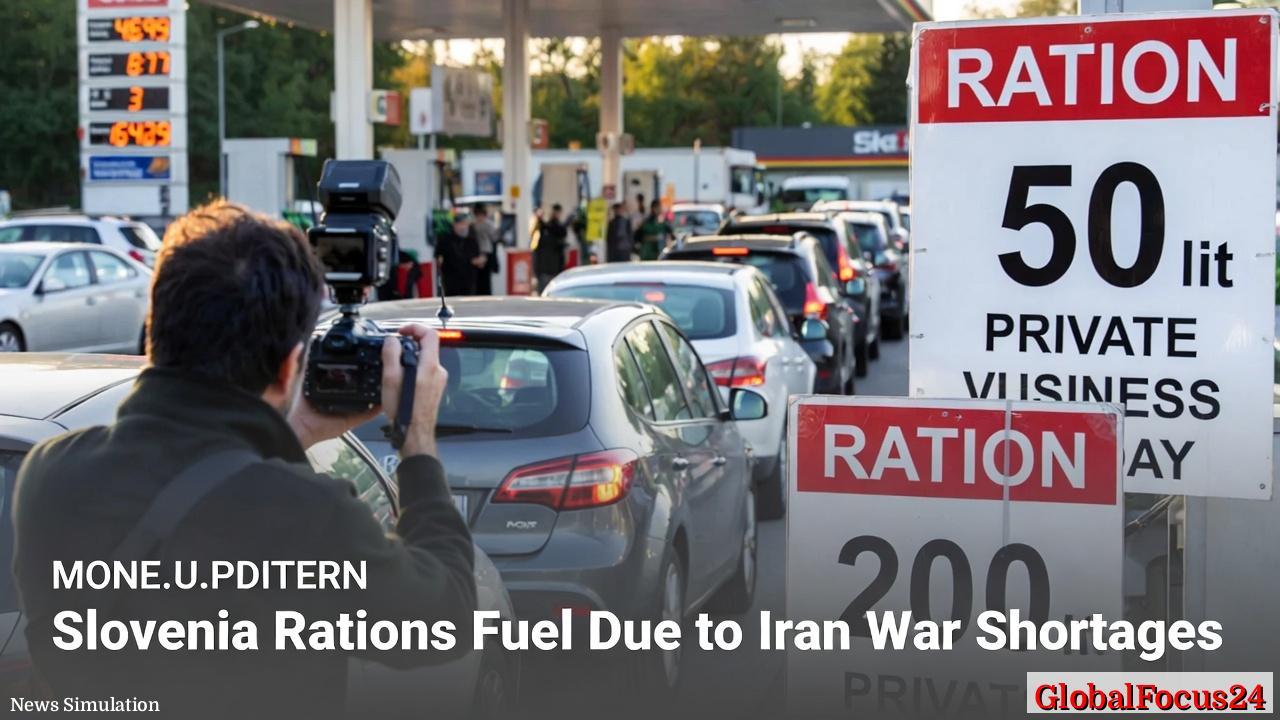
Ljubljana — In a move that underscores the deepening energy turmoil across Europe, Slovenia has become the first country on the continent to introduce formal fuel rationing. Starting this week, private vehicle owners are limited to 50 liters of fuel per day, while businesses are allowed up to 200 liters. The government says the measure is temporary but necessary to preserve national reserves amid growing supply disruptions stemming from the escalating Iran war and a surge of cross-border stockpiling.
The announcement came late Friday following an emergency cabinet meeting. Prime Minister Andrej Zidan described the rationing order as “an act of responsibility” in the face of “unprecedented regional instability.” Officials say the decision aims to prevent panic buying and to secure energy continuity for essential sectors, including healthcare, transportation, and food logistics.
The Cross-Border Rush That Sparked the Shortages
Fuel shortages in Slovenia began building earlier in March when reports surfaced of long lines forming at service stations near the Croatian and Austrian borders. Drivers from neighboring countries, lured by relatively lower fuel prices, began crossing into Slovenia to fill their tanks and containers. Within days, several fuel stations in Maribor and Ptuj reported running dry.
“People were queuing from dawn,” said a petrol station manager in Celje. “We were refilling twice as often as usual, but demand just kept rising. Truckers were filling not only their fleets but also jerry cans, fearing what was coming next.”
Slovenia’s Ministry of Infrastructure confirmed fuel sales in border districts had surged by more than 40 percent in the first ten days of March. Officials said this unexpected outflow, combined with delayed shipments from refineries in Italy, made rationing unavoidable.
The Iran War’s Ripple Through Global Energy Markets
The conflict in Iran has rippled severely through global energy networks. With major oil shipments from the Persian Gulf disrupted by restricted shipping lanes and sabotage along the Strait of Hormuz, crude prices have soared to their highest level since 2022. Benchmark Brent crude recently hit $144 per barrel, straining countries heavily reliant on imports.
The European Union, already grappling with post-pandemic economic fragility and recovery from recent energy shocks, finds itself once again at the mercy of geopolitical currents far beyond its borders. While larger economies such as Germany and France have deeper strategic reserves, smaller nations like Slovenia are more exposed to supply chain breaks.
Energy analysts note that Slovenia’s decision may foreshadow broader measures across Central and Eastern Europe if the crisis deepens. “Slovenia often acts as a bellwether for regional energy stress,” said Tomas Reczek, an energy economist based in Prague. “If they are rationing now, it suggests serious logistical bottlenecks are forming in southern European supply corridors.”
Historical Context: Europe’s Rare Use of Rationing
Fuel rationing has been exceedingly rare in Europe since the 1970s oil shocks. Then, nations such as the United Kingdom, the Netherlands, and West Germany imposed limits on consumption amid Arab embargoes and price spikes. Slovenia’s move, therefore, marks the first formal rationing regime in modern European history since those decades.
During the 1973 crisis, fuel coupons and alternate driving days became common across Western nations. Governments employed car-free Sundays and restricted commercial deliveries to manage shortages. Slovenia’s digital-era approach differs in form but not in spirit: limits are automatically enforced through the country’s electronic fuel tracking system, with gas stations receiving daily transaction quotas.
“This is rationing for the 21st century,” said energy historian Dr. Katja Marjan of the University of Ljubljana. “Instead of paper coupons, your limit is built into the billing system. It reflects both our technological progress and the intensity of the situation.”
Economic Repercussions and Market Confidence
The immediate economic consequences are profound. Transport firms, logistics operators, and agricultural producers – all major fuel consumers – have begun warning of possible price increases and delivery delays. Small logistics businesses, especially those that rely on just-in-time supply chains, are among the hardest hit.
“Most fleets can’t afford to idle,” said Boris Hribar, head of the Slovenian Freight Association. “If fuel deliveries are delayed for even a few days, perishables, exports, and public services all start to feel the strain.”
Slovenia’s national inflation rate is expected to rise as distributors pass higher transport costs onto consumers. The euro briefly wobbled in early trading on fears that rationing in one EU member could signal wider disruptions. Stock markets across Central Europe saw energy-related shares edge higher as investors bet on further fuel scarcity.
Comparison with Regional Policies
Neighboring countries are monitoring developments closely. Croatia and Hungary have introduced mandatory fuel conservation guidelines but stopped short of imposing binding rations. Austria has activated an “energy resilience alert,” a preliminary stage of its national emergency plan that could eventually lead to partial rationing if imports from Italy or the Balkans falter.
In Italy and Germany, authorities are emphasizing voluntary consumption cuts. Some municipalities have reinstated earlier pandemic-style remote work incentives to curb commuting demand. Meanwhile, the European Commission is coordinating with member states to streamline refinery shipments and diversify imports from West Africa and the United States.
“Energy solidarity is being tested like never before,” said Reczek. “The EU’s response will set a precedent for how the continent handles energy scarcity in an increasingly unstable world.”
Public Reaction and the Road Ahead
On the streets of Ljubljana, reactions have been mixed. While some drivers expressed frustration over the inconvenience, others voiced understanding. “It’s not ideal, but at least this way we can avoid complete chaos,” said Ana Jereb, a local teacher. “We saw what panic buying did during the pandemic—this feels more controlled.”
Social media in Slovenia has been abuzz with images of closed fuel stations and long lines stretching through city outskirts. Many stations have already posted signs limiting service to essential users during nighttime hours. The government insists that no one will be left without necessary fuel for emergency or critical operations.
Authorities have also warned against hoarding, with police increasing patrols near border crossings and freight hubs. Fuel smugglers face severe penalties under emergency laws enacted over the weekend, including fines up to €25,000 for private resale.
Government Strategy and Energy Reserves
The Ministry of Economy says Slovenia is currently operating at roughly 70 percent of its strategic fuel reserves, enough for about six weeks under restricted consumption levels. Officials are negotiating alternative supply contracts with refineries in Trieste and Rijeka, though maritime supply lines remain congested due to heightened naval presence and insurance costs in the Mediterranean.
The government also plans to accelerate renewable capacity installation and expand electric mobility infrastructure. An updated “National Energy Resilience Plan” is expected next month, outlining measures for domestic production and cross-border cooperation on grid stability.
“Slovenia has no oil of its own,” said Marjan. “Its geographic position between Italy, Hungary, and Croatia makes it extremely dependent on smooth cross-border operations. Any disruption downstream quickly magnifies at home.”
Lessons From the Crisis
Energy analysts suggest Slovenia’s rationing may become a case study in balancing market discipline with social stability. While public patience remains largely intact, prolonged restrictions risk eroding confidence and could fuel economic disparities between urban and rural communities.
Historically, countries that introduced rationing early during energy crises fared better in maintaining public order. Switzerland and Denmark during the 1970s, for example, managed shortages through well-communicated, uniform restrictions that avoided black-market distortions. Whether Slovenia can replicate such stability in the digital age remains uncertain.
A Continental Wake-up Call
The European energy landscape is visibly shifting. With the Middle East conflict encroaching on vital maritime supply routes, Europe’s tenuous energy independence is once again under scrutiny. Slovenia’s decision is both a precautionary move and an implicit warning to other nations that the margin for error is narrowing.
As the conflict in Iran continues and global reserves tighten, energy security will likely dominate European policy debates for months to come. Rationing, once an artifact of mid-20th-century crisis management, may now return as a feature of modern life—one that could redefine how Europe powers its economy in an era of enduring volatility.