Sen. Rick Scott Condemns Streamer Hasan Piker Over Violent Rhetoric, Rekindling Debate on Online Speech and Public Accountability
Escalating Tensions Between Public Officials and Online Influencers
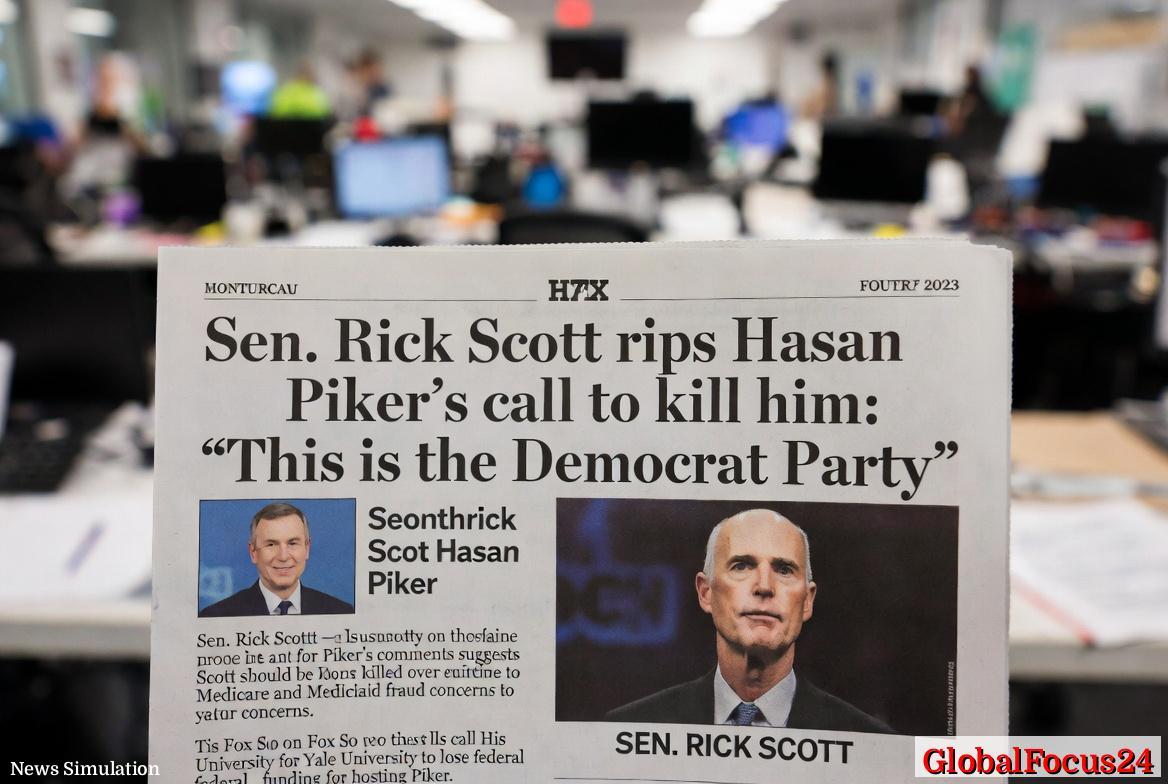
Florida Senator Rick Scott has publicly denounced political livestreamer Hasan Piker following remarks made during a recent broadcast that suggested violence against the lawmaker. The incident has intensified scrutiny over the boundaries of online political commentary, the responsibilities of digital influencers, and the broader implications for public discourse in an increasingly fragmented media environment.
During a livestream, Piker stated that concern over Medicare and Medicaid fraud could lead to the conclusion that Scott “should be killed,” a comment that quickly drew backlash. Scott responded in a televised interview, asserting that the streamer had directly incited violence against him and others. The exchange has since fueled debate over free expression, the influence of digital personalities, and the role of institutions that host controversial speakers.
The Rise of Political Livestreaming
The controversy highlights the growing influence of livestreaming platforms in shaping political narratives. Over the past decade, digital content creators have emerged as key voices in public debate, particularly among younger audiences who increasingly consume news and commentary through platforms such as Twitch, YouTube, and TikTok.
Unlike traditional media outlets, livestreaming often blends opinion, entertainment, and real-time audience interaction. This format can amplify emotional and provocative statements, sometimes without the editorial safeguards found in conventional journalism. Analysts note that the immediacy of livestreaming creates both opportunities for engagement and risks of unfiltered rhetoric.
Piker, who has amassed millions of followers, is among a new generation of political commentators whose reach rivals that of established media figures. His broadcasts frequently address domestic policy, international conflicts, and economic inequality, often in a highly informal and confrontational style.
Historical Context of Political Speech and Incitement
The United States has long grappled with the tension between free speech and incitement. Legal standards, shaped by landmark Supreme Court decisions such as Brandenburg v. Ohio (1969), establish that speech is protected unless it is directed at inciting imminent lawless action and is likely to produce such action.
In practice, however, the line between protected expression and harmful rhetoric remains contested, particularly in the digital age. Social media platforms and livestreaming services have developed their own policies to address threats and harassment, but enforcement varies widely.
Past controversies involving public figures and inflammatory remarks have often sparked similar debates. From talk radio in the 1990s to cable news in the early 2000s, each new medium has prompted questions about accountability and the societal impact of amplified voices.
Scott’s Response and Institutional Implications
Senator Scott’s response extended beyond condemning the statement itself. He also called for Yale University to lose federal funding after the institution hosted Piker as a speaker. Scott argued that organizations providing platforms to individuals who engage in extreme rhetoric should face financial consequences, particularly when public funds are involved.
Universities have historically served as venues for a wide range of viewpoints, including controversial ones. The principle of academic freedom has often been cited in defense of inviting speakers with divergent perspectives. However, debates over campus speech have intensified in recent years, with institutions facing pressure from multiple sides regarding whom they choose to host.
The question of federal funding adds another layer of complexity. Higher education institutions receive billions of dollars annually through research grants, student aid programs, and other federal initiatives. Calls to condition that funding on speech-related considerations raise legal and policy questions that extend beyond any single incident.
Economic and Policy Background: Medicare and Medicaid Fraud
The dispute also touches on longstanding concerns about fraud within federal healthcare programs. Medicare and Medicaid, which together provide coverage to more than 140 million Americans, represent a significant portion of federal spending. Efforts to combat fraud have been a priority for policymakers across administrations.
Historically, healthcare fraud cases have involved billing irregularities, unnecessary procedures, and other schemes that exploit reimbursement systems. The federal government has recovered billions of dollars through enforcement actions, but experts estimate that improper payments still account for a notable share of total expenditures.
Scott’s own business history intersects with this issue. Before entering politics, he co-founded Columbia Hospital Corporation, which later merged into Columbia/HCA. The company became the subject of a major federal investigation in the 1990s and ultimately paid $1.7 billion in fines and settlements related to fraudulent billing practices, marking one of the largest healthcare fraud cases in U.S. history at the time.
Scott has consistently stated that he was unaware of the wrongdoing and was never criminally charged. The episode remains part of his public record and is frequently referenced in discussions of healthcare policy and corporate accountability.
The Influence of Digital Personalities in Modern Politics
Piker’s prominence reflects a broader shift in how political ideas are disseminated and debated. Influencers with large online followings increasingly interact with candidates, attend campaign events, and shape public perception of policy issues.
Some political strategists argue that engaging with digital creators is essential for reaching younger voters. Others caution that the informal and sometimes provocative nature of online discourse can complicate messaging and create reputational risks.
Recent election cycles have demonstrated the growing importance of digital outreach. Campaigns now allocate significant resources to social media engagement, influencer partnerships, and online content production. This trend mirrors developments in other regions, including Europe and parts of Asia, where digital platforms have similarly transformed political communication.
Regional and Global Comparisons
The challenges posed by online political speech are not unique to the United States. Governments and regulators worldwide are grappling with how to balance free expression with the need to prevent harmful content.
In the European Union, legislation such as the Digital Services Act imposes stricter requirements on platforms to monitor and remove illegal content, including threats and incitement to violence. In contrast, the U.S. approach has traditionally emphasized broad protections for speech, with platforms largely responsible for self-regulation under Section 230 of the Communications Decency Act.
Countries in Asia have adopted a range of strategies, from stringent content controls to more decentralized frameworks. These differing approaches reflect cultural, legal, and political variations, but all face the common challenge of addressing rapidly evolving digital ecosystems.
Public Reaction and Ongoing Debate
Public reaction to the exchange between Scott and Piker has been sharply divided. Some observers view the streamer’s comments as an example of irresponsible rhetoric that crosses ethical boundaries, while others see the response as part of a broader conflict over political expression and media influence.
Advocacy groups focused on online safety have emphasized the importance of addressing language that could be interpreted as endorsing violence. At the same time, free speech organizations caution against measures that could chill legitimate political discourse.
The incident also underscores the role of media amplification. Statements made during livestreams can quickly spread across platforms, reaching audiences far beyond their original context. This dynamic can intensify controversies and complicate efforts to assess intent and impact.
The Future of Political Discourse in the Digital Age
As digital platforms continue to reshape how information is shared and consumed, the intersection of politics, media, and technology is likely to remain a focal point of public debate. Policymakers, institutions, and content creators all face evolving expectations regarding accountability and responsibility.
The dispute involving Senator Scott and Hasan Piker illustrates the complexities of this landscape. It raises questions about the limits of acceptable speech, the influence of online personalities, and the mechanisms available to address conflicts that emerge in highly visible digital spaces.
With the 2026 election cycle approaching, the role of livestreaming and social media in shaping political narratives is expected to grow further. How stakeholders navigate these challenges may have lasting implications for democratic engagement, public trust, and the norms that govern political communication in the years ahead.