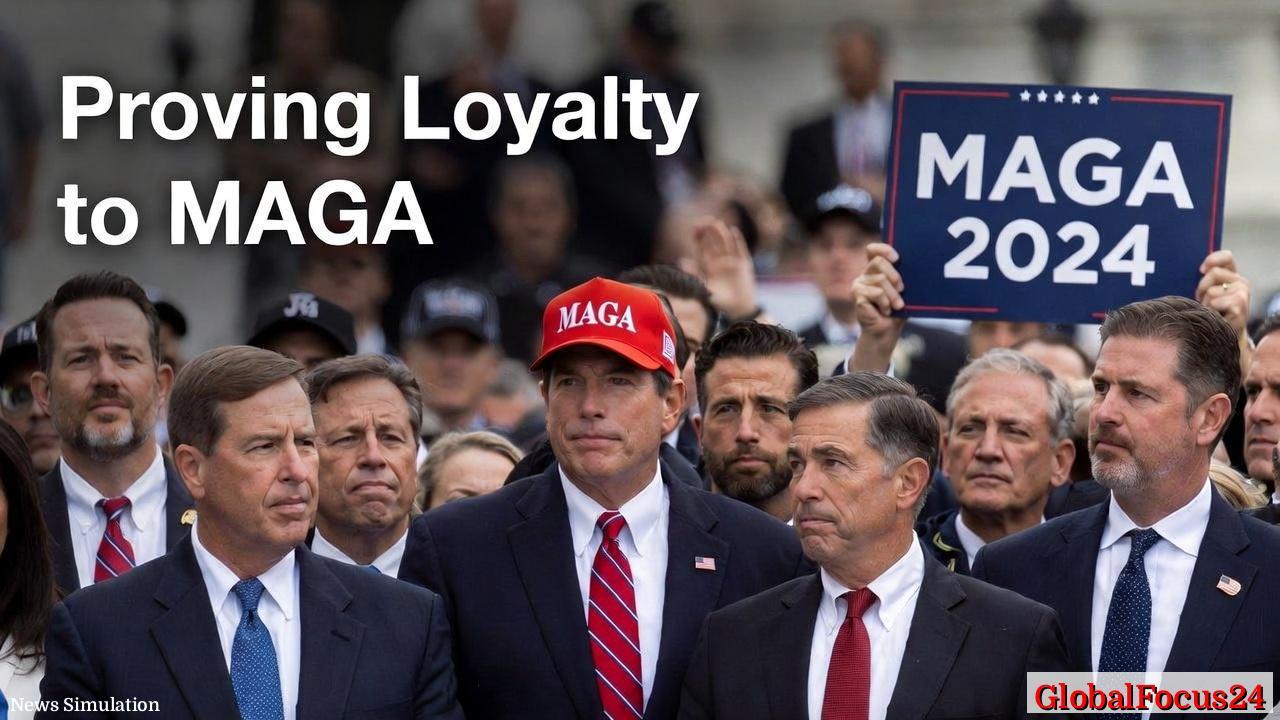
Republican Leaders Scramble to Prove Loyalty as Trump’s Decision to Go to War Divides the GOP Base
As the Republican Party navigates one of the most turbulent political moments in its modern history, its leaders find themselves under increasing pressure to reaffirm loyalty to the “Make America Great Again” movement. Former President Donald Trump’s decision to launch military action overseas—an unexpected and deeply polarizing move—has shaken the confidence of his political base and exposed fissures within the party that had been carefully papered over since his rise to power.
A Party at a Crossroads
For years, the Republican Party has aligned itself firmly around Trump’s brand of populism, nationalist rhetoric, and combative style. Yet his recent decision to take the United States into a new conflict has unsettled sections of his most ardent supporters. The move contradicted the isolationist stance that helped define the MAGA movement, raising urgent questions about Trump’s long-term strategy and the ideological direction of the party.
Behind closed doors, Republican lawmakers and strategists are grappling with how to respond. Some senior figures have doubled down, insisting that unity behind Trump remains essential for the party’s survival, especially with midterm elections approaching. Others, however, fear that continued alignment with Trump—particularly after a controversial military campaign—could alienate independents and moderate conservatives who have grown weary of political volatility.
The Weight of History
The political tension surrounding Trump’s wartime decision recalls earlier moments when American presidents faced internal dissent from their own ranks. In 1965, when President Lyndon B. Johnson escalated U.S. involvement in Vietnam, divisions within the Democratic Party helped fuel a generational realignment. Similarly, President George W. Bush’s decision to invade Iraq in 2003 initially rallied Republicans but ultimately created fractures that took years to mend.
For Trump’s Republican Party, the stakes are comparably high. The modern GOP’s identity has been reshaped by Trump’s political instincts—anti-establishment fervor, skepticism toward global alliances, and a promise to prioritize domestic concerns over foreign intervention. His pivot to an overseas conflict complicates that narrative, forcing party leaders to reconcile a contradiction that strikes at the heart of their appeal to working-class voters who embraced his “America First” message.
Economic and Political Fallout
The immediate economic consequences of the conflict have already begun to emerge. Energy prices surged in the days following the announcement, with global markets reacting nervously to uncertainty about supply routes and regional stability. Analysts suggest that if the conflict expands, the U.S. could face prolonged inflationary pressure, driven by rising oil costs and disruptions in trade.
Domestically, rising fuel and consumer prices could quickly erode public support for military action—a dynamic that has historically shaped U.S. foreign policy debates. Voters who initially rally behind the flag in times of crisis often turn disillusioned when costs mount. Should that pattern repeat itself, Trump’s political calculus may backfire, threatening not only his legacy but also Republican prospects in key swing districts.
The economic implications stretch well beyond consumer prices. Defense contractors and energy companies stand to benefit in the short term from increased spending and production demands. Meanwhile, small businesses already facing high borrowing costs could struggle to absorb further price shocks. Economists estimate that if oil prices remain elevated for several months, U.S. GDP growth could slow by as much as half a percentage point.
A Fractured Party Response
Within days of the announcement, a visible split appeared among Republican lawmakers. High-profile Trump allies immediately took to social media and conservative networks to defend the decision, framing it as a necessary show of strength to protect American interests abroad. Others remained conspicuously silent, weighing whether public support might wane once battlefield realities became clearer.
Senators from states with strong libertarian or isolationist traditions voiced concern that the operation represented a betrayal of Trump’s earlier opposition to “endless wars.” Some privately expressed worry that the decision could deepen skepticism among younger conservatives—many of whom were drawn to the MAGA movement precisely because it positioned itself against the establishment hawkishness of prior decades.
Political strategists now describe the party’s internal atmosphere as tense but not yet rebellious. Party leaders, including those competing for influence in Trump’s shadow, are attempting to balance loyalty with caution. Their challenge lies in appealing to both the MAGA faithful and pragmatic Republican voters wary of renewed international entanglements.
Midterm Elections in the Balance
With midterm elections fast approaching, the question of how Trump’s decision affects the political landscape looms large. Historically, wartime dynamics can cut both ways for the party in power. A perception of decisive leadership may initially boost approval ratings; yet prolonged conflict, mounting casualties, or economic strain can quickly reverse that momentum.
For Republican strategists, the midterms were already a delicate proposition. Trump’s continued dominance over the party’s base ensures his endorsements remain coveted, but his polarizing presence has also complicated efforts to expand the GOP coalition. Suburban and swing-state voters who might have returned to the Republican fold amid economic uncertainty may now hesitate if they associate the party with another costly foreign conflict.
Regional Perspectives and Voter Sentiment
The reaction to Trump’s wartime decision has not been uniform across the country. In Rust Belt states that powered his 2016 victory, early polling suggests a mix of confusion and unease. Voters who once celebrated his anti-interventionist stance see the shift as inconsistent with his campaign promises.
In contrast, parts of the South and Mountain West—where patriotism and defense industry employment are historically strong—have shown more supportive attitudes. Some voters there view the conflict as inevitable given global instability, expressing faith that Trump’s leadership will deliver quick results.
Yet even in these regions, economic anxiety tempers enthusiasm. With agricultural exports and manufacturing still recovering from trade disruptions of prior years, many rural voters worry that new global tensions could further depress demand for American goods.
Implications for U.S. Foreign Policy
Beyond partisan concerns, foreign policy experts note that the decision signals a major recalibration of U.S. strategy. Trump’s earlier approach had emphasized withdrawal from global commitments, renegotiation of alliances, and a focus on domestic renewal. Engaging in a military campaign abroad reverses much of that positioning, potentially redrawing international expectations for American engagement under his leadership.
Allied nations, uncertain of U.S. resolve after years of diplomatic retrenchment, are responding cautiously. European capitals have expressed conditional support while urging de-escalation, wary of being drawn into an open-ended conflict. In Asia, meanwhile, regional powers are recalibrating their own security stances, concerned about the ripple effects on trade routes and regional stability.
The Road Ahead for the GOP
Within Republican circles, the months ahead could prove decisive. If the conflict is brief and perceived as successful, it might strengthen Trump’s narrative of strong leadership and reinforce GOP unity heading into the midterms. However, if the war drags on or public opinion turns sharply against it, the fallout could be severe, accelerating intra-party fractures and fueling primary challenges against incumbents aligned too closely with Trump.
Political historians warn that major wars often realign domestic politics in unexpected ways. From the Mexican-American War to Iraq, U.S. military engagements have reshaped coalitions and redefined ideologies. Whether Trump’s decision triggers such a shift within the Republican Party remains uncertain, but the signs of strain are already visible.
Uncertain Future
As Republican leaders publicly reaffirm their loyalty to the former president, their private conversations tell a different story—one of apprehension, calculation, and doubt. The challenge they face is existential: how to sustain Trump’s populist movement while adapting to shifting public sentiment and global realities.
The coming months will reveal whether the MAGA coalition, once bound by a shared distrust of foreign wars and establishment politics, can withstand the pressure of its leader’s most controversial decision yet. Regardless of the outcome, the episode underscores a broader truth about American politics in this era: one man’s choices continue to shape not only the Republican Party, but the nation’s trajectory at home and abroad.