Record Inflows into International Equity Funds Signal Investor Shift
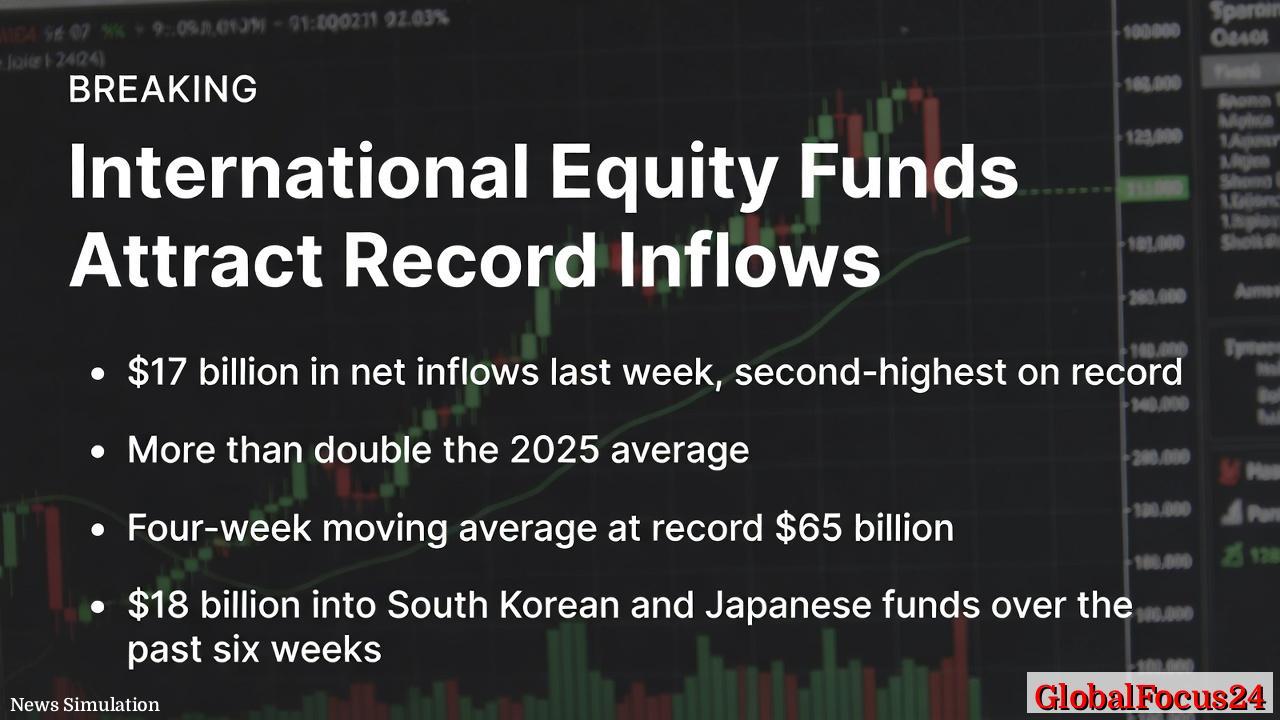
Investors funneled a robust $17 billion into international equity funds last week, signaling a pronounced shift toward non-domestic markets. The surge marks the second-highest weekly inflow on record and more than double the average pace seen throughout 2025. The momentum has buoyed the four-week moving average of inflows to an all-time high of $65 billion, underscoring a sustained appetite for international exposure amid evolving global economic dynamics.
Historical context and market backdrop
- A pattern of renewed interest in developed and emerging markets outside the United States has emerged over the past several quarters. After a period of relative caution, international equities have drawn renewed attention as investors seek diversification, potential growth differentials, and hedges against domestic market cycles.
- Within this broader trend, regional leadership has become more pronounced. South Korea and Japan have been notable beneficiaries, with the past six weeks totaling $18 billion in inflows to Korean equities alone, a new peak over comparable multi-week windows. The rebound in Korea comes as investors weigh the country’s semiconductor and manufacturing cycles against broader regional growth prospects.
- Japan’s exposure has also gained traction, driven by factors such as improving corporate governance signals, ongoing monetary policy normalization conversations, and tourism- and consumer-related rebounds as domestic demand stabilizes. The combination of both East Asian economies highlights a broader shift toward Asian equity allocations within global portfolios.
Economic impact and market implications
- Capital allocation shifts can influence currency dynamics, equity valuations, and sector-specific leadership. Large inflows to international funds can support demand for local equities, potentially narrowing discount gaps that have persisted in some markets relative to developed peers.
- The inflow surge contributes to liquidity improvements in international markets, aiding smaller-cap and mid-cap segments that often rely more on foreign investor participation. This enhanced liquidity can support price discovery and potentially reduce volatility during periods of global macro uncertainty.
- For fund managers, the inflows necessitate prudent asset allocation and careful risk management. Coordinating geographic and sector exposures helps balance growth potential with currency and regional risk factors, while maintaining adherence to investment mandates and client objectives.
Regional comparisons and standout markets
- South Korea: The six-week, $18 billion inflow tally into Korean equities places the country at the forefront of the international allocation shift. Investors have been weighing the resilience of Korea’s export sectors, particularly semiconductors and technology components, against macro challenges in other regions. This leadership position underscores Korea’s appeal as a core anchor within broad Asia-Pacific exposure.
- Japan: Following Korea, Japan has drawn notable capital as investors anticipate ongoing corporate governance improvements and a gradual normalization of monetary policy, alongside a modest recovery in domestic consumption. The convergence of structural reforms and improving earnings visibility has supported a more constructive stance toward Japanese equities.
- Other regions: While Korea and Japan lead, inflows into broader international markets indicate a diversified approach among investors. Developed markets in Europe and the Pacific, alongside certain emerging markets, have benefited from the renewed appetite for international diversification. The pace of inflows suggests that global portfolios are recalibrating to balance growth opportunities with risk controls.
Investor sentiment and potential risks
- The current surge reflects a combination of favorable valuation levels, improving visibility into corporate earnings abroad, and a search for yield and growth outside domestic markets. Investors appear to be layering exposure across regions to capture a range of growth drivers, structural reforms, and cyclical rebounds.
- Potential risks include currency fluctuations, geopolitical tensions, and regional economic deceleration that could dampen equity performance. While inflows signal confidence, ongoing monitoring of macro indicators—such as inflation trends, central bank policy paths, and trade dynamics—remains essential for sustaining long-term allocations.
- Public reaction to this shift has been varied. Some market participants view the move as a prudent diversification step, while others monitor for signs of overheating in specific markets. Overall, the market narrative emphasizes balance: seeking growth abroad while maintaining disciplined risk management at the portfolio level.
Sector and thematic considerations
- Technology and manufacturing: Regions with strong semiconductor ecosystems and export-driven sectors have often attracted inflows as investors seek exposure to high-growth tech cycles. This thematic tilt dovetails with Korea’s leadership position and Japan’s ongoing technology-enabled earnings potential.
- Consumer and services: As domestic demand begins to recover in certain economies, consumer-focused sectors could contribute to upside in regional indices. Tourism, travel-related services, and consumer goods firms may benefit from improving external demand and domestic normalization.
- Financials and energy: Broader international allocations can give investors access to diversified financials and energy plays, depending on country-specific cycles and policy environments. Careful stock selection and risk assessment help capitalize on these macro-driven opportunities.
What this means for global portfolios
- Diversification benefits: The inflow surge reinforces the long-standing principle that geographic diversification can smooth risk-adjusted returns and provide exposure to different growth trajectories.
- Benchmark considerations: As international exposure grows, investors and advisors may revisit benchmark allocations and cross-border tax considerations to optimize after-tax results and fiduciary outcomes.
- Tactical vs. strategic allocation: The momentum hints at a possible transitional phase in portfolio construction, where managers blend strategic regional weightings with tactical overlays aligned to macro signals, earnings revisions, and currency expectations.
Historical parallels and longer-term outlook
- Historically, periods of heightened cross-border investment have preceded broader shifts in asset allocation, particularly when domestic markets face limited upside relative to global opportunities. The current environment, marked by a confluence of favorable valuations and earnings potential abroad, aligns with those patterns.
- Looking ahead, sustained inflows will depend on continued corporate earnings growth in international markets, currency stability, and a favorable global macro backdrop. If these conditions persist, regional leadership in Asia-Pacific, Europe, and emerging markets could reinforce a durable repositioning of portfolios away from a home-country bias.
Key metrics to watch
- Net inflows into international equity funds: Tracking weekly and monthly movements helps gauge whether the current momentum persists or stabilizes into a more measured pace.
- Four-week and six-week moving averages: These indicators offer insight into the persistence of capital flows and potential inflection points in investor sentiment.
- Regional dispersion of inflows: Monitoring which markets attract the most capital can reveal evolving preferences and potential reallocation strategies.
Public and industry responses
- Financial professionals and market observers have noted the alignment between investor demand and the improving earnings horizon for several international markets. Advisers are increasingly emphasizing diversification as a core pillar of risk management and long-term growth.
- Public sentiment around international investing remains pragmatic. Many investors acknowledge the benefits of exposure to multiple economies, while remaining mindful of the need for disciplined risk controls and a balanced approach to currency risk.
Conclusion
The latest wave of capital into international equity funds signals a clear investor shift toward global diversification and exposure to non-domestic growth engines. With South Korea at the forefront and Japan following closely, the trend highlights a reevaluation of regional leadership and a rebalancing of portfolios in favor of international exposure. As markets monitor earnings trajectories, policy developments, and currency movements, this momentum could reshape the global investment landscape in the months ahead. Investors across the spectrum will likely weigh the benefits of international diversification against possible macro and geopolitical uncertainties, aiming to construct resilient, growth-oriented portfolios that can navigate a dynamic and interconnected world.