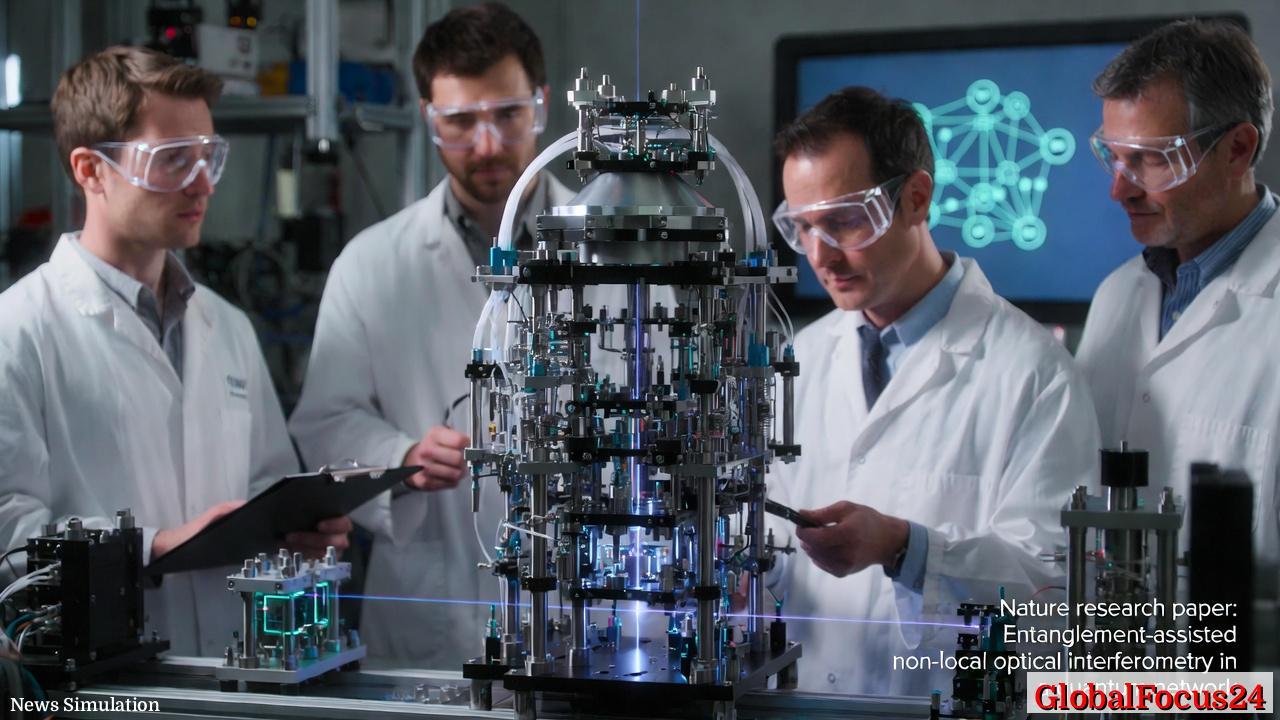
Scientists Achieve Breakthrough in Long-Distance Quantum Interferometry Using Diamond-Based Quantum Network
A Leap Forward in Quantum-Enhanced Optical Measurement
In a major advance for quantum optics and precision measurement, a team of physicists has successfully demonstrated entanglement-assisted non-local optical interferometry using a quantum network built from silicon-vacancy (SiV) centers embedded in diamond nanocavities. The achievement marks a milestone in the development of quantum-enhanced sensing, extending the range and precision of optical interferometry far beyond what was previously possible.
The experiment enabled differential phase measurements of extremely weak incident light between two spatially separated stations—effectively linking them through quantum entanglement. By integrating event-ready remote entanglement, photon mode erasure, and non-destructive photon heralding, the researchers overcame fundamental noise limits and photon losses that traditionally constrain non-local optical measurements at low light levels.
Extending the Frontier: From Hundreds of Meters to Kilometers
The team achieved stable interferometric operation over a fiber-optic baseline of 1.55 kilometers—a distance nearly five times longer than the 330-meter baseline typical of current state-of-the-art optical telescope arrays. This leap in experimental distance demonstrates the feasibility of using networked quantum systems for high-resolution, long-baseline observations that were once thought impractical due to decoherence and optical loss.
By using diamond nanocavities as host materials for the silicon-vacancy centers, the researchers combined optical stability, spin coherence, and photon indistinguishability in a single architecture. These properties were crucial for maintaining strong entanglement fidelity and stable Bell-state correlations across the entire baseline length.
Quantum Networks and the Challenge of Light-Level Precision
Conventional optical interferometry relies on the superposition of light waves to detect minute differences in phase, allowing scientists to measure distances, image faint celestial objects, and even test fundamental physics. However, when light intensities are extremely low, random vacuum fluctuations and photon losses introduce noise that severely degrades measurement precision.
The entanglement-assisted approach offers a way around this limitation. By sharing quantum-entangled photon states between distant stations, the new method allows phase information to be correlated non-locally, effectively filtering out noise and preserving weak optical signals that would otherwise be lost. The technique improves the signal-to-noise ratio (SNR) scaling for weak signals—an essential step toward the next generation of quantum-enhanced optical instruments.
Benchmark Results: Fidelity, Visibility, and Stability
During the experiments, the entangled photon pairs were generated and distributed across the quantum network with rates reaching up to 13 hertz at a fidelity of at least 0.5, and 1.9 hertz at a fidelity of 0.79. Nuclear spin Bell-state fidelity was sustained at 0.63 over the full 1.55-kilometer separation, while phase oscillation visibility was observed at 0.11—a significant result given the optical path length and environmental noise factors.
These performance metrics indicate not only the robustness of entanglement over kilometer distances but also the ability to preserve phase coherence between photons that have never interacted directly. Maintaining such correlations under real-world fiber conditions marks a major technical accomplishment and a practical step toward scalable quantum sensing networks.
The Role of Photon Mode Erasure and Non-Destructive Detection
A key innovation in this work was the use of photon mode erasure to conceal which-path information about the light arriving at each station. By making it impossible to distinguish which photon originated from which source, the system forces quantum interference to manifest in a non-local, correlated manner. This principle, rooted in the foundations of quantum mechanics, allows distant detectors to behave as if they are part of a single coordinated interferometric system.
Non-destructive photon heralding added another layer of precision, allowing the detection of relevant quantum events without disrupting the entangled state. Together, these methods enabled the network to operate in an “event-ready” configuration—triggering measurements only when successful entanglement was confirmed. This approach dramatically improves efficiency and reliability in quantum sensing protocols where photon scarcity is a limiting factor.
Historical Context: From Michelson to Quantum Networks
Interferometry has a legacy stretching back more than a century, beginning with Michelson’s pioneering 19th-century experiments that established the wave nature of light and later contributed to modern physics foundations. Optical interferometers evolved through radio astronomy, gravitational-wave detection, and high-resolution imaging, continually pushing the limits of phase measurement sensitivity.
However, all classical interferometric instruments suffer from a fundamental trade-off between baseline distance and coherence. As light beams travel farther apart, environmental fluctuations, dispersion, and photon loss erode the signal correlations needed for accurate interference. The implementation of quantum entanglement effectively breaks through this limit by replacing classical coherence with quantum correlations that remain intact even when physical photons are kilometers apart.
Implications for Astronomy and High-Resolution Imaging
The most immediate impact of this development may be in astronomy, where optical interferometry has long been used to achieve ultra-high angular resolution by coherently combining light from multiple telescopes. The new quantum-assisted method could allow distant observatories to link through entangled photons instead of classical optical beams, forming “virtual telescopes” that operate across continental distances.
This capability could help image exoplanets, map stellar surfaces, and measure cosmic phenomena with unprecedented precision. In addition to astrophysics, quantum-correlated interferometry could transform advanced microscopy by improving sensitivity to molecular-scale changes and enabling non-invasive imaging at resolutions previously unattainable.
Regional and Global Comparisons in Quantum Research
Several major research hubs—including centers in Europe, North America, and Asia—are currently racing to develop distributed quantum networks, each focusing on different physical systems such as trapped ions, superconducting qubits, or color centers in diamond. The use of silicon-vacancy centers represents a particularly promising platform given their optical addressability, long spin coherence times, and compatibility with nanophotonic integration.
Compared with prior demonstrations that relied on nitrogen-vacancy (NV) centers or atomic ensembles, the SiV-based approach offers greater spectral stability and enhanced photon indistinguishability—both critical for high-fidelity entanglement distribution. The 1.55-kilometer milestone now places this network among the most advanced long-baseline quantum communication systems developed to date, matching or surpassing previous records achieved with trapped atoms and cavity systems.
Economic and Technological Implications
Beyond its scientific significance, the ability to perform entanglement-based interferometry over kilometer distances holds substantial economic potential. Quantum-enhanced sensing could boost multiple industries that depend on precision light measurement—ranging from semiconductor manufacturing and biomedical imaging to Earth observation and telecommunications.
For instance, integrated photonic devices built from diamond nanostructures could one day enable portable quantum interferometers for autonomous navigation, environmental monitoring, or space-based observation platforms. The reliability and scalability of diamond-based quantum systems also make them appealing for next-generation secure communication networks and quantum computing interconnects.
The successful demonstration thus sets the stage for deeper collaboration between quantum science laboratories and high-tech sectors in optics, computing, and materials engineering, particularly in regions with strong semiconductor and nanofabrication capacity.
Overcoming Quantum Limits and Path Forward
Despite its achievements, the current system still operates with modest entanglement rates and limited phase visibility. Improving these parameters will require optimizing photon collection efficiency, minimizing decoherence from the environment, and developing active feedback control for dynamic phase stabilization. Researchers are also exploring hybrid architectures that combine diamond color centers with integrated silicon photonics and superconducting detectors for faster and more stable entanglement generation.
Next-generation experiments aim to scale the baseline beyond 10 kilometers, integrating quantum repeaters to overcome fiber loss and extend network reach. Such advancements could eventually link observatories in different cities—or even continents—through shared quantum states, realizing a global quantum sensor array.
A Glimpse Into the Quantum Future
The realization of entanglement-assisted non-local optical interferometry marks more than a technical breakthrough; it represents a step toward a fundamentally new way of observing the universe. By harnessing quantum correlations instead of classical coherence, scientists can transcend the traditional limits of distance, signal strength, and noise.
Whether used to sharpen the view of distant stars, map living cells without damage, or detect infinitesimal shifts in the fabric of space-time, the fusion of quantum physics and interferometry is poised to redefine the precision frontier. With this demonstration, the foundation has been laid for a new era of long-baseline quantum-enhanced measurement—where the boundaries of observation expand not by building larger mirrors or longer arms, but by entangling the light itself.