Quantum Interference with Massive Particles Pushes Quantum Frontier Forward
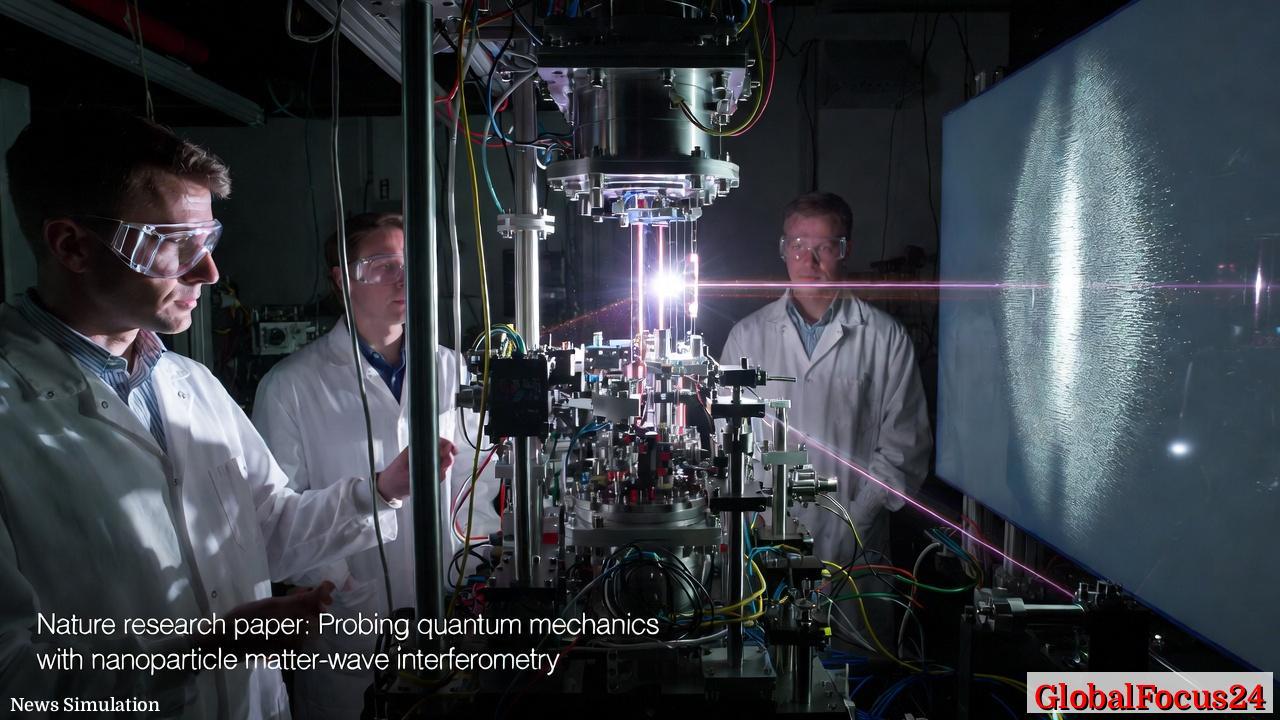
In a landmark advancement for quantum physics, researchers have demonstrated matter-wave interferometry using nanoparticles containing tens of thousands of atoms. This achievement extends quantum interference to objects orders of magnitude more massive than previous experiments, sharpening tests of quantum mechanics at unprecedented scales and offering new avenues for precision sensing and fundamental science.
A quantum milestone in the nanoscale-to-macroscale transition Matter-wave interferometry is a cornerstone of quantum science, where particles such as electrons or atoms exhibit wave-like interference patterns. For decades, scientists have exploited this phenomenon to probe the superposition principle and the probabilistic nature of quantum states. However, pushing interference to larger, more complex systems has confronted researchers with formidable challenges: environmental decoherence, internal energy states, and the precise control of motion become increasingly difficult as mass grows.
The recent breakthrough tackles these hurdles head-on. By preparing nanoparticles with internal and external degrees of freedom under meticulous control, the team created high-contrast interference patterns that survive long enough to be detected and analyzed. The particles used in the experiment contain on the order of tens of thousands of atoms, placing them firmly in a regime where quantum predictions and classical intuitions can be tested side by side. The result is not merely a demonstration of a delicate phenomenon; it is a substantial extension of the mass scale for which quantum behavior has been observed in a coherent, controllable manner.
Historical context: tracing the arc from atoms to large molecules To appreciate the significance of this achievement, it helps to review the historical arc of matter-wave experiments. Early demonstrations, such as electron interference in the early 20th century, established the wave-particle duality at fundamental levels. After the mid-century synthesis, researchers extended interference techniques to atoms and then to small molecules, gradually increasing the complexity and size of the systems that could exhibit interference. Each step required overcoming new sources of decoherence and refining measurement precision.
The current work marks a decisive leap beyond prior mass milestones. Previous experiments had demonstrated quantum interference with increasingly larger molecules and nanoparticles, but reaching interference with objects containing tens of thousands of atoms signals a qualitative and quantitative leap. This progression mirrors broader efforts in quantum science to test the boundaries of the theory—specifically, to constrain hypothetical modifications to quantum mechanics that might emerge at macroscopic scales.
Technical innovations that enabled the leap Several core innovations underlie the success of this experiment:
- Internal-state control: The researchers achieved refined manipulation of the nanoparticles’ internal energy configurations. By carefully preparing and stabilizing internal states, they reduced unwanted transitions that could collapse the delicate quantum superposition.
- External-motion management: The external trajectory of each particle was governed with high precision. This included controlling velocity, rotation, and environmental interactions so that the particles remained coherently phased during the interferometric sequence.
- High-contrast detection: Detecting the interference patterns required sensitive measurement schemes capable of distinguishing minute variations in probability distributions. The methodology yielded interference fringes with high contrast, a key indicator that quantum coherence persisted through the system’s evolution.
- Environmental isolation: Given the mass and complexity of the nanoparticles, isolating them from environmental disturbances—such as stray electromagnetic fields, collisions with background gas molecules, and thermal fluctuations—was essential. The experimental setup achieved exceptional isolation and vacuum conditions, enabling the fragile quantum states to endure long enough for interference to emerge.
Implications for quantum theory and fundamental tests This advancement provides more stringent tests of quantum theory in regimes where classical intuitions might begin to reassert themselves. Certain speculative modifications to quantum mechanics suggest that superposition could degrade as mass or complexity increases, or that objective collapse mechanisms might suppress interference for very large systems. By demonstrating coherent interference at masses approaching tens of thousands of atoms, the experiment tightens the parameter space in which such theories could operate. In practical terms, it strengthens confidence that quantum behavior persists deeper into the macroscopic domain than previously demonstrated.
The work also contributes to the ongoing dialogue about where the quantum-classical boundary lies. If interference can be observed with larger and more complex objects, the boundary shifts further toward the quantum side, reinforcing the notion that quantum laws are universal and do not arbitrarily cease to apply at larger scales. This has implications for how scientists conceptualize measurement, decoherence, and the emergence of classical reality from quantum substrates.
Regional and economic context: benchmarking against global research ecosystems The pursuit of high-midelity quantum experiments is historically concentrated in regions with robust funding for fundamental science, advanced fabrication capabilities, and interdisciplinary collaboration. The current achievement fits within a broader global effort to develop quantum technologies—ranging from sensing and imaging to computation and communication. Countries with strong research universities, national laboratories, and vibrant private-sector partnerships have been able to invest in the infrastructure required for advanced quantum experiments: ultra-high vacuum systems, cryogenic environments, and precision metrology tools.
From a regional perspective, the advancement exemplifies how investment in fundamental science yields downstream economic and strategic benefits. Precision sensing capabilities derived from quantum interference techniques—such as enhanced inertial navigation, gravimetry, and field sensing—have applications spanning geology, seismology, petroleum exploration, and infrastructure monitoring. Even as the work remains rooted in fundamental physics, its ripple effects touch industries that rely on sensitive measurement and accurate detection in challenging environments.
A look at regional comparisons highlights several patterns:
- Locations with strong university ecosystems and collaborations with national laboratories tend to accelerate breakthroughs in quantum science through shared facilities and talent pipelines.
- Regions investing in clean-room manufacturing, nanofabrication, and advanced vacuum technology build the practical foundations for scalable quantum experiments.
- Economic models that mix public funding with private collaboration often yield the most rapid translation from laboratory demonstration to market-ready sensing and metrology tools.
Potential applications in precision sensing and measurement Beyond its foundational significance, the ability to observe quantum interference in massive nanoparticles opens practical pathways in precision sensing. Quantum-enhanced sensors exploit coherence and entanglement to surpass classical limits in measurement accuracy. In contexts where minute signals must be detected amid noise—such as gravitational anomalies, underground mapping, or sensitive force measurements—the refined control demonstrated in these experiments could inform the design of next-generation sensors.
For example, matter-wave interferometry has long shown promise for ultra-sensitive inertial sensors, capable of detecting accelerations with extraordinary precision. Expanding the mass scale in which interference is observable suggests new regimes for calibrating and deploying such sensors in harsh or remote environments where conventional technologies struggle. The technique may also inspire novel metrological tools that harness quantum coherence to probe fundamental constants or to monitor subtle environmental changes over time.
Public reaction and the culture of discovery Breakthroughs at the frontier of quantum science tend to capture public imagination, not only for their technical sophistication but also for their philosophical implications. Observers often perceive the work as a tangible bridge between the quantum world and familiar macroscopic experience. Public interest typically centers on the notion that the strange rules of quantum physics might extend further into everyday phenomena than once thought, sparking curiosity about how soon quantum technologies could touch consumer devices, healthcare, or national security applications.
Researchers commonly emphasize that these experiments are careful, incremental steps in a long chain of investigations. Each new mass scale tested, each refinement in coherence time, contributes to a growing, coherent narrative about the universality of quantum mechanics. The public discourse surrounding such work tends to balance excitement with caution, acknowledging both the enormous potential and the rigorous safeguards that guide experimental science.
Scientific and ethical considerations As experiments expand into larger and more complex systems, scientists remain mindful of ethical and safety considerations. The research operates within established laboratory safety norms and regulatory frameworks designed to protect researchers and the surrounding environment. The broader scientific community continues to assess the societal implications of quantum technologies, including concerns about dual-use applications and equitable access to advanced capabilities.
From a methodological standpoint, transparent reporting and peer review remain essential. Reproducibility across independent laboratories bolsters confidence in results and helps establish standardized benchmarks for future work. The field benefits from open data practices, collaborative replication efforts, and cross-disciplinary dialogue that strengthen the reliability and impact of high-mass matter-wave experiments.
Looking ahead: next steps and long-term prospects The demonstration of quantum interference with nanoparticles containing tens of thousands of atoms is a springboard for ongoing exploration. Several natural trajectories emerge for future research:
- Mass scaling: Pushing interference to still larger objects to further test the quantum-classical boundary and tighten bounds on any potential collapse mechanisms.
- Coherence optimization: Developing techniques to extend coherence times and reduce residual decoherence channels, enabling more complex interferometric sequences.
- Multimodal sensing: Combining matter-wave interferometry with complementary measurement modalities to create robust, high-sensitivity sensors for geophysical, industrial, or medical applications.
- Fundamental constants and tests: Employing massive interferometers to probe possible variations in fundamental constants or to search for novel interactions beyond the Standard Model of particle physics.
These directions collectively point toward a future where quantum interference becomes a versatile instrument for both fundamental inquiry and practical technology. The fusion of deep theoretical questions with tangible measurement capabilities defines a growing frontier in modern science.
Conclusion: redefining the quantum-luminosity horizon The successful observation of matter-wave interference in nanoparticles with masses on the order of tens of thousands of atoms marks a pivotal moment in quantum science. It demonstrates that quantum coherence can endure in systems far larger and more intricate than previously realized, reinforcing the universality of quantum principles. As researchers continue to refine control over internal and external degrees of freedom and to extend coherence, the boundary between quantum and classical descriptions will be pushed even further, inviting new tests, new technologies, and a deeper appreciation of the strange yet surprisingly persistent quantum fabric of the universe.
In a landscape where innovation travels from fundamental theory to practical tools, this achievement stands as a compelling testament to human ingenuity. The coming years are likely to reveal how these advances in matter-wave interferometry translate into real-world benefits, from precision navigation to environmental sensing, while continuing to illuminate the mysteries at the heart of quantum reality.