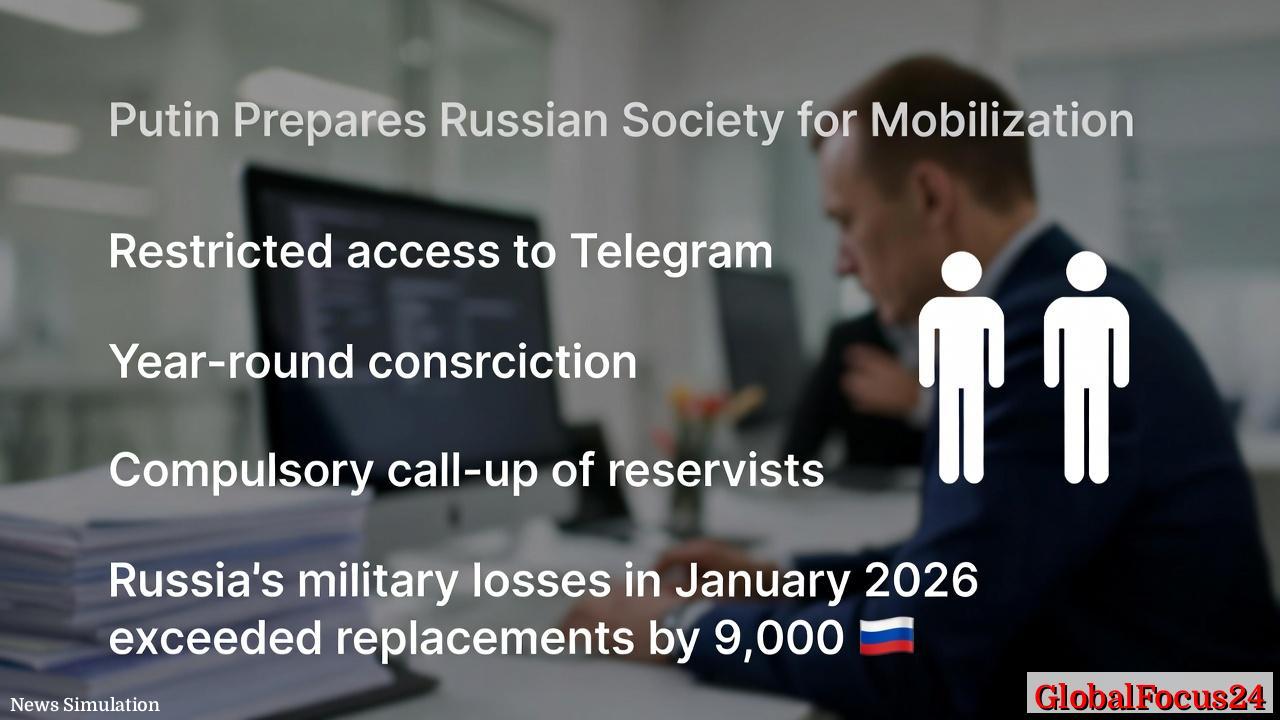
Putin Prepares Russian Society for Mobilization Amid Mounting Battlefield Losses
Moscow Tightens Control Over Draft Evasion and Criticism
Russian President Vladimir Putin is laying the groundwork for a new phase of mobilization as the war in Ukraine continues into its fourth year, straining both Russia’s military manpower and its economy. On February 18, 2026, the State Duma passed the first reading of a bill intensifying penalties for those who evade military duty. The legislation seeks not only to criminalize draft evasion but to reframe military service as an unquestioned civic obligation—part of an effort by the Kremlin to prepare the population for renewed call-ups of reservists.
The bill, which includes measures to expand surveillance and prosecution of perceived “anti-patriotic behavior,” is widely viewed by analysts as a preemptive move to limit domestic dissent and tighten informational control. Alongside these legal changes, the government has restricted access to Telegram, a major communication platform used by independent journalists and regional discussion forums. The move underscores how Kremlin authorities are attempting to centralize control over the narrative of the war, suppress criticism, and foster a sense of national unity under the banner of defense.
Legislative Steps Toward Renewed Mobilization
This tightening of internal controls builds on a series of legislative and administrative changes throughout late 2025. In October 2025, the Russian parliament passed a bill permitting the deployment of active reservists abroad without officially declaring general mobilization. Just weeks later, on November 4, President Putin signed a decree converting conscription into a year-round process. The announced goal was bureaucratic efficiency, but military observers interpreted it as a move to enhance the state’s capacity for rapid force generation and replacement of battlefield losses.
By December 8, 2025, another presidential decree authorized the compulsory call-up of inactive reservists for “military assemblies” in 2026, encompassing personnel from a wide range of state security and defense agencies. Together, these measures provide the legal scaffolding for what Russian officials call rolling reserve mobilization—a system allowing limited, rotating call-ups without triggering the political backlash that accompanied the 2022 partial mobilization.
Experts suggest this incremental approach could sustain Russia’s war effort while avoiding the social unrest that erupted during earlier mass drafts. Still, it indicates a recognition that voluntary recruitment campaigns, which relied heavily on financial incentives and regional quotas, are no longer sufficient to fill the ranks.
Shrinking Recruitment Base and Rising Losses
Independent military analysts estimate Russia’s personnel losses in Ukraine continue to exceed new recruitment. By January 2026, casualty figures reportedly outpaced replacements by about 9,000 troops, reflecting a dwindling pool of volunteers willing to fight after nearly four years of conflict. Despite official claims of steady enlistment, demographic challenges and widespread fatigue are hampering Moscow’s efforts to sustain its offensive momentum.
The Kremlin’s reliance on regional recruitment drives—offering substantial signing bonuses, deferred loans, and housing incentives—proved effective in 2023 and 2024 but has diminished over time. In smaller industrial towns and rural regions, eligible recruits have largely been exhausted. The result is a labor vacuum at home and growing pressure on industries already struggling with workforce shortages.
The government’s solution—tapping deeper into the reserve pool—reflects both a strategic necessity and a calculated political gamble. By avoiding the politically charged term “mobilization,” the Kremlin hopes to mitigate public backlash while effectively expanding the military’s manpower base through administrative and legislative maneuvers.
The Economic Strain of Sustained Conflict
Russia’s prolonged military campaign has placed heavy burdens on its economy. Labor shortages, especially in manufacturing, logistics, and construction, have grown acute as hundreds of thousands of men serve abroad or have emigrated to avoid the draft. The Central Bank of Russia reported a tightening labor market throughout 2025, contributing to upward wage pressure that fuels inflation.
Small and medium-sized enterprises—already under strain from sanctions and reduced demand—find it increasingly difficult to replace lost workers. Many regions reliant on industrial labor have seen production delays, while inflation-adjusted wages have stagnated. The Kremlin has attempted to offset these pressures through targeted subsidies and regional grants, but economists warn that deeper mobilization could further erode productivity and consumer confidence.
Historically, large-scale mobilization has disrupted Russia’s domestic economy. During World War II, the Soviet Union’s extensive conscription transformed the labor force and strained supply chains for civilian goods. While modern Russia’s circumstances differ, the parallels underscore the trade-offs between prolonged warfare and internal economic stability.
Tightening Information Control
As the government prepares for new mobilization phases, control of the information space has become a central strategy. The recent restrictions on Telegram, one of Russia’s most widely used communication platforms, mark a significant escalation in the Kremlin’s digital oversight campaign. Officials argue the move is necessary to combat “false information” and protect national security, but critics view it as an attempt to silence complaints from soldiers’ families and veterans’ groups frustrated by inadequate compensation and logistical failures.
The curbs on online communication follow a series of measures in 2025 that expanded the reach of state censors. New digital security amendments authorized authorities to block websites and social media accounts deemed “hostile to state interests.” Analysts say these steps reflect the Kremlin’s recognition that public opinion—particularly among urban youth and military families—remains a vulnerable flank in its campaign to sustain war morale.
Regional Comparisons and the Broader Mobilization Pattern
Other post-Soviet states have closely monitored Russia’s mobilization policies. Belarus, Moscow’s key military ally, maintains a similar reserve structure but has avoided direct deployment in Ukraine. Kazakhstan and Armenia, in contrast, have distanced themselves from Russian defense initiatives, wary of being pulled into broader regional confrontation.
In Ukraine, the Kremlin’s steady buildup of reserve forces has not gone unnoticed. Kyiv has likewise increased its own call-ups and broadened eligibility criteria to address ongoing manpower needs. The parallel mobilizations on both sides of the front underscore how the conflict has entered an attritional phase, where sustained replacement capacity may prove as decisive as battlefield tactics.
Beyond the immediate region, European and NATO officials are bracing for the strategic consequences of Russia’s evolving mobilization model. By normalizing extended conscription cycles and near-continuous call-ups, Russia is edging toward a semi-permanent wartime footing—a development that could reshape military planning across Eastern Europe for years to come.
Historical Context: From Partial Mobilization to Managed Militarization
Russia’s initial partial mobilization in September 2022 sparked widespread anxiety and flight among eligible men, with more than 200,000 reported to have left the country within weeks. The public backlash pushed the Kremlin to refine its approach, emphasizing voluntarism and incentives rather than coercion.
Over time, that strategy has shifted again. The series of decrees since late 2025 represent a gradual reversion toward compulsory service, albeit under bureaucratic and legal cover. This reflects the state’s historical pattern of alternating between periods of centralized conscription and decentralized recruitment—a rhythm dating back to the Soviet era when recruitment surges often coincided with wartime fatigue.
Yet today’s mobilization drive occurs in a vastly different economic and social landscape. Modern Russian society, urbanized and digitally connected, is less tolerant of prolonged state control over personal mobility and information. Managing that tension may be among the Kremlin’s greatest challenges as it balances the demands of war with the need for domestic stability.
Outlook: Balancing Military Demands and Domestic Stability
The Kremlin’s current course suggests that Russia is preparing for a protracted conflict requiring sustained manpower inflows rather than short-term surges. By restructuring laws, broadening conscription channels, and tightening public discourse, the government is signaling that mobilization—overt or covert—will remain a fixture of Russian life throughout 2026.
However, this strategy carries risks. Prolonged mobilization could exacerbate demographic and economic pressures, while stricter information controls may intensify public resentment. The government’s ability to manage these dynamics without triggering social unrest will likely define the next phase of its wartime governance.
For now, Moscow appears intent on ensuring a continuous, steady stream of recruits—an approach designed to maintain battlefield momentum without openly declaring a new nationwide mobilization. Whether the Russian public will continue to accept this managed militarization remains one of the most consequential questions facing the country in 2026.